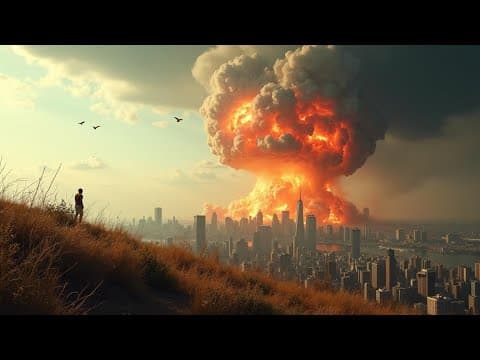
[0:00]Every civilization believes it will last forever. Ours is no different. We built our cities higher, our machines smarter, our weapons stronger. Convinced that progress meant safety. But what if we're wrong? What if the end doesn't come from the outside, but from within us? Three forces now stand ready to erase everything we've built, each born from human hands, each capable of ending the world in a different way.
[0:53]At 3:27 a.m., a radar operator at Thule Air Force Base in Greenland watches red blips appear along the Arctic corridor. The classic route for Russian intercontinental ballistic missiles. Within seconds the dots multiply, 5, 20, 50. Those dots are not blips, but boosters climbing through the cold sky. The operator radios. Command, this isn't a drill. We have confirmed launches.
[1:27]Russia's modern road mobile RS-24 Yars and its aging but heavy R-30M family, the SS-18 Satan lineage, are designed to get multiple warheads airborne fast. The RS-24 is a solid fuel Merv capable ICBM deployed in both silo and mobile launchers. It's practical range covers intercontinental targets, and a single missile can carry several independently targetable re-entry vehicles. A way to put multiple high yield strikes in the air from one launcher. The R-36M variants were built for brute force, very large throw weights, and warheads that in some configurations are measured in the megatons, making them devastating counter value and counter force weapons. At sea, Russia's Borei class ballistic missile submarines can release RM-56 Bulava SLBMs. Bulava is designed to carry multiple warheads with penetration aids and is meant to be a concealed, survivable leg of the triad. Launches from submarines shorten warning times because they can be fired from relative proximity to coasts. On the American and NATO side, the LGM-30 Minute Man 3 ICBM force and the sea based UGM-133 Trident 2 D5 form the analogous response options. Minuteman flight times to Eurasian targets are typically in the 25 to 35-minute band. Trident D5 flight times depend on launch position, but can be under 15 to 30 minutes for closer arcs. At roughly 8:03 a.m. US Eastern Time, the first large detonations occur. These are the prompt high-yield strikes intended to decapitate command, destroy military nodes and vaporize population centers. An 800-kiloton atmosphere burst over a capital produces a white flash visible hundreds of kilometers away. A blast that vaporizes structures at ground zero and ignites fire storms for miles beyond. Detonations at this stage target both counterforce and counter value locations. Russia's heavy R-36M variants or the RS-24 MERVED packages can be loaded for multiple hard targets. US counterforce options would include precisely targeted Trident D5 warheads or Minute Man 3 re-entry vehicles. Strategic bombers like the B2 and B52 carrying modern B-61 family weapons, the B61-12 being a guided variable yield design, add flexibility in delivery and yield selection. Though airborne bombers can only meaningfully contribute if they are already aloft or near the target. At the 20-minute mark, American Strategic Command, after confirming multiple detonations, orders retaliation. US Trident 2 D5 missiles fired from Ohio-class submarines can place accurate MERV or single warhead re-entry vehicles on Moscow or strategic military targets with flight times that, depending on launch point, can be under 30 minutes. The land leg, Minuteman 3, is measured for quick response, and the airborne leg, B2s and B52s, offer variable yield options via B61 family bombs. That combination gives the US multiple delivery modes, but it also guarantees a massive count of warheads aloft in minutes. On the Russian side, Hypersonic boost glide vehicles such as Avangard, reported to maneuver at extremely high speed during re-entry, reduce interception windows and complicate tracking. Their presence compresses decision times and increases the temptation for launch on warning postures. Modern interceptors can engage some fraction of warheads or their decoys, but MERV and penetration aids are intentionally designed to overwhelm defenses. The result, the retaliation wave is almost certain to land in dozens or hundreds of places within the next 10 minutes. By the half hour mark, the character of the crisis changes from targeting to systemic collapse. Hundreds of detonations have already occurred. EMP from high-altitude bursts and the sheer density of explosions create a cascade of cascading failures. Power grids trip under surges and failures. Satellites are degraded by debris and radiation. GPS accuracy collapses in many regions and civil telecommunications fail. The skies streak with re-entry vehicles. The upper air glows red with intense thermal radiation and fireballs. All of this produces immense amounts of black carbon and dust that begin their ascent toward the stratosphere. As detonations accumulate and fires rage, enormous quantities of soot and vaporized material are lofted into the stratosphere. The dynamics are physical and direct. Fire storms generated by urban conflagrations inject black carbon thousands of meters high. Once in the stratosphere, that soot is not readily washed out by rain and instead spreads globally, reducing incoming solar radiation. At the same time, fallout from surface and low-altitude detonations sends radioactive isotopes like cesium 137, strontium 90, and plutonium particulates across continents. These isotopes have long half-lives that contaminate land and water and create long-term health hazards. Ocean launches and detonations pollute marine systems as radioactive material washes into currents and bioaccumulates in food chains. The combined climate and radiological effects ensure that even areas not directly hit by a warhead face collapse of food production, water safety and public health infrastructure within weeks to months. An hour after the first launch, weapon counts and flight times explain the grim totals. Hundreds to thousands of re-entry vehicles have detonated across the Northern Hemisphere and beyond. Land, sea and air infrastructure lie in ruins. Satellites essential to modern logistics are damaged or destroyed, and electromagnetic disruption has taken down banking, transport and emergency communications. Many delivery modes, many warheads, multiple launch arcs, short flight times and penetration aids, all conspire to make the first hour irreversible. Beyond this point, global casualty counts are in the hundreds of millions. Infrastructure is largely destroyed and the first physical steps of nuclear winter are underway. The planet's climate system and biosphere have already been pushed onto a path that will cause famine, disease and ecosystem collapse. The technical architecture that kept super fighting states in mutually assured destruction has now executed its grim logic. Months later, the environmental, radiological and systemic damage begun in that first hour will have cascaded into planetary scale disruptions. Sunlight will remain reduced where soot is thickest. Harvests will fail. Potable water will be scarce and biological systems from insects to crops to fish populations will be devastated. That was only the opening act. What happens next could change the fate of billions.
[9:13]What if I told you that tomorrow morning, billions of people could already be dead? And you wouldn't even know why. No sirens. No news alerts. Just silence. Experts warn that if World War III begins, the first hour could determine the fate of humanity. And the choices made in those 60 minutes could mean the difference between survival and extinction. Stay until the end because you'll discover the real trigger that could start the next World War. The weapons you've never heard of that could end it instantly, and the single survival detail that could save your life if it all happens before sunrise tomorrow. In the Pacific, Chinese warships shadow American destroyers near Taiwan every day. One miscalculation, one collision could unleash a storm of missiles across the region. In Eastern Europe, Russian and NATO forces stand just 150 kilometers apart, both armed with nuclear capable systems. The US has stationed B-61 tactical nukes in Belgium, Italy and Germany. Russia has deployed Iskander M launchers in Kaliningrad. Every side claims it's for deterrence, but everyone's finger is already hovering over the trigger. Here's the part that keeps generals awake at night. If war erupts, the side that fires first has the advantage, for about 20 minutes. That's all it takes before global retaliation begins. In those minutes, you'd see the most advanced weapons in human history unleashed. American B2 Spirits and the new B21 Raider stealth bombers would take off. Invisible to radar, carrying AGM-158 JASSM ER cruise missiles, capable of striking 900 kilometers away. Russian TU-160 White Swan bombers would respond with Kh-102 nuclear cruise missiles. From the sea, US submarines would launch Tomahawk Block 5 missiles. Each one able to hit a target with pinpoint accuracy from over 1600 kilometers away. In the skies, Hypersonic missiles like the Russian Kinzhal, the Chinese DF-17 and the US AGM-183 ARRW would streak through the atmosphere at over Mach 10. Far too fast for any known defense to stop. These weapons cut reaction time from minutes to seconds. By the time radar detects them, it's already too late. And that's the horrifying truth. The first phase of World War III would be over before the public even knew it started. Missiles rain down. Command centers vanish. Airfields crater. The US deploys F-35s and F-22 Raptors to eliminate enemy aircraft before they leave the ground. NATO's Eurofighter Typhoons scramble across Europe.
[12:15]Russian SU-57 Stealth fighters rise to meet them. Dog fights break out over the Baltic and Black Seas. Meanwhile, the oceans ignite. The US Navy's carrier strike groups, led by the USS Gerald R. Ford, face off against China's Type 003 Fujian carrier. Submarines stalk beneath the surface, each one carrying the power to destroy entire nations. The American Ohio class and British Vanguard class submarines each carry Trident 2 D5 nuclear missiles with MERV warheads, capable of wiping out dozens of cities in one launch. As casualties soar and global communication collapses, leaders face the ultimate dilemma. Do they surrender or escalate? That's where tactical nuclear weapons come in. Smaller than city destroying bombs, these warheads are designed for the battlefield to obliterate an advancing tank column or military base. Once one side uses them, the other will respond in kind. From there, it's a chain reaction. The nuclear threshold breaks. The US could deploy W-762 low-yield warheads from its submarines. Russia could retaliate with Iskander M or Poseidon nuclear torpedoes. A Doomsday weapon capable of creating radioactive tsunamis. China, which traditionally avoids nuclear first use, could launch DF-41 ICBMs reaching anywhere on Earth. At this point, nuclear Armageddon becomes inevitable. Within 30 minutes of the first nuclear exchange, hundreds of warheads detonate around the world. Cities vanish in blinding fireballs. The air itself ignites. Temperatures near ground zero reach 50 million degrees Celsius. Entire regions are flattened. In the next two hours, radioactive fallout spreads across continents. Winds carry deadly isotopes thousands of miles away. Survivors choke on ash and radiation. Fires merge into massive fire storms, each generating hurricane-force winds that feed the inferno. And that's not even the end. Scientists warn that a large-scale nuclear war would throw over 150 million tons of soot into the upper atmosphere, blocking sunlight and plunging Earth into a nuclear winter lasting decades. Temperatures would drop by 15 degrees Celsius globally. Crops would fail. Ecosystems would collapse. The bombs wouldn't kill everyone immediately, but famine and disease would. Studies suggest over 5 billion people could starve in the following years. Even space wouldn't be safe. Anti-satellite weapons would turn orbit into a graveyard of debris. The Kessler effect would make launches impossible for generations. Without satellites, the global economy collapses completely. Humanity would be technologically blind. The most advanced civilizations on Earth would fall back to 19th-century survival. No power grids, no medicine, no transport, no food systems. Governments would crumble. Nations would dissolve. Weeks after the last bombs, survivors would emerge into a world they no longer recognized. Black skies, frozen oceans, a sun dimmed to a faint red disc, cities reduced to skeletons of steel and ash. And yet, somewhere underground, the remnants of governments, perhaps inside Cheyenne Mountain in the US, or Yamantau in Russia, would attempt to re-establish control. But over what? The world that existed before the war would be gone forever. Here's the question no one can answer. Could World War III still be prevented? The tools for peace still exist, back channel diplomacy, nuclear treaties, crisis hotlines. The US and Russia maintain a direct line to avoid accidental escalation. NATO conducts deconfliction talks. But these systems are eroding. Nations are modernizing nuclear arsenals instead of dismantling them. The global arms race is back and faster than ever. For the first time in history, artificial intelligence is entering nuclear command systems. Drones can make lethal decisions in milliseconds. Algorithms could misinterpret sensor data and trigger retaliation. The risk of accidental Armageddon has never been higher. If World War III starts tomorrow, it won't look like the wars you learned about in school. There won't be time for soldiers to march or tanks to advance. The entire course of the war, the rise, the climax, the extinction, could unfold in less than one hour. That's how fragile our world has become. So if you woke up tomorrow and the world was on fire, ask yourself this, would you survive the first 24 hours? Because the terrifying truth isn't what happens if World War III starts. It's that it could already have started, silently, without anyone realizing it. The next World War might not be nuclear at all. Something far more sinister could already be unfolding right now. When most people imagine the end of the world, they see a flash in the sky. Nuclear fire, mushroom clouds, entire cities obliterated in seconds. Humanity has lived under that shadow since 1945. But what if the apocalypse didn't come with a bang? What if it came quietly, on the breath of a stranger in a subway car, in a handshake at the airport, in a cough on an elevator? What if the next World War isn't fought with missiles and tanks, but with microbes? This isn't science fiction. Biological warfare is a threat so real, so immediate, that it might eclipse even nuclear war. Because while a nuclear bomb destroys a city once, a virus can keep multiplying, leaping from person to person, silently spreading until it topples nations. Think about this. The 1918 Spanish Flu killed up to 50 million people, more than World War I itself. That virus wasn't engineered. It wasn't weaponized and it spread in a world without modern air travel. Today, with 4.5 billion airline passengers per year, a single infected traveler could trigger a global pandemic in days. And modern biotechnology means we're no longer talking about nature's accidents. We're talking about engineered superviruses designed to spread faster, kill harder and resist every treatment we have. Some researchers even warn about ethnic bioweapons, pathogens tailored to exploit genetic differences in populations. Imagine a virus that doesn't just kill, but selectively kills.
[20:04]Still think nuclear war is the worst-case scenario? Let's run a thought experiment. Imagine an engineered pathogen released in New York City's subway during morning rush hour. Day one, patient zero boards a crowded train. He feels fine. He coughs once. Within minutes, dozens inhale the virus. By the end of the day, hundreds are exposed. Day three, hospitals report clusters of patients with flu-like symptoms. Doctors assume it's seasonal influenza. No red flags. Meanwhile, travelers leave JFK, Newark and LaGuardia airports, infected but unaware, heading to London, Tokyo, Dubai and São Paulo. Day five, the first patients die. But they don't just die. They deteriorate with terrifying speed, high fever, respiratory failure, neurological collapse. Doctors realize this isn't the flu. It's something new, something engineered.
[21:23]Day seven, panic. Social media explodes with rumors, conspiracy theories and fake cures. Pharmacies run out of basic medicines. Grocery stores are looted. Day 10, governments impose quarantines, martial law in some districts. But compliance is patchy. Some refuse, others flee, spreading the virus further. Day 14, infections appear worldwide. London, Delhi, Sydney, Mexico City. Panic spreads faster than the pathogen. Stock markets crash. Airlines collapse. Borders close. But the virus has already won. It hitched rides on people who moved before anyone knew it existed. Day 30, the death toll climbs into the millions. Hospitals worldwide collapse. Food supplies break down. Military units report mass sickness. And in the background, something even more dangerous brews. Countries begin to suspect each other. Who released it? Was it China? The US? A terrorist group? Or was it just an accident? Miscalculation could lead to retaliation. Retaliation could spiral into conventional war. And in the chaos, a nuclear strike could be launched by mistake. This isn't fantasy. Simulations run by the Johns Hopkins Center for Health Security found that a smallpox-like outbreak could kill 150 million people in a year, even with modern medicine. That's more than any nuclear exchange short of all-out apocalypse. The real nightmare is that bioweapons don't even need to be lethal to win. Imagine a virus designed not to kill, but to sterilize. A silent weapon that ensures a rival population dwindles over generations. That's war without a single shot fired. War waged in DNA itself. Unlike nuclear bombs, which require uranium enrichment plants and missile silos, bioweapons can fit in a vial, in a backpack. Now, pause and ask yourself, would you even know if one had been released? That's the horror. A nuclear detonation is obvious. You see the blast. You know you're under attack. But a virus, you'd think it was flu season until it was too late. By the time leaders realized what was happening, it could already be everywhere. And unlike nuclear fallout, which is localized, a pathogen doesn't stop at city limits. Borders mean nothing. Armies can't fight it. Tanks can't roll against it. Missiles can't shoot it down. And yet, most governments are still far more prepared for nuclear war than biological war. The US has missile defense systems, underground bunkers, and nuclear retaliation plans. But against a fast-moving engineered virus, we have limited vaccine stockpiles, fragile hospital systems and no global coordination. There's another layer most people miss. Bioweapons are almost impossible to attribute. If a nuclear missile hits, you can trace the launch. Satellites, radars, flight paths, it's obvious who fired. But if a virus emerges, how do you know? Was it an accident in a lab? Was it terrorism? Was it natural? That ambiguity is dangerous because in the fog of confusion, nations might assume the worst. And once nuclear powers start blaming each other, the escalation ladder is short. So ask yourself this, could the next World War be fought not with bombs but with breath? Could the next apocalypse come from a cough, not a missile? It's not just possible, it's likely. Nature alone has produced killers that dwarfed wars. The Black Death in the 14th century wiped out a third of Europe. That was without gene editing, without labs, without intent. If nature can do that, what could human ingenuity unleash?