[0:00]Power is a game of masks. And the most dangerous thing you can do is let yours slip. Look around you. We live in an era of oversharing. We are encouraged to be "authentic," to "speak our truth," and to "express our feelings." Modern society celebrates the loud, the expressive, and the transparent. But in the world of power, transparency is a death sentence. The moment you open your mouth to explain your actions, your motives, or your worth, you have already handed over the keys to your kingdom. You have become a defendant in a trial where you are the only one who believes in your innocence. Robert Greene's 4th Law of Power is simple, yet brutal: Always Say Less Than Necessary. Why? Because human beings are machines of interpretation. When you are silent, people are forced to fill the void with their own insecurities and imaginations. They project their fears onto you. They see depth where there may be none. But the moment you speak too much, you provide them with the very tools they need to dismantle you. You become predictable. You become common. And what is common is never respected. Let's be honest. Your urge to talk is not about communication. It's about fear. When someone accuses you, or when a silence lingers too long in a room, your biology betrays you. You feel a spike in cortisol—the stress hormone. Your brain enters a "fight or flight" mode. To your subconscious, silence feels like a social death. You feel the desperate need to "fix" the atmosphere, to smooth things over, to make sure everyone knows you are a "good person." This is the biology of a subject, not a sovereign. You are seeking validation. Every extra word you utter is a plea for the other person to say, "I understand you. I accept you." But every time you do this, you are subconsciously signaling that their opinion of you matters more than your opinion of yourself. You are placing your emotional stability in their hands. A master of power does not seek to be understood. They seek to be feared, respected, or obeyed. Understanding is for friends; power is for rivals. Consider the Sun King, Louis XIV of France. He was the master of the "long stare." Sultans, ambassadors, and high-ranking nobles would come to him with frantic pleas, complex political problems, or emotional outbursts. They would talk for hours, trying to gauge the King's reaction. They wanted a sign. A nod. A frown. Anything to tell them where they stood. Louis XIV would sit there, as still as a statue. His face was a blank canvas. When they finally finished, exhausted by their own words, he would look at them and say three words: "I shall see." Then he would walk away. That was it. No explanation. No feedback. No reassurance. The result? The nobles would leave the room in a state of psychological collapse. They would spend the next week analyzing those three words. "What did he mean? Did I say too much? Is he angry? Is he pleased?" By saying less, Louis XIV didn't just maintain his power—he multiplied it. He became a god-like figure because he was as unpredictable as fate itself. Think of your words like money. If a government prints too much currency, the value of that currency drops to zero. This is inflation. Most people are currently suffering from "verbal hyper-inflation." They talk so much that their words have no value. When they speak, nobody listens, because they already know what's coming. They are white noise. But look at the person who rarely speaks. When they finally open their mouth, the room goes silent. People lean in. Why? Because those words are rare. They are valuable. Greene teaches us that even if you are saying something banal or simple, if you make it short and keep your expression guarded, it will seem original and profound. You are not just communicating information; you are creating an aura. Silence is not an absence. It is a weapon. It is a vacuum. In any interaction, the person who is more comfortable with silence holds the power. When you stop talking, you create a psychological hole. The human brain hates holes. It feels a primal urge to fill them. If you are negotiating, or if someone is attacking you, use the vacuum. Just look at them. Don't blink. Don't react. Wait. In that silence, the other person will start to crack. They will start talking just to kill the discomfort. They will reveal their secrets, their weaknesses, and their true intentions. They will literally dig their own grave while you watch, simply because you had the discipline to keep your mouth shut. They aren't fighting you anymore. They are fighting themselves. And that is the ultimate victory. To be common is to be forgotten. Humanity has a natural instinct to categorize everything. When you meet someone new, their brain is working overtime to put you in a box. "Is he a salesman? Is he a subordinate? Is he a threat?" When you talk, you provide the data for that box. You tell them your likes, your dislikes, your past, and your insecurities. You make it easy for them. Once they have categorized you, they no longer need to pay attention to you. You have become "common." Robert Greene observes that the most powerful figures in history were those who remained uncategorizable. By saying less than necessary, you deny the world the data it needs to put you in a box. You remain a moving target. You become an enigma. And the human mind is naturally drawn to enigmas like a moth to a flame. Let's return to the attack. Someone tries to humiliate you. The low-value individual reacts. They enter the "Defensive Frame." They explain why the attacker is wrong. By doing so, they validate the attacker's right to judge them. The high-value individual—the Greene disciple—uses the "Observational Frame." When an insult is hurled, instead of speaking, you look. You look at the attacker as if they are a biological specimen under a microscope. You observe their frantic energy, their red face, their desperate need for a reaction. Your silence says: "I see you. I see your insecurity. And it does not move me." This is the ultimate power play. You are not ignoring them; you are out-framing them. You are the judge, and they are the performer begging for a score. By the time you finally speak—if you choose to speak at all—your words will carry the weight of a final verdict, not a plea for understanding. The Sphinx is one of the oldest symbols of power. It is a creature that knows the answer to the riddle but refuses to speak it. It simply exists, massive and immovable. To master Law 4, you must build your own Sphinx Persona. This requires a complete detachment from your emotions in public spaces. Most people's faces are like open books. You can see their fear, their excitement, and their hesitation. They are psychologically "leaky." A strategist, however, is impenetrable. When you practice silence, you also practice the "poker face." You learn to keep your eyes steady and your breath calm. When you are silent and still, you become a mirror. People will see their own reflections in your silence, and often, they won't like what they see. They will start to feel small in your presence, not because you did anything to them, but because you refused to join them in their chaos. Power is not a set of rigid rules; it is a fluid game. To follow Law 4 blindly is to become a suspicious target. If you are always silent, people will eventually begin to distrust you. They will think you are hiding something sinister. Silence can sometimes be interpreted as arrogance or a lack of intelligence if used incorrectly. The secret is to use silence as a contrast. Be talkative about things that don't matter. Talk about the weather, a movie, or trivial news. Give them "filler" words. This makes people feel comfortable and safe. It creates the illusion of transparency. But when the conversation turns to nitty-gritty details, to your plans, to your true opinions, or to a conflict—that is when you go silent. That is when you pull back. By being "normally" social in trivial matters, your strategic silence in important matters becomes even more chilling and effective. We end where we began: with the child inside you. The reason you find it so hard to be silent is that you are still that child begging for a parent to say, "I see you, and you are good. To be truly dangerous, to be truly sovereign, you must kill that child. You must reach a point of internal security where it does not matter if the world misunderstands you. In fact, you should prefer to be misunderstood. If they understand you, they can predict you. If they can predict you, they can destroy you. Power belongs to the one who can stand alone in their own truth, without the need for a witness. When you stop needing permission to exist, you stop needing to explain yourself. And when you stop explaining yourself, you finally become free. Always say less than necessary. Not because you have nothing to say, but because you are the only one worthy of hearing it.
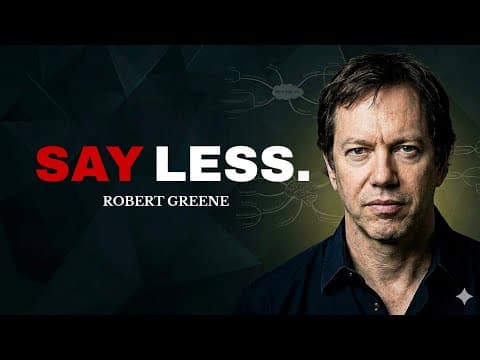
ALWAYS Say Less. (Robert Greene’s Psychology)
COVERT
10m 28s1,570 words~8 min read
YouTube auto captions
Transcript source
YouTube auto captions
This transcript was extracted from YouTube's auto-generated caption track. The transcript below is server-rendered so it can be read, searched, cited, and shared without opening the original YouTube player.
Pull quotes
[0:00]We are encouraged to be "authentic," to "speak our truth," and to "express our feelings." Modern society celebrates the loud, the expressive, and the transparent.
[0:00]The moment you open your mouth to explain your actions, your motives, or your worth, you have already handed over the keys to your kingdom.
[0:00]You have become a defendant in a trial where you are the only one who believes in your innocence.
[0:00]Robert Greene's 4th Law of Power is simple, yet brutal: Always Say Less Than Necessary.
Use this transcript
Related transcript hubs
Watch on YouTube
Share
MORE TRANSCRIPTS


