[0:06]Most chemical reactions do not occur spontaneously in a cell. Instead, cells rely on proteins called enzymes to kick start chemical reactions and speed them up, enabling cells to get the most out of the energy sources available to them. Enzymes have a unique way of kick starting reactions. They work by binding to one or more specific molecules called reactants or substrates. Binding occurs at a special region on the enzyme called the active site. Once the substrates bind to the active site, they form what's called an enzyme substrate complex. As the enzyme and substrates begin to react, some of the chemical bonds in the substrates begin to weaken, causing them to link together. Eventually, the chemical reactions at the active site lead to the formation of a different molecule. This is referred to as the product. Once the reaction has occurred, the product is released from the active site.
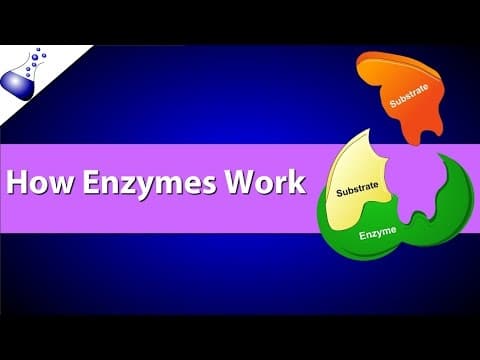
How Enzymes Work
RicochetScience
1m 16s152 words~1 min read
YouTube auto captions
Transcript source
YouTube auto captions
This transcript was extracted from YouTube's auto-generated caption track. The transcript below is server-rendered so it can be read, searched, cited, and shared without opening the original YouTube player.
Pull quotes
[0:06]Instead, cells rely on proteins called enzymes to kick start chemical reactions and speed them up, enabling cells to get the most out of the energy sources available to them.
[0:06]They work by binding to one or more specific molecules called reactants or substrates.
[0:06]Once the substrates bind to the active site, they form what's called an enzyme substrate complex.
[0:06]As the enzyme and substrates begin to react, some of the chemical bonds in the substrates begin to weaken, causing them to link together.
Use this transcript
Related transcript hubs
Watch on YouTube
Share
MORE TRANSCRIPTS


