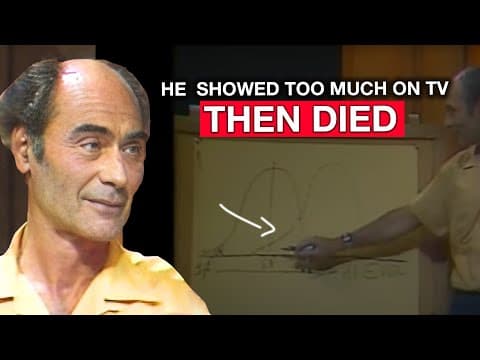
[0:00]That is classified as a non-physical reality. What happens is that that slit opens up, opens up more and more and more. So you see more and more of that reality and we assume that we see different realities. They're not very different realities but rather a very extended broad view of one very large reality. Can we speed that up by doing it? Yeah. Well, you use techniques which push the nervous system a lot faster. Those techniques are available. Shortly after making that claim, he was gone. In 1979, Itzhak Bentov was on his way to Japan to meet with leading scientists and share that he had cracked the code of reality. But his first flight from Chicago to Los Angeles never made it. The plane crashed. Strange. The man who had spent years mapping the hidden architecture of consciousness died on his way to reveal it. Later, parts of his work surfaced in CIA files, quietly folded into their own projects. Modern physics now flirts with this idea through Quantum Field Theory. But Bentov wasn't a physicist chasing equations. He was describing the cosmos like a giant interconnected hologram, where every fragment contains the whole picture. Think about that for a second. If your mind is tuning into a universal signal, then death might not be the end. It could be just changing the channel. The soul is the repository of information that we gathered during life. Well, okay, maybe we should draw another diagram. Physical bodies are here, another physical body, another physical body, and this is Joe, and this is Jim, and this is Sarah, etcetera. Now, clearly on the this is the physical level, yeah? Now on this physical level we are separate. You sit there, and I sit here, and we're all separate. Let's draw another level. This level is slightly higher and let's call this the level of the soul, yeah? Well, there will be some mingling here. Let's let's draw this person as extending to practically infinity this way. Now look what happens. At the physical level we are separate. We're separate and there's this much distance between us. Let's say that on the soul level, this person extends this much and the other person gets slightly mixed in with him. That is the souls are in a way in touch with each other. Okay, they overlap is too large. Now let's go now to a higher level, and let's call this say the level of the higher self, which is kind of a boss of the soul. There what we find is that this fellow's higher self extends this much and the other fellows extends this much. There is more overlap between them. On a very highest level, which is the high spiritual level, we are basically overlapping completely. Everybody is overlapping everybody else. In other words, every thing and everyone is everywhere. In other words, we have become omnipresent. This is a state of highly spiritual perfected beings or gods you may call. Okay? Okay. And so we exist on all of those simultaneously. On all of those simultaneously. But we are not aware of that. And in your view, then if we when we see each other as separate entities, that's only seen on one plane of reality. Correct. And that was just his starting point. Because Bentov didn't stop at the mind. He mapped out how your heart and brain physically interact with the cosmos. The results were shocking and the evidence measurable. But that's where his story takes an even stranger turn. Well, let's take a simple example. A family sitting at a dinner table and there's a kid maybe 15 years old, 16 years old. And he looks up and suddenly he says to his mother, hey ma, look at, there's there's our dead grandmother is standing in the corner right. Mother looks around, there's nobody. Then the psychiatrist says, oh, young fellow you're in trouble, and then he writes out a little prescription for rulo orazine or electroshock or whatever, and pretty soon in a matter of two weeks, kid is back in shape, very normal. No longer sees anything. No longer sees anything. Yeah. So the process has been reversed. This is called the psychotic episode or acute schizophrenic break or whatever it is. And what you would say is that there's a good chance that that kid has seen. Very good chance that the kid has a spontaneous opening of his senses. That is classified as a non-physical reality. The nervous system is that thing that gives us the picture of our realities, that is our realities, that reality which you see all around you, the flowers and the chairs and the microphones and the tea cup. is given to us by our senses. We don't see light which is beyond UV and beyond infrared. We hear only a limited scale of vibrations, like for instance, we hear anymore from 50 to 20,000 maximum. In other words, all our senses are limited. So, what happens is that that slit opens up, opens up more and more and more. So you see more and more of that reality and we assume that we see different realities. They're not very different realities but rather a very extended broad view of one very large reality. Through years of experiments and self-observation, he discovered that the heartbeat sends a rhythmic wave up the spine into the brain. This microscopic mechanical motion, measured in fractions of a millimeter, generates oscillations that synchronize with the body's electromagnetic field. Here's the twist. Those oscillations match frequencies found throughout nature. From the vibration of atoms to the rotation of planets. To him, this wasn't a coincidence. It was evidence of a built-in cosmic feedback loop. Itzhak Bentov, he wrote Stalking the Wild Pendulum, is probably one of the greatest works he created so that people could understand what a holographic matrix field is or a holographic universe, so you could understand entrainment, so you could understand the electrostatic field surrounding the Earth. He coined these simple, crazy little phrases, these explanations for people. He said, you know, we're just all raisins in the jelly, in the Jell-O. And if one raisin is vibrating at a higher frequency, stronger amplitude and it a higher frequency, soon all of the other raisins in the in the Jell-O will begin to resonate in that way. And the only way they can't is if they can overpower that amplitude and that frequency and if they can do that and they can have a constructive or a destructive wave interference, they can overpower the other wave. He illustrated the heart as a low-frequency oscillator, producing standing waves that extend beyond the body. In theory, these waves could interact with the universal field described earlier. Decades later, research from the HeartMath Institute confirmed that the heart's electromagnetic field extends several feet outside the body and can influence brain activity, a concept he proposed long before modern instruments could detect it. To him, meditation wasn't just about calming the mind. It was a precise method of tuning the heart-brain system so it could resonate with the deeper architecture of the universe. When tuned correctly, the body could become a gateway to expanded perception, a state where boundaries dissolve and reality is experienced as a seamless whole. This was presented not as mysticism, but as a reproducible process. If true, it means the human body is a finely tuned instrument. One that most people never learned to play. But this map of the body was just the beginning. In 2003, a CIA document quietly appeared in the public domain. A 29-page analysis labeled Gateway Process. These CIA documents that came out that had been unclassified or declassified for years, people can go online and check it out.
[9:07]But basically what these documents show is the power of doing mind and heart coherence meditations, focused on specific intentions, and how that can expand your consciousness. Even affect reality in a very powerful way. It's something that revealed more about what reality might be, and it's something that also really expanded their sense of the way reality works and how we can influence it. On the surface, it was a military report on altered states of consciousness. But buried in the technical jargon was something eerie. Page after page, describing concepts nearly identical to what Bentov had mapped decades earlier. It spoke of the brain and body as oscillating systems, of consciousness extending beyond space and time, and of accessing non-ordinary realities through controlled resonance. Why would the CIA care? According to the report, mastering these techniques could allow for remote viewing, the ability to perceive events and locations without being physically present. In other words, spying without ever leaving the room. It even describes the possibility of projecting one's consciousness across the universe, or into the past and future. This was not sci-fi speculation. It was treated as a strategic asset. The Gateway document wasn't theoretical. It was part of a larger intelligence program. One that blended physics, neuroscience, and the very same universal field ideas that Bentov explored. And just like his work, it was measured, charted, and taken very seriously, which raises a disturbing question. If this knowledge could truly bend perception, who controls it, controls reality? And the CIA wasn't about to let that power go unnoticed. But the Gateway file is just one piece of the puzzle, because once you start looking, you find a trail of other classified projects, each stranger than the last. Another file describes biological signal entrainment, where test subjects were exposed to faint rhythmic pulses, too subtle to consciously notice, that altered brainwaves and decision-making. The idea was simple. If you could synchronize someone's neural rhythms with a desired state, you can make them more suggestible. Without saying a word. These were not science fiction concepts. Internal memos describe field trials where operatives passed coded messages across crowded rooms using nothing but pre-arranged micro-gestures and sound frequencies masked in background noise. This is the key. Perception control isn't just about advanced tech. It's about knowing the blind spots built into every human brain, then designing an environment to exploit them. And then there's the strangest: controlled dissociation. Select operatives were trained to detach their awareness from normal sensory flow, entering an observer state where time felt distorted and memory recall was near perfect. It was the same principle Bentov mapped, tuning the body's oscillations and stepping outside ordinary processing of reality. But here, it was engineered not for enlightenment, but for control. To truly weaponize perception, you don't just change what someone sees. You rewrite the story their mind tells about it. And that's where a former US Navy interrogator takes the concept to another level entirely. Essentially, what Elron Hubbard does is have people read out of this book, uh, of Alice in Wonderland. The the verbage is very confusing. And Elron Hubbard openly wrote about this in his work and then the CIA without even attributing anything to him, copied it almost word for word in an interrogation manual. Really? Oh, yeah. So, being able to speak confusing phrases helps you to be more persuasive. They discovered this in the 50s and 60s that if I can confuse your brain, your brain acts as though someone who is, it's somebody that's falling. So, if you imagine when you're falling, your limbs are flailing all over the place and the first solid object that they can come in contact with, it's going to like grab around it, no matter what, even if it's a thorn bush or something. Okay. Right. So, any anything that's solid in that moment of confusion is going to get grabbed on to. So, the correllary of the brain correllary to this is, if a person's confused, the first logical piece of information they hear after being confused will be automatically accepted, or more automatically accepted without being screened or scrutinized by the brain. Hughes spent decades training military and intelligence operatives in advanced influence techniques. His claim is blunt. Confusion is not an accident. It's engineered. He calls it controlled perception. The idea is to subtly dismantle someone's mental map of reality and replace it with a version that serves your objective, without them ever realizing the swap happened. Here's how it works. First, overload the target with contradictions. Give them two or three truths that can't coexist. The brain will scramble to resolve the conflict. And in that state, it's wide open to suggestion. Next, layer sensory cues, symbols, color patterns, even specific rhythms in speech that bypass conscious filtering. Over time, the target's internal narrative shifts, but they believe it was their own conclusion all along. Hughes warns that at scale, this doesn't just change opinions. It can create entire parallel realities within a population. Two people can live in the same physical world, yet inhabit completely different mental ones. Each certain they're right. And here's where Bentov's influence theory meets modern tradecraft. If human perception is a tunable system, then controlled perception is the operating manual. Instead of guiding someone to enlightenment, it guides them into a constructed version of reality. One you control. Unlike Cold War experiments that required labs and specialists, these methods can be deployed through ordinary media, culture, even casual conversation. And once the perception shift takes hold, undoing it is nearly impossible. But in the digital age, these principles didn't vanish. They evolved. What once required trained operatives and controlled environments is now woven into the very platforms billions of people use every day. The tools have changed, but the objective remains. Shape the lens through which reality is seen. Google was incubated and funded by CIA and NSA and Darpa. And how the page rank algorithm and um all of the pro proprietary proprietary IP that's used in Google was developed first in Darpa, and then there was these two people that are listed in that article from CIA and NSA who were visiting Sergey Brandt many times when he was developing it and testing it. And they were funding it. And this is proven. Yeah, this is his article right here. How the CIA made Google inside the secret network. Good God. Fascinating, fascinating deep dive this guy did. The infrastructure they built doesn't just answer questions or connect people. It quietly maps behavior, preferences, and thought patterns on a global scale. In practice, this means the digital environment can be shaped with extraordinary precision. Each search, scroll, and click contributes to a constantly evolving model of how the user interacts with the world. The deeper the model, the easier it becomes to anticipate and design for specific responses. If you use blue light specifically, it actually destroys the dopamine reward tracks in your brain. Just so you know, meta and Google today own those patents. Cru's observation adds another layer. The influence isn't limited to what appears on the screen, but to the screen itself. The spectral quality of artificial light, especially in prolonged exposure, affects the brain's chemistry. Lower dopamine shifts the mind into a state of reduced drive and heightened receptivity, subtly altering how information is processed. Taken together, these elements form an ecosystem that doesn't just communicate, it conditions. Not in the overt heavy-handed sense of past propaganda, but through gradual, adaptive feedback. The result is a mental environment where certain narratives find easier passage, and others fade into the background. But for the agencies that pioneered these methods, influence was never just about controlling the present moment. And their most unconventional experiments, they went further, testing whether perception could reach into events that hadn't even happened yet. People's patterns of interaction and speech are extremely predictive of things like engagement and compliance. The pattern of mobility you have during the day, the pattern of how you communicate people, even from accelerometers, how you move. You see people are exhibiting behavior that could be best described as foraging behavior. Very ancient biological, uh, behavior, whereby people have routines and then they break loose and they sort of exploratory vignettes and then they go back to their routine. This is where influence becomes something more than persuasion. In the past, you could only react to what people were doing. Now, predictive models mean you can act before they've even made the choice. Pentland's research shows that with enough behavioral data, algorithms can forecast shifts in opinion, consumption, even social unrest, and design interventions to steer them. And these interventions don't need to be heavy-handed. Change the timing of a notification, subtly adjust the framing of a headline, reorder a list of search results, and you've shifted the odds toward a preferred outcome. It feels organic, but it's engineered. Your brain does not react to the world. Using past experience, your brain predicts and constructs your experience of the world. The way that we see emotions in others are deeply rooted in predictions, right? So, to us it feels like we just look at someone's face and we just read the emotion that's there in their facial expressions the way that we would read words on a page. But actually under the hood, your brain is predicting. It's using past experience based on similar situations to try to make meaning. This is the real loop. Data feeds predictions. Predictions shape context. Context alters what your mind believes is real. At scale, it means the same infrastructure that serves you news or entertainment can also run quiet experiments, shifting collective perception in ways that feel natural, inevitable, even self-generated. Over time, the loop tightens. Every click, pause, or scroll teaches the system more about you, refining the predictions, making the nudges smaller, more precise, and harder to detect. The better the model knows you, the less it needs to push. A perfectly tuned environment doesn't force compliance. It makes you walk willingly toward the path it's already drawn. And because it operates on probabilities, it doesn't need to be right about everyone, just enough people, enough of the time, to shift the trajectory of an entire society. But if reality itself can be bent through a predictive feedback loop, then the question isn't just who's controlling the present, it's who's already written your next move, before you even knew there was a choice to make.


