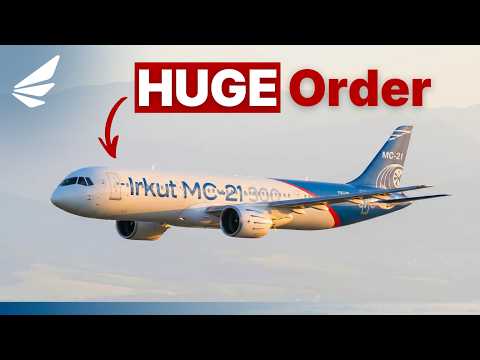
[0:07]Here's a sentence that should not make sense in 2026. Russia's biggest airline just placed a firm order for Russia's own homegrown jet and turned its back on the Boeing 737 Max.
[0:18]Because on the surface, it sounds like a bold commercial play. Like some underdog aircraft just walked into a room full of giants and said, I'll take it from here.
[0:27]The kind of David versus Goliath story that aviation nerds like us lose sleep over.
[0:32]But the moment you start pulling on that thread, the story completely unravels, because this isn't a competition.
[0:38]It isn't a bold strategic pivot and it certainly isn't Aeroflot sitting down with spreadsheets, comparing fuel burn numbers over a nice cup of tea.
[0:46]What's actually happening here is something far more uncomfortable to say out loud. An entire aviation system, one of the most globally connected industries on the planet, quietly fracturing.
[0:57]And the MC-21 isn't the winner of a race. It's the only aircraft left in the building.
[1:01]Let's go back to the beginning.
[1:08]For decades, choosing a narrow body aircraft was one of the most coldly rational decisions in commercial aviation.
[1:15]Airlines would sit across the table from Boeing or Airbus. They'd compare fuel efficiency, range, operating costs, cabin width, maintenance expenses, delivery timelines, financing terms, discounts.
[1:27]Every decimal point mattered. Every dollar per seat mile was interrogated.
[1:31]These were not emotional purchases. They were billion dollar economic calculations made by people who treat aviation like chess.
[1:39]And the result? A beautiful, functional global duopoly.
[1:43]Boeing and Airbus split the narrow body world between the 737 Max and the A320 Neo family.
[1:49]Airlines from Dubai to Delhi to Detroit operated within the same interconnected system of shared supply chains, common certification standards, and global leasing networks.
[2:00]If you needed 20 aircraft next year, you call your lessor.
[2:04]If an engine part failed in Nairobi, the replacement was on a plane to you by Tuesday.
[2:09]That was the world, efficient, predictable, ruthlessly optimized.
[2:13]Now, meet the aircraft that just walked into it.
[2:21]The Yakolev MC-21, officially designated the MC-21-310 in its fully domesticated form, is Russia's answer to the narrow body duopoly.
[2:31]Built by the Irkut Corporation under the United Aircraft Corporation Umbrella, it was designed from the outset to go head-to-head with the 737 Max and A320 Neo in the same market segment.
[2:42]Single aisle, short to medium haul, high frequency routes.
[2:46]On paper, some of the specs are genuinely impressive. The MC-21 has a cabin width of 3.81 meters, the widest in its class, edging out the 737 Max's 3.53 meters.
[2:58]It can carry up to 211 passengers, essentially identical to the 737 Max 8.
[3:03]And its composite wing, manufactured from carbon fiber reinforced polymer, was considered a genuine engineering achievement when the program launched.
[3:11]The original design also had a serious engine option, the Pratt & Whitney PW1400G, a world class power plant.
[3:18]European safety certification was in the works. There were export ambitions. At the 2017 Max Show, industry analysts were forecasting demand for over 1,000 MC-21s over the following two decades.
[3:30]Then, the 24th of February 2022 happened. Russia invaded Ukraine, and everything I just said became largely irrelevant.
[3:42]By September 2022, Aeroflot Group, Russia's state-owned flag carrier, signed a memorandum for 339 domestically produced aircraft.
[3:52]The package included 210 MC-21s, 89 of the revamped Superjet SJ-100s, and 40 Tupolev Tu-214s, all to be delivered by 2030.
[4:04]Then, in 2024, at the St. Petersburg International Economic Forum, Aeroflot CEO Sergei Aleksandrovsky dropped something even more striking.
[4:14]The airline was negotiating to transfer its entire fleet order exclusively to the MC-21, effectively dropping the SJ-100 expansion and dismissing the Tu-214 as economically inefficient.
[4:26]One aircraft type, total standardization, a complete bet on a single domestic platform.
[4:32]And right now, Aeroflot has a firm contract for 18 MC-21s, with negotiations for 90 more expected to close by the end of 2025.
[4:41]The target is 200 aircraft by 2033, with 108 expected by 2030.
[4:47]At first read, this sounds like a bold strategic move. Fleet standardization reduces training costs, operating a single type simplifies maintenance.
[4:57]It's what smart airlines do. But here's the part most headlines quietly skip past. Aeroflot didn't compare two aircraft and choose one. Russia's geopolitical actions meant that other options had already been removed from the table before anyone even sat down.
[5:15]The morning of 24th February, 2022, marked one of the fastest structural collapses in commercial aviation history.
[5:22]Within days of Russia's invasion of Ukraine, the European Union and the United States imposed sweeping sanctions on Russian aviation.
[5:30]The consequences were immediate and total.
[5:33]Western aircraft lessors who had provided over 597 aircraft to Russian airlines on operating lease contracts worth nearly $15 billion were given a 30-day window to terminate all agreements.
[5:44]The deadline was the 28th of March, 2022.
[5:47]Here's the number that explains everything. At the time sanctions hit, more than 80% of the fleet operated by Russia's 20 largest airlines consisted of foreign origin aircraft.
[5:58]And roughly 80% of that fleet was leased, not owned.
[6:01]Boeing, Airbus, Pratt & Whitney, General Electric, Honeywell, the entire mechanical backbone of Russian civil aviation was Western.
[6:13]Overnight, that pipeline shut. Aircraft deliveries halted. Spare parts stopped shipping. Maintenance support was withdrawn.
[6:18]Boeing and Airbus suspended all services to Russian carriers.
[6:22]The Irish Aviation Authority and Bermuda Civil Aviation Authority suspended the airworthiness certificates of hundreds of aircraft registered under their flags and operating in Russia.
[6:32]And the global leasing system, the financial mechanism that allowed airlines to access aircraft without buying them outright, became completely inaccessible.
[6:40]What happened next was, to put it charitably, unprecedented.
[6:45]Russia refused to return the aircraft. Putin signed a decree on the 14th of March 2022, allowing Russian airlines to re-register the lease jets under domestic certification, giving them Russian airworthiness documents that carry zero international recognition.
[6:59]By the time the dust settled, over 500 Western-owned aircraft were stranded on Russian soil.
[7:05]The insured value of those confiscated jets, approximately $10 billion.
[7:09]Leasing companies from Air Cap to Carlyle Aviation Partners began filing lawsuits that are still grinding through courts today.
[7:17]Russian airlines were now flying internationally unrecognized aircraft, cannibalizing parts from grounded jets to keep the operational ones in the air.
[7:24]This wasn't turbulence. This was a controlled crash landing of an entire aviation economy.
[7:34]So when you hear that Aeroflot chose the MC-21 over the Boeing 737 Max, what you're actually hearing is this:
[7:40]An airline with no access to Western jets, no access to Western parts, no access to Western leasing, and no prospect of any of that changing in the near term, signing contracts with the only manufacturer it is legally and practically able to work with.
[7:54]This is not a competitive decision, it's a survival calculation.
[7:58]And the MC-21 itself reflects exactly how brutal that reality is.
[8:04]The original MC-21-300 with Pratt & Whitney engines was denied European certification on the 14th of March 2022.
[8:10]The same day that Putin signed the aircraft confiscation decree. That version is now effectively dead.
[8:17]The production aircraft, the MC-21-310, runs on the domestically developed Aviadvigatel PD-14 engine.
[8:25]Those engines only entered mass production in early 2025.
[8:29]Serial production of the aircraft itself was only authorized on the 28th of March 2024.
[8:35]The first all-Russian MC-21, fitted with domestic avionics, a Russian-made composite wing, and PD-14 engines, took its maiden flight on the 23rd of April 2025.
[8:46]This is a jet that flew its first fully domestic test flight less than a year ago and is expected to begin delivery to Aeroflot in 2026.
[8:54]The trade-offs from the Russification process are real.
[8:58]Replacing Western composite materials with domestic equivalents added approximately 3 tons to the aircraft's weight.
[9:05]The knock-on effect, the MC-21-310's operational range in two class configuration, sits at only around 3,850 kilometers.
[9:13]Compared to over 6,500 kilometers for the 737 Max.
[9:18]Russia's own Deputy Prime Minister acknowledged the gap publicly and said a 1,000 kilometer range improvement was being targeted over the next three years.
[9:26]The engine production situation is also fragile.
[9:29]Russian newspaper Kommersant reported in early 2025 that while 24 PD-14 engines were originally planned for production that year, the number was revised down to just seven units.
[9:40]Even under optimistic projections, MC-21 production is expected to reach only 36 aircraft per year after 2029, less than half of the 72 per year originally promised.
[9:51]Aeroflot itself quietly revised its own targets. Instead of 200 aircraft by 2030, it now expects 108. The remaining 92 have been pushed back to 2032.
[10:02]None of this reads like a triumph. It reads like a program making the best of an extraordinarily difficult hand.
[10:12]Here's the part that separates this story from every other aircraft program you've ever read about.
[10:17]Boeing and Airbus build their aircraft in the way that great restaurants source their ingredients, globally, selectively, from the best suppliers in the world.
[10:28]The Leap engine on the 737 Max is made by CFM International, a joint venture between GE in America and Safran in France.
[10:33]The avionics come from Honeywell, the composites from companies across Europe and Japan.
[10:38]It is, by its very design, a product of the entire interconnected world.
[10:43]Russia is now trying to do the opposite, build everything, engines, avionics, composites, auxiliary power units, navigation systems, air conditioning, landing gear, entirely within its own borders.
[10:55]Not because it wants to, but because it has to.
[11:00]The Russian government has already spent over 650 billion rubles in two years propping up the aviation industry.
[11:05]It has redirected funds originally earmarked for a joint wide-body program with China into MC-21 weight reduction and performance improvement work, with up to 2.2 billion rubles reallocated in late 2025 alone.
[11:18]Its Trade Ministry issued a 14 billion ruble tender in April 2025, specifically to improve the PD-14 engine's fuel efficiency, acoustics and weight.
[11:28]What Russia is building painfully, slowly, with enormous state subsidy, is a closed loop aviation ecosystem.
[11:36]One that doesn't require Boeing, doesn't require Airbus, doesn't require Irish leasing companies or American part suppliers or European safety agencies.
[11:44]Whether it succeeds on its own terms is genuinely uncertain. The delays have been relentless.
[11:49]The program was supposed to deliver aircraft in 2022, then 2024, then 2025.
[11:55]Now 2026, with certification of the fully domestic variant expected to complete somewhere between September and December 2026.
[12:04]But here's the critical insight. Whether the MC-21 succeeds or struggles, Russia is not stopping.
[12:09]At this point, there is no choice, no alternative path. The commitment is structural, not optional.
[12:13]The story of the MC-21 is not really about one aircraft.
[12:16]It's about what happens when the global system that made aviation the most internationally integrated industry on Earth is forced to choose sides.
[12:20]When it does, the market doesn't simply shift, it fragments.
[13:51]For decades, when an airline needed a narrow body aircraft, the answer was always the same two-fun numbers.
[13:58]Now, there might be a third. It's slower, it's heavier, it has a shorter range and an unproven service record.
[14:05]But it is being built, and it will fly, and Aeroflot will operate it regardless, because there is no other viable path open to them.
[14:12]The story of the MC-21 is not really about one aircraft. It's about what happens when the global system that made aviation the most internationally integrated industry on Earth is forced to choose sides.
[14:24]When it does, the market doesn't simply shift, it fragments.
[14:28]And once aviation fragments, once you have parallel systems with different rules, different parts, different certification regimes, putting it back together is a project that takes decades, if it happens at all.
[14:39]The next time someone tells you a Russian jet just beat the Boeing 737 Max, remember what you now know.
[14:45]Nobody won anything here. Something much larger simply broke.


