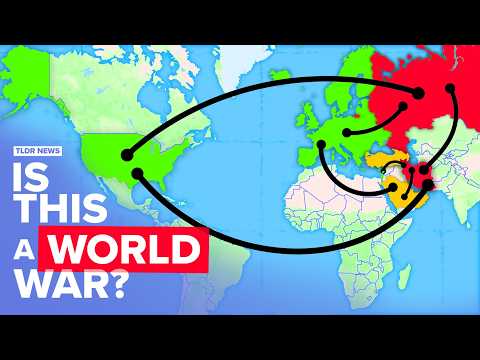
[0:00]Since the US and Israel launched their war against Iran on the 28th of February, more than 20 countries in Europe and Asia have become militarily involved. All six Gulf Cooperation Council, or GCC states, plus Jordan, Cyprus, Turkey, Iraq, and Azerbaijan, have been targeted by Iranian drones or missiles. While the UK, France, Germany, Greece, Italy, the Netherlands, and Spain have sent warships to Cyprus and the Eastern Mediterranean as part of a European naval build-up. On top of that, Russia is reportedly providing Iran with intelligence to target US forces in the Middle East. While Ukraine is assisting the US and GCC countries with shooting down Iranian-made Shahead drones, which Russia has been using to attack Ukraine, connecting the two regional wars in Ukraine and Iran. So, in this video, we'll explain the network of countries currently involved in the Iran War, and discuss whether we're in the foothills of another World War.
[1:04]If you've read George Orwell's 1984, you might remember the books three powerful superpowers, covering today's US, Russia and China. In the latest issue of our magazine, we consider how these Orwean spheres of influence are taking shape, and whether we're entering a new age of Empires. That's just one of 72 pages in the magazine, because as always, there's more to too long than you'd expect. Purchase your copy by clicking the link in the description. First, we'll look at the roughly 20 countries that are militarily involved in the Iran war. Less than two weeks ago, the US and Israel launched joint air strikes on Iran, killing Iranian supreme leader, Ayatollah Ali Khamenei, and dozens of other Iranian leaders, with the stated aim of destroying Iran's nuclear and missile capabilities. According to Iran, the US-Israeli strikes have targeted over 10,000 civilian sites, including residential buildings and hospitals, killing more than 1,300 civilians so far. In retaliation, Iran launched a major regional assault, targeting US bases, as well as civilian and oil infrastructure in the Gulf states, Saudi Arabia, Kuwait, Bahrain, Qatar, the UAE and Oman. As well as towards Jordan, Iraq and a UK military base in Cyprus, prompting the UK to send a warship and anti-drone helicopters to Cyprus. France, Germany, Greece, Italy, the Netherlands, and Spain have all also since deployed warships to the Eastern Mediterranean, continuing a European naval build-up. Then, late last week, two more countries, Turkey and Azerbaijan, were also apparently attacked by Iran, although we should say Iran has denied responsibility for these strikes. This might just sound like another regional conflict in the Middle East, but new developments have now linked the Iran war to the Russia-Ukraine conflict. Russia is reportedly providing Iran with intelligence to target US forces in the Middle East. While Ukraine is providing expertise in cost-effective drone interception to the US and Gulf states, to prevent the US from having to use up its expensive air defense systems. This intertwining of two nominally separate conflicts, the Russia-Ukraine war and the US-Israel-Iran war, is dangerous in and of itself. And has also left the South Caucasus countries of Azerbaijan, Armenia, and Georgia, which are key transit and energy corridors linking Europe to Asia, caught in the middle, having to manage the heightened risks from two major neighboring conflicts. This rapid expansion of the war in Iran has led to some speculation that we might be in the opening phases of a Third World War. This might sound melodramatic, but it's far from a fringe opinion. A Politico poll published last month, and carried out before the war in Iran, found that a plurality of American, Canadian, French, and British respondents thought the outbreak of World War III was more likely than not within the next five years, with only Germans saying the opposite. And in December, NATO Secretary General Mark Ruder ominously warned that Europe must be prepared for the scale of war our grandparents and great-grandparents endured. There's also been some speculation that, given the US is not just preoccupied in Iran, but is actively shifting military assets from the Indo-Pacific to the Middle East, that this might encourage China to try its luck in Taiwan in the near future. Which would mean large-scale wars in most parts of the world. So, is this anxiety merited? Are we really in the foothills of World War III? Well, there are definitely causes for concern. The US and Russia, arguably two of the world's great military powers, are now fighting what essentially looks like proxy wars against one another in both Ukraine and Iran. Five of the world's nine nuclear powers, the US, Israel, the UK, France, and Russia, are involved in some sort of conflict. And this is all happening against the backdrop of wider geopolitical insecurity as the so-called rules-based order breaks down. In reaction to this new found insecurity, countries are negotiating new military alliances with one another. You see this most clearly in the Middle East, where a number of countries are worried about Israeli aggression, and apparently no longer see the US as a reliable security guarantor. This seems to have at least partly motivated the recent defense pact between Saudi Arabia and Pakistan, and there are now rumors that it might be expanded to include Turkey. The Saudis have also deepened security cooperation with Somalia and Egypt, while the UAE, the Saudi's regional rival, have responded by deepening security ties with Ethiopia and India. And Israel is apparently pushing for a new so-called hexagon of alliances, which would include Israel, India, Greece, and Cyprus. New alliances are a rational response to a deteriorating security situation. But this situation is also eerily reminiscent of what happened in the prelude to World War I, when European countries built complex webs of alliances in an attempt to create a stable balance of power on the continent. This is a massive simplification, but all of these overlapping alliances basically created a row of dominoes that started falling once Austria-Hungary declared war on Serbia. Russia then stepped in to defend its ally Serbia, Germany then stepped in to defend Austria-Hungary, France then stepped in to defend Russia, and Britain stepped in to defend Belgium, when it got caught in between Germany and France, triggering a world war. Nonetheless, while things clearly don't look great, a third World War isn't necessarily inevitable, for at least three reasons. First, nuclear weapons still function as a ceiling on escalation. This explains why, for instance, Russia hasn't hit the US, the UK, or France despite their support for Ukraine. Second, a World War would presumably require direct conflict between the US and another superpower. But Trump is such a big fan of both Putin and Xi that it's hard to imagine that happening at the moment. But third, and most importantly, the lessons of the past few years, or even decades, is that war doesn't work. America is finding this out in Iran right now, and should have really learned from Afghanistan and Iraq. And, contrary to what's often assumed, Russia's war in Ukraine has gone terribly for Putin. Russia failed to meet its maximalist objectives in the opening weeks of the war, and has now spent trillions of rubles and thousands of lives to make minimal territorial progress. Israel has had some impressive tactical successes in recent years, but these haven't translated into long-term gains. Not only is the war in Iran not going to plan, but Hamas is still in control of Gaza, and Hezbollah are putting up more of a fight than the Israelis apparently expected in Lebanon. As such, the hope must be that the miserly track record of war deters the world's leaders from dragging it into another global one. Now, if you're want to binge-watch our videos, or, in fact, any news videos recently, it's very understandable that you might feel as though the world isn't super safe right now. You're probably doing all you can to at least feel in control of your online security. You're adding an extra one or capital letter into your passwords, but is that always enough? Well, luckily, our sponsor this week, NordVPN, takes your safety seriously, and expertly works to protect all of your data online. It's an unfortunate reality that online scams and fishing attacks are on the rise right now. With us getting bombarded by emails from our banks, social media accounts, and constant newsletters we've forgot we even signed up to, it's easier than ever to click the wrong thing. But with NordVPN's certified anti-fishing tool, you don't have to worry about your online safety being compromised, as their threat protection pro feature detects at least 85% of fishing websites, blocking millions of scams every single month. Even if one slipped through and you did reach a suspicious website, NordVPN's data encryption tools would protect against a number of other attacks, like malicious man-in-the-middle data breaches and intense DDoS attacks. And don't worry, if you're worried about past sensitive information being compromised, NordVPN's Dark web monitoring is always scanning for your details and passwords and can actively notify you before you even notice. Their super handy Nord Pass feature will even upgrade those old passwords for you and keep them all organized and safe in one place. NordVPN isn't just the fastest VPN on the planet, it's a much-needed shield to protect you from all those threats online. So, if cyber security is as important to you as it is to us, sign up to NordVPN today. Simply click the link in the description or go to nordvpn.com/tldr and not only will you get a massive discount, but you also get four extra months totally free. There's no better time to protect yourself. So, once again, that's nordvpn.com/tldr and it's completely risk-free with their 30-day money-back guarantee.


