[0:00]Dear friends and followers, welcome back to my channel and in today's video, we'll be taking an even deeper look at the fascinating world of jet engines, this time focusing on the turbofan engine as part of this video series about jet engines.
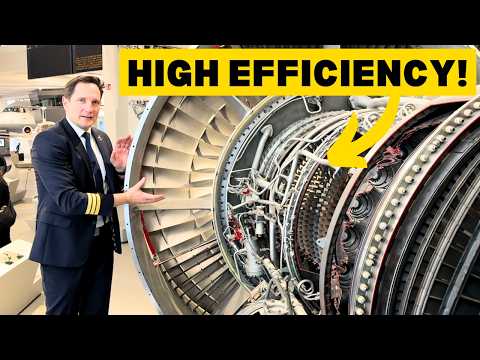
[0:16]I'll take you through how they work, showcasing it with this beautiful Pratt and Whitney JT9D-7 engine.
[0:25]The physics behind them and some cool engineering details that you might not learn in a typical flight school.
[0:32]So, if you're curious about what keeps an airplane flying, this is the perfect video for you. So let's get started.
[0:45]A turbofan engine is one of the most common types of jet engines used in modern aviation, especially in commercial aircraft.
[0:53]Its name combines Turbojet, the type of engine I introduced you in my last video, with the word fan because of the addition of a large fan at the front of the engine.
[1:06]Now, this design makes turbofans much more efficient than older turbojets, especially at the speeds used by most airliners.
[1:14]Now, stick around to learn why exactly this is the case.
[1:18]Let us first take a look at the components of a turbofan engine. Now when breaking it down to the very basics, a turbofan consists of two major parts, the gas turbine engine and a large ducted fan around it.
[1:36]Now the gas turbine essentially produces energy by burning fuel. It works exactly like a turbojet and to simplify it, you can even view it as a turbojet inside the bigger turbofan engine.
[1:49]Now the inner turbojet-like structure, also known as the gas turbine, simply the core, consists of three basic components, you already know if you have watched my last video about that topic.
[2:00]It is the compressor section, a combustion chamber, and a turbine which is driving the compressor to keep the process running.
[2:12]In a turbofan engine, we now have a huge fan at the front, which introduces a couple of more components to work the way it is supposed to.
[2:21]Now the fan at the front basically pushes a large amount of air backwards. Now to make this work, we need yet another turbine that's connected to the fan in order to draw the energy for the rotation.
[2:36]Therefore, a second shaft is needed on which the fan, the corresponding turbine, and usually another set of compressor stages are mounted to also use the energy to further increase the pressure ratio.
[2:51]Now these shafts are called the low pressure and high pressure shaft and are marked with N1 and N2.
[2:59]There are some engines which even have a third shaft mainly for improved compressor characteristics and this third shaft or spool is then called the intermediate shaft.
[3:10]Now examples for the Rolls-Royce RB211 which powers, for example, the older 747 models, or the younger brother of this engine, the Rolls-Royce Trent 900, which is used on the Airbus A380, have three shafts.
[3:24]So when using two shafts like in the case of this engine, there is a low pressure turbine driving the low pressure compressor and the fan and a high pressure turbine driving the high pressure compressor of the gas turbine, which in combination with the combustion chamber form the powerhouse of the engine.
[3:51]Note that the two shafts are not connected and rotate independently from another. The high pressure, high energy gas from the combustion chamber drives therefore the high pressure turbine and its shaft and additionally the low pressure turbine and its shaft.
[4:11]Now if you not have watched my previous video and want to learn how this process works in detail, I highly recommend you watch it.
[4:17]Now, where exactly is the difference between a turbojet and a turbofan?
[4:23]Now a turbofan differs from a turbojet as not all the air flows through the engine's core where the combustion occurs.
[4:34]A majority of air actually bypasses the engine core entirely and is pushed by the fan through the duct outside of the core, providing extra thrust without the need for burning more fuel.
[4:47]Now this mix of core and bypass air flow is what makes turbofans so efficient.
[4:54]Sorry for the quick interruption, just wanted to say if you want to become a pilot and you want to inform yourself on all the steps that you need to beg, or if you need a supportive community if you are already on your way on becoming a pilot, check out the link below and join my Patreon group.
[5:11]You will not regret it. There's a huge group of people who are just willing to help.
[5:15]We're going to have regular zoom calls, we're going to have direct messaging, we can chat with each other. It's going to be great. Check it out and see you on the other side. See ya.
[5:22]Okay, now looking at the rear through the engine, okay? Now you know that one of the key features of a turbofan is something called the bypass ratio.
[5:34]This is the ratio of the air that bypasses the engine core to the air that passes through the core.
[6:09]To give you some numbers, the bypass ratio of a CFM56 engine used on an Airbus A320 or the Boeing 737 is around 5 to 1 or 6 to 1, depending on the variant.
[6:21]Now the Trent engine of the Airbus A380 has a ratio of just shy of 9 to 1 and the absolute monster is the GE9X that will power the 777X, has a bypass ratio of over 10 to 1, making it the biggest jet engine ever built.
[6:42]In contrast, low bypass turbofans are used in fighter jets. Now these engines focus more on speed and power, sometimes even equipped with afterburners for extra thrust, but more on that in another video.
[6:54]Why are turbofans so much more efficient? The key advantage of a turbofan engine is its fuel efficiency.
[7:02]Older turbojet engines expelled exhaust gases at very high speeds, which wasted energy, especially at lower flight speeds.
[7:12]Now turbofans address this by pushing larger volumes of air at slower speeds, reducing wasted energy and making them much more efficient for subsonic and transonic flights, namely the speeds commercial airliners fly at nowadays.
[7:28]Here's a good question. What do you think was the famous Concorde powered by a turbojet or a turbofan engine?
[7:36]Comment below. It is even easier to understand when we take a look at the thrust formula I introduced you in my last video.
[7:44]From this formula, we can clearly see that in order to increase thrust, we can try and accelerate the exhaust gases to a higher speed, meaning we would have to put more energy in it, hence burning more fuel, or we can simply push more air through the engine.
[8:03]In turbofan engines, the air pushed around the engine core might be way slower than the core stream, but the sheer mass of it results in a significant increase in thrust with again no additional use of fuel.
[8:15]The thrust of modern engines come primarily from the bypass, reaching values of up to 80% or more of the total thrust.
[8:26]This efficiency improvement is crucial because fuel is one of the most significant operating costs for airliners.
[8:31]So by using more air to generate thrust and wasting less fuel on unnecessary exhaust, high bypass turbofans are able to power planes more efficiently over long distances.
[8:44]Efficiency and Environmental Impact. Of course, when talking about the environmental impact of aviation, we have to address the propulsion systems.
[8:53]Jet engines, like all combustion engines, cause many different kinds of pollution, for example, the CO2 and the nitrogen oxide or unburned hydrocarbon emissions to noise pollution.
[9:07]With regards to engine noise, it can be said that turbofan engines are much quieter since the bypassed air literally acts as a shield that dampens the noise emissions coming from the engine core.
[9:20]In terms of greenhouse gas emissions, well, we can all agree that the engine will not run without any fuel, but we can work towards getting the most amount of thrust out of the fuel.
[9:32]So by increasing the bypass ratio can significantly lower specific fuel consumption which measures how much fuel is used per unit of thrust.
[9:43]This is why engines with high bypass ratios, like those used in large airliners, are some of the most fuel-efficient engines ever designed while simultaneously minimizing the amount of pollutants per unit of thrust.
[9:58]Or how about adding a gearbox between the low pressure shaft and the fan to make the engine operate even more efficiently?
[10:09]Maybe that's worth making another video. Conclusion. In summary, the turbofan engine is a revolutionary advancement in jet engine technology.
[10:19]It combines the power of a turbojet with the added efficiency of a large fan that pushes the air backwards which then bypasses the engine core.
[10:29]This design enables modern aircraft to fly more efficiently than ever before while reducing the fuel consumption and noise.
[10:37]For commercial airliners to military jets, turbofans power much of the aviation world today, making them a critical component involved in civil and military aviation.
[10:50]Thanks to their continued development, air travel has become more accessible, cost-effective and environmentally friendly.
[10:55]That's it for today. If you have any more questions or explanatory notes regarding the turbofan engine, feel free to use the comment section below.
[11:03]And by the way, next video is going to be about the afterburner, do not miss out on that.
[11:08]If you have some other aviation-related questions, please be sure to check out my other videos or ask in the comment below for the chance to have your question answered in a future video.
[11:18]Thank you very much for your time. Here's your checklist for today: subscribe to my channel, check, activate the notification bell, check, follow my Instagram account, check, and don't forget, a good pilot is always learning. Wishing you all the best. Your Captain Joe.