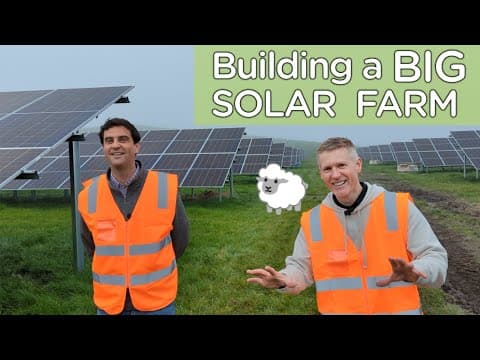
[0:00]New Zealand is one of the last relatively sunny, wealthy countries to adopt solar. But not for long, with sites like this.
[0:14]What a chonker. And the good news is, it's not even finished, but it will be by the end of this video. All right, we'll get to that in a sec, but first, I want to ask this dude, Andrew, how big is the site? Uh, it's 4 megawatts peak. Is 4 megawatts peak a lot? Um, well, it's large at the moment for New Zealand, but we're currently going through a bit of a solar revolution, so in a couple of years time, it'll be pretty small. What's the physical size of this place? Uh, we're 6 and a half hectares of formerly, uh, beef grazing territory. Formerly beef. 6 and a half hectares for those that don't speak Roman Catholic. What's that in like meters? 65,000 m^2. All right. As for the panels themselves, I mean, I mean, look how many there are. How many panels are there? Uh, we've got 5,740 uh, panels, and they're 700 watts each. Oh, okay, 700 watts each.
[1:03]Wait, so I remember you saying before we started recording that not only the sunlight hits these from above, but you also get some of the energy back reflecting off the ground. That's right. That's right. So they're called bifacial panels. Um, so they're transparent on the back. Uh, light gets reflected from the ground back onto the panels and produces a little bit extra energy. I'm not a panelologist, so what kind of solar panels are these? Um, so they're called crystalline panels, made out of silicon crystalline. Um, and they're called N-type, which is a certain way of creating the crystal, which I don't really understand. I don't think anybody does, but it makes them slightly better than the ones that were being produced a few years ago. One thing I noticed that there's a lot of grass around here. Yep. So obviously this can still have animals on it, right? Because the, uh, Institute of Research on Facebook, people told me that this land is now useless with solar panels on it. How true is that? Don't listen to Facebook. What? Are you telling me that the engineers on Facebook are wrong? They are completely wrong. Um, there's a lot of grass here. There's a lot of ability to graze sheep. Um, and it's also something that the local council considered in granting our resource consent application. So after this, once it's all said and done, there's going to be animals on this land. Correct. What flavor of animal? Uh, sheep. Oh, okay. I like sheep. I'm a kiwi, I have to like sheep. It's the law. All this grass we're seeing here, this is, this is not just about to die because the panels have been chopped on. This grass is grown after the panels have been put in. Correct. So you can still grow grass. You can still grow grass. It won't grow in the same speed, um, because it doesn't get the same amount of light, but it does still grow. How hard was it to get all the resource consent, all the bureaucracy? Was it straightforward? Was it a challenge? Um, it was a challenge. I think because we were the first ones in the Waikato area to do it. Um, we had to, um, basically educate a lot of people along the way of what we were doing. At the end of the day, um, yeah, we managed to get the resource consent, so happy days. What sort of challenges do you have? I mean, it's just, you don't you just rock on up and jam some holes in the dirt and away you go. Uh, well, we have to convince the council that what we're doing is, is, is good for the area. Um, uh, we have to convince them that we're not taking valuable productive farmland out of the equation. Um, we also have to prove to them that we're going to construct it in a, in a well-managed and safe way. Um, and also flooding risks and things like that. We also do a glint and glare analysis to make sure we're not blinding people that walking walking by. That's a good point. Coming back to the researchers of the University of Facebook, they've mentioned that they don't want the New Zealand tax payer to be paying for this stuff. So who's paying for it? Okay, so that's more nonsense from Facebook people. I refuse to believe it. Facebook wouldn't lie. Um, so this, uh, New Zealand's quite unique because we don't have any government subsidies whatsoever. There's no taxpayer money at all paying for this. It's a private investment. So the kiwi user of electricity, that's you and me and you. We benefit from clean energy and we don't pay for it. That's right.
[3:42]Okay, I'm failing to see the downside. Okay, so obviously this is a massive site, but one question that people on Facebook will be asking is, what about carbon? Like, it's obviously, they'll they'll be complaining that minerals and pollution and we should just be burning diesel constantly. I am walking in mud and it looks like I'm an extra in Michael Jackson thriller video. Sorry, Yeah, what about carbon? Um, so this site, uh, will offset about 600 tons per year. And that's assuming a 100 grams of CO2 per kilowatt hour. That's impressive. That's a lot of carbon not being released into the atmosphere. That's right. That's right. Now, I know you're thinking potatoes. I do. So we've we actually developed a PEO, potato emissions offset. So this farm on an average day will offset CO2 from 32,000 potatoes per day. Sure. Sure. I hate those birds. They make such an awful noise. They crap on the panels too. Oh, do they? Yeah, it's annoying. Actually, this is a good point. What about bird droppings and dirt on the panels? Those birds are a pain. If you if you look up here, we've got a big Oh, yeah, I can see that. bird crap right there. How do you clean that off? Um, by hand with a big scrubbing brush. How often will you need to clean it? Or you you don't know yet? Um, we we actually don't know yet. We're we're going to monitor the um the losses that we do get from from dirt. Um and optimize the cleaning based on loss of revenue. Um, but big chunky bird craps like that, we will need to Okay. take them off. Because that does reduce the efficiency somewhat. It's a quiet day. Yes, it's still cloudy, but the feeling's buzzing. Like the sun's tying to poke through. That's the next question people on Facebook will want to ask is how efficient are these on a day like today or in winter? Aren't they aren't they effectively useless? No, they work pretty well. In fact, um winter, like the the depths of winter, uh, the worst month of the year will produce, uh, is, is about 40% of the best month. You've still got some stuff going in the ground. So when's the completion date? Um, we're about six weeks away. We've got a 23 ton transformer that's due, uh, in about three weeks from now. Um, which is getting craned on a massive truck, which is pretty cool. Um, and then that's going to get uh tested and commissioned the following weeks after that. So we're hoping for commercial operation date or COD, uh, early September. Early September. Well, with the magic of editing, we can appear in early September just like I think I might have clicked my fingers a bit hard because it's late summer now, and as you can see, the solar farms complete. I'm going to go find Andrew and see how many kilowatts of electricity we're making. Andrew, long time no see. So, what's happening? How much power are we generating on this lovely sunny day? Well, we're a beautiful sunny day in March, so we're at our maximum, which is 3.3 megawatts. It's a little more than my own rooftop solar system. So, it's been up and running for a few months now. Have there been any dramas? What's the biggest problems you've had to overcome? Uh, the biggest issue is that we've had, um, has been the wholesale price. So we sell directly to the spot market. We don't have a hedge in place, right? So when we were commissioning this thing, the price was 4, $500 a megawatt hour. As soon as we turned it on, it dropped to $50, $40 bucks. Was that because there's so much water in the lakes? That's right. So, it started raining in the South Island. All of a sudden the dams are full. Next minute, we've got an oversupply of water, which is means an oversupply of energy. Um, so all our hard work, getting nothing for the energy for the first few months. Oh, you're not So, but that was that was then. It's been, I mean, you look see the color of the grass. Except for underneath the solar panels. It's it's all generally a bit brownish. So, we've had a dry summer. What has that meant? Well, we were making hardly any money for the first few months, and then midway through January, it stopped raining. Um, and then the dam, the dam levels started dropping and dropping, and the price started going up. So, the last few months, we've been doing all right. Okay. So, we've made about half of our yearly revenue, or what we expected to make in a year, in about two and a half months. At the time you built this, was this the biggest solar project your company had done? Yes, that's right. It's well, it's the first ground-mounted solar farm we've done. You've got another one going on right now. You're about to head off to, right? That's right. Yeah, yeah. Okay. So, what can you take from this and transpose? What have you learned or or what do you know not to do in the future? Uh, I wouldn't construct another one in winter. Oh, okay. Yeah, yeah. We we this site drains quite nicely because it's quite sandy soil, but the other project that we've started, we started at the tail end of winter. We were bogging all the trucks, bogging the machines, bogging the tractors. Oh, okay. Okay. Speaking of heavy civil works, uh, when I was here last time, you'd just built the concrete foundation for that container, which is is a transformer. It's a transformer, it's a high voltage switchgear and and a combiner box and a coms unit for the farm. That looks like a ready to roll unit. Is that just rock off the ship and you just put it there? Pretty much, yeah. It all gets pre-manufactured overseas. Um, it's actually made by Huawei, the big Telco, uh, conglomerate, that arrives on a ship. We build the foundation in advance and the truck rocks up, we crane it onto the foundation, connect it up, and then away it goes. Plug and play. Pretty much. People on Facebook told me that that was where the, you wouldn't get anything to grow, but it is lush when I was here a few months ago. It's a lush now, and the rest of the place is dry. Let's talk payback time. I don't know how much you can disclose, but what is a sort of average cost someone might expect to pay for a system like this? Look, for a 4 megawatt, um somewhere between 5 and 5 and a half mil. Okay. That would be all in with, you know, development costs, resource consent, grid studies, and there's a few variations around geotag and distance from the farm to the grid. So somewhere around that region would be, would be a good number. What sort of payback time could someone like the owner of the solar farm expect on average? If you were to lock in a hedge, um, so lock in a rate with the power company. I'd say somewhere between 7 to 8 years. It's the same as my home solar system. Pretty much. And after 7 or 8 years, once it's paid off, it gets the landowner, or the owner of the solar panel's just laughing all the way to the bank. Pretty much. Why isn't everyone doing this? Well, it's a new industry, really. Okay, all right. But in terms of the payback for this farm, I've got no idea. Right. Because we're on the wholesale market. We made nothing for two months. And then we're right now it's doing great. So, it might start raining in the South Island and the North Island in the next few months and then we go back to making nothing. Don't know. Swings and roundabouts. Okay. All right. Kind of fun actually to watch it. As long as nothing changes, probably about 7-8 years, but if power prices go up, which we all know they will, on average that payback time is going to get shorter. I think so, yeah. If there are any farmers or landowners watching this and think, hey, I'd like to be making bank in 7 years. Where do they start? What do they do? I think the first thing they need to do is have a look at the grid infrastructure around their property, um, and then have a look what flat land they've got in the area, um, and then give a hopefully a a C and S member a call. I remember in the first half of this video back when it was still cold and misty. You were saying that New Zealand's one of the last relatively sunny, relatively wealthy countries to adopt solar. So, why would we adopt solar? Okay, there's energy security, there's lower electricity costs, but is there any environmental benefits? It's an economic decision for for, you know, private investors, right? Um, but I think the main benefits in New Zealand that that solar can do, that it can't do overseas is that we're 50 or 60% hydro our electricity supply. So, when we have a dry year, we're screwed, right? And if we have multiple dry years, we're going back to the dark ages, right? So with solar, every unit of energy that we generate from solar is a little bit of water that doesn't need to go out of the dams, which is shoring up our energy supply. So, that means with more solar, we can treat the dams like a battery, rather than just a constantly running source. Basically, use it when we need it, use this when we can. And there you have it. That is the guts of this massive 4 megawatt solar install. If you have land, like the owner of this land and you want to make some money out of it and you want to do your bit for diversifying your land use, then why not chuck solar on it? Or at least investigate it. Contact the crowd like Andrew from Kiwi Solar. They can come out and check it out and see what it's worth for you. Basically, you'd be crazy not to consider solar in 2025.