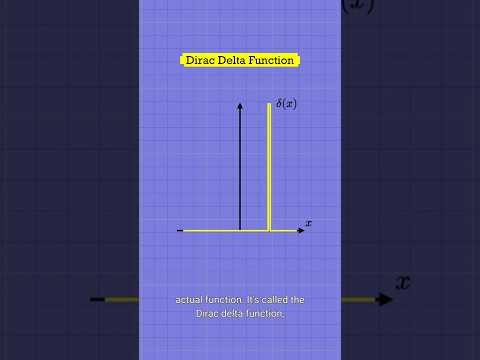
[0:00]One of the weirdest functions in physics isn't even an actual function. It's called the Dirac delta function, and here's how to think about it. Picture a simple rectangular function of width W and height one over W. The total area underneath it is then always equal to one, whatever W happens to be. In particular, if we let W shrink down to be infinitesimally small, we get an infinitely tall spike, but with that same area of one underneath it. That's the Dirac delta function, delta of X. It's equal to zero everywhere except at x equals 0, where it shoots off to infinity. But when we integrate it to find out how much area lies underneath, we always get one. More generally, look what happens when we integrate delta against any other function f of x. Since the integrand is zero everywhere except the origin, we can replace f of x with its value at that point and pull that factor outside the integral, which is once again equal to one. And so, the effect of integrating a function against Delta of X is to pick out its value at the location of the spike. Now, if you're thinking it's suspicious to try to construct a function that's equal to infinity at one point and zero everywhere else, you're absolutely right. And so mathematicians actually define the delta function by this key property, and they call it a generalized function or a distribution. And that's why the Dirac Delta function is
The Dirac Delta Function, Visually Explained
Physics with Elliot
1m 24s253 words~2 min read
AI audio transcription
Transcript source
AI audio transcription
This transcript was generated from the video's audio because no usable YouTube caption track was available. The transcript below is server-rendered so it can be read, searched, cited, and shared without opening the original YouTube player.
Pull quotes
[0:00]The total area underneath it is then always equal to one, whatever W happens to be.
[0:00]In particular, if we let W shrink down to be infinitesimally small, we get an infinitely tall spike, but with that same area of one underneath it.
[0:00]It's equal to zero everywhere except at x equals 0, where it shoots off to infinity.
[0:00]But when we integrate it to find out how much area lies underneath, we always get one.
Use this transcript
Related transcript hubs
Watch on YouTube
Share
MORE TRANSCRIPTS


