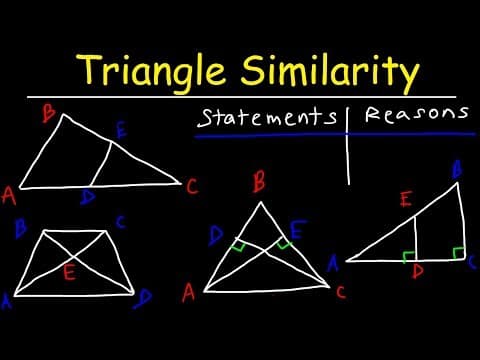
[0:01]In this video, we're going to talk about the different ways in which we can prove that two triangles are similar. And we're also going to go over some two column proof examples as well.
[0:13]So let's say if we have two triangles, and the first one's going to be called triangle ABC, and the second one, triangle DEF.
[0:30]Now, if you can show that angle A is congruent to angle D, and angle B is congruent to angle E, and angle C is congruent to angle F.
[0:44]If you can prove that all three angles are congruent to their corresponding angles, then you could show that triangle ABC is similar to triangle DEF.
[0:58]And this is known as the AAA Postulate. Now, the use of this postulate is uncommon.
[1:08]It's you don't see it very often. But if you could show that angle A is congruent to angle D, and if angle B is congruent to angle E, and if angle C is congruent to angle F, then by that postulate you can show that these two triangles are similar.
[1:27]Now, there's another postulate that's similar but a lot more useful in a sense that it's more commonly used.
[1:38]Let's say if we have the same three triangles. You could also prove that two triangles are similar if you show that two of the three angles are congruent.
[1:51]So let's say if we show that angle A is congruent to angle C, and if you could show that angle B is congruent to angle E, then this is enough to say that the two triangles, triangle ABC is similar to triangle DEF.
[2:14]And this can be proven using the AA Postulate, because we only really need two angles to be congruent, because if two angles are congruent, automatically the third one's going to be congruent.
[2:27]So this is the minimum work needed to show that these two triangles are congruent.
[2:34]Now another method that we could use to prove that the two triangles are similar is by calculating the ratio of the corresponding sides.
[2:49]So if we can show that the ratio of AB and DE, these two corresponding sides have the same ratio as BC over EF, that's these two corresponding sides, and if that's equal to AC over DF, then this is enough to say that the triangle, triangle ABC is similar to triangle DEF.
[3:19]And we could use the side, side, side triangle similarity postulate.
[3:25]So that's another way in which you can prove if two triangles are similar. And it looks like I forgot the letter E here.
[3:39]Now, there's one more postulate that we need to talk about. And it's the side, angle, side postulate.
[3:54]So if we could show that angle A and angle D are congruent, and if we could show that these two sides, let's say are similar, or they have the same ratio, AB and DE, as these two sides, AC and DF, then using the side, angle, side postulate, we could say that triangle ABC is similar to triangle DEF.
[4:36]And so that's the SAS postulate for triangle similarity.
[4:42]So those are the four main postulates that you can use to prove if two triangles are similar.
[4:48]So let's work on some examples.
[4:54]So let's say this is triangle ABC, and this is triangle DEF.
[5:03]So let's say AB is 12, BC is 15, and AC is 18.
[5:08]Let's say DE is 4, EF is 5, and DF is 6. So are these two triangles similar?
[5:17]And also, what postulate would you use to prove if they're similar?
[5:23]So, first let's find the ratio between AB and DE.
[5:28]AB is 12 and the correspondent side is 4.
[5:32]So the ratio between these two triangles is 3. And then if we divide BC by EF, BC is 15, EF is 5.
[5:41]If we divide those, that's 3. And AC divided by DF. AC is 18, DF is 6. If we divide those, that's 3.
[5:51]So we can make the statement that AB over DE is equal to BC over EF, which is equal to AC over DF. So now that we've shown that the ratio of the corresponding sides of these two triangles are equal to each other, we can make the statement that triangle ABC is similar to triangle DEF.
[6:21]And so the postulate that we can use is the side, side, side triangle similarity postulate.
[6:33]Now, let's try another example.
[6:39]So let's say this is angle A, B, and C.
[6:45]Let's say we have this line. Let's say this is D and E.
[6:53]Let's say that DC is 7, and EC is 12, and AD is 14, and BE is 24.
[7:05]So are there two triangles that are similar?
[7:08]And if so, what are the two triangles? Now, let's focus on the small triangle, which is DEC, and also the large triangle, which is ABC.
[7:25]So notice that DC is 7, EC is 12. AC is the sum of 14 and 7, so that's 21.
[7:33]And BC is the sum of 24 and 12, which is 36. And notice that they share a common side, that is angle C.
[7:44]So first, we can show that angle C is congruent to angle C. That's the first thing we need to do.
[7:51]Once we've established that, we can also see that AC divided by DC has the same ratio.
[8:00]It's 21 over 7, which is 3. And so, and then we could say that BC over EC, that's uh 36 over 12, which is 3.
[8:18]So now, we can make the statement that AC over DC is equal to BC over EC.
[8:27]So we've shown that the angles, angle C is congruent, and that these two sides have the same ratio as these two sides.
[8:40]So we can prove that the triangles are similar based on the side, angle, side triangle similarity postulate.
[8:47]So it's based on SAS. And so we can make the final statement that triangle ABC is similar to triangle DEC.
[9:03]Now, let's work on a simple two column proof using what we learned.
[9:18]Let's say this is E. So in this problem, we're given this information.
[9:34]Let's say that ABCD is an isosceles trapezoid.
[9:46]And with this information, go ahead and prove that triangle BEC is similar to triangle DEA.
[10:03]So use the two column proof to show that. So first, let's rewrite our given statement.
[10:20]So ABCD is an isosceles trapezoid.
[10:28]Isosceles trapezoids have legs that are congruent. And also, the lower base angles are congruent as well.
[10:36]Even the upper base angles are congruent.
[10:39]So those are some basic properties of an isosceles trapezoid. And this is given to us.
[10:48]Now, let's move on to number two. What do you think we could do next to prove that these two triangles are congruent?
[10:55]So that's BEC and DEA. For one thing, notice that the vertical angles are congruent.
[11:06]And also, we could show that angle EAD is congruent to angle ECB if we could show that these lines are parallel.
[11:20]And the bases for any type of isosceles trapezoid are always parallel.
[11:28]So let's say that BC is parallel to AD. And so what we could say is that bases of an isosceles trapezoid are parallel.
[11:48]And so let's mark that in the figure. So BC and AD are parallel. Now, number three. We can now make the statement that angle EAD is congruent to angle ECB.
[12:05]This is angle EAD. And that's congruent to angle ECB. And the reason that we could say this is that if we have parallel lines, then the alternate interior angles are congruent.
[12:30]Here are the two parallel lines, and these are alternate interior angles, which are congruent if the lines are parallel.
[12:40]So now, let's move on to our fourth statement, and that is that angle BEC is congruent to angle DEA.
[12:51]So this is BEC, and this is DEA. So we know that these two they form vertical angles.
[13:00]And so in step four, we can say that vertical angles are congruent. So now step five, our final statement, triangle BEC is similar to triangle DEA.
[13:19]And this is based on the angle, angle, postulate, because we've shown that two angles are congruent in both triangles.
[13:28]And we've shown that using statements two and four. And so that's a simple way in which you can prove that two triangles are similar using a two column proof.
[13:41]Let's work on another example.
[13:47]So let's say this is triangle ABC, and here we have, let's say this is D and this is E.
[14:02]So for this problem, we're given the following information, and that is that AB divided by AE is equal to AC divided by AD.
[14:20]So your task is to prove that triangle AED is similar to triangle ABC.
[14:37]So let's use a two column proof. If you want to, go ahead and try this problem.
[14:54]So let's find out. So let's start with the given, and that is that AB divided by AE is equal to AC over AD.
[15:12]Now, let's draw the two triangles that we're trying to prove.
[15:16]So we're trying to prove that AED is similar to ABC. So this is ABC, and this is AED.
[15:33]Now AB divided by AE is equal to AC divided by AD. So these two corresponding sides have the same ratio, based on this equation.
[15:51]So then we might be able to use the side, angle, side postulate to prove that these two triangles are similar.
[15:57]And notice that both triangles share a common angle, and that's angle A. So in step two, we could say that angle A is congruent to itself, based on the reflexive property.
[16:14]And so now we have enough to prove that the two triangles are similar, using the side, angle, side postulate.
[16:22]The two sides, they have the same ratio, the two corresponding sides, and the angles are congruent. So now we can say that triangle AED is similar to triangle ABC.
[16:35]And the reason for this, it's the side, angle, side postulate, and we've used statements one and two to prove that.
[16:45]Let's work on another two column proof that is not as long as the last one.
[16:49]So as usual, let's say this is A, B, and C.
[16:55]Let's draw a horizontal line in the middle. And so this is going to be D and E.
[17:04]So in this problem, we're given the following information, and that is that AE and CD are altitudes.
[17:26]So with this information, we need to prove that angle BAE is congruent to angle BCD.
[17:43]So how can we do so? Go ahead and try this problem.
[17:52]So let's find out. So let's start with the given information, and that is that AE and CD are altitudes.
[18:15]Now, let's create a mental outline of the steps that we need to take in order to get the answer.
[18:22]We need to prove that these two angles are congruent. So that's angle BAE and angle BCD. If we can prove that those two triangles are similar, then we could show that those two angles are congruent.
[18:38]So let's draw those two triangles. So this is A, B, E, and here we have C, B, D.
[18:56]So now what do we know about altitudes? Altitudes form right angles with the side that's opposite to the vertex.
[19:04]So A is a vertex, and the side opposite to it is BC. So altitude AE is going to be perpendicular to BC.
[19:16]And the same is true for the other altitude. So therefore, we could say that angle BDC, which is this angle, and angle BEA, which is this angle, those two angles are right angles.
[19:40]And the reason for this, definition of an altitude. Altitudes they form right angles with the side opposite to the vertex.
[19:53]Now, because those two angles are right angles, they have to be congruent to each other.
[19:57]So we could say that angle BDC is congruent to angle BEA. And the reason, right angles are congruent.
[20:11]So let's mark that. So this is BDC, and this is BEA. So those two are congruent.
[20:22]Now, these two angles are common to both triangles. So in step four, we could say that angle B is congruent to itself, based on the reflexive property.
[20:41]So now that we've shown that two angles of these two triangles are congruent, we can now make the statement that those two triangles are similar.
[20:49]So in step five, we're going to say that triangle BDC is similar to triangle BEA.
[21:04]And this is based on the angle, angle, postulate for triangle similarity, and we've used statements three and four to establish it.
[21:16]So now that we've shown that the two triangles are similar, we can now state that any of its angles are congruent.
[21:24]Therefore, these two angles must be congruent. So we can now make the statement that angle BAE is congruent to angle BCD.
[22:11]So let's work out one more proof.
[22:18]So as usual, let's say this is A, B, and C.
[22:23]Let's draw a horizontal line in the middle. And so this is going to be D and E.
[22:31]So in this problem, we're given the following information, and that is that DE is parallel to AC.
[22:47]And we need to prove that the product of AB and BE is equal to the product of BC and BD.
[23:06]So what do you think we need to do in order to show that the last statement is true?
[23:14]Well, let's find out. So let's start with our given, and that is that DE is parallel to AC.
[23:33]And so let's put some marks on the figure.
[23:38]Now, because the two lines are parallel, that means that there's going to be some angles that are congruent.
[23:47]And so it turns out that these two angles are congruent to each other.
[23:51]They're corresponding angles. So in step two, we could say that angle BDE, which is this angle, that's congruent to angle A.
[24:04]And the reason is since we have parallel lines, the corresponding angles are congruent.
[24:20]Now, let's move on to step three. Now, let's draw a picture.
[24:25]In order to prove this statement, we need to prove that two triangles are similar.
[24:30]So we need to prove that the small triangle is similar to the large triangle.
[24:37]So the small triangle is going to be triangle BDE, which is this triangle here.
[24:47]And we need to show that it's similar to the large triangle, ABC.
[24:54]So right now, we've shown that angle BDE is congruent to angle A.
[25:00]Notice that these two triangles share a common side, and that is angle B. So in step three, we could say that angle B is congruent to itself, based on the reflexive property.
[25:18]So now that we know that the two angles of these two triangles are congruent, we can make the statement that the two triangles are similar.
[25:28]So in step four, let's say that triangle BDE is similar to triangle BAC.
[25:44]And so this is based on the angle, angle, postulate using statements two and three.
[25:55]So now we can move on to step five. So what do we need to do at this point?
[26:01]Because the two triangles are similar, we could say that the corresponding sides are proportional.
[26:09]So we could say that AB to BD, they have the same ratio as BC and BE.
[26:20]So AB over BD is equal to BC over BE. And for step five, we could say that the corresponding sides of similar triangles are proportional.
[27:01]So now we can move on to step six. And let's cross multiply these two fractions. So AB times BE is equal to BC times BD.
[27:23]And this is known as the means, extremes product theorem.
[27:38]So that's how you can prove this statement. So once you show that the two triangles are similar, you could show that the corresponding sides are proportional.
[27:48]And rearranging this equation based on the means, extremes products theorem, you could show that this relation is true.
[28:00]And so that's how you can prove that statement. So let's say if you have A over B, which is equal to C over D.
[28:06]These two are known as the means. And these two are known as the extremes. So you can rewrite this equation like this. You could say E1, that's one of the extremes over M1 is equal to M2, the other mean over the other extreme, E2.
[28:29]Now, if you cross multiply, you're going to get M1 times M2. So that's the product of the means. And then if you multiply these two, you're going to get the product of the extremes.
[28:43]So the products of the means, M1 times M2 is equal to the product of the extremes, E1 times E2. And so that's all I got for this video. Hopefully, you found it to be useful. Thanks for watching.