[0:00]Please, ma'am. We have with us Dr. D.B. Pant from CSIR IITR, Dr. Elizabeth Bargerin from JRC EUD Joint Research Centre European Commission Italy as resource person. It's an honour to have you here today. Now I would like to invite Professor Atul Kumar Johri, School of Life Sciences JNU, and Professor Pankaj Sharma MIT Institute of Biotechnology as a chair person of the session.
[0:33]Uh, thank you very much for asking us to chair the session. And I have with me Dr. Pankaj Sharma from MIT University. So this session have two speakers and one is the Dr. A.B. Pant, uh, who is, uh, from CSIR Indian Institute of Toxicology Research. He's going to speak on development of alternatives to laboratory animals in biomedical research, where we are. Dr. Pant is a toxicologist. He's from as I said from, uh, Health and Assessment Group CSIR Indian Institute of Toxicology, and he is regarded, is known for his work on cell based models as alternatives to laboratory animals for neutotoxicity development. Neutotoxicity, cytotoxicity and photo toxicity. He is also serving as a GLP inspector of N G C M A India. He's an elected fellow of the Academy of Toxicological Sciences USA. I'll not take much time as we are running short of time and I request Dr. Panth to please start his talk. Thank you very much. Thank you so much, sir. So at the outset, let me express my thanks to organizers, especially to Professor Vijaypal Singh for inviting me to deliver this talk. So as my, the title of my talk is Development of Alternatives to Laboratory Animals in Biomedical Research, where we are. So basically the concern is why we are worried and why we are talking that animals should be used or not used or how much we can use or for what purpose we need the alternatives.
[2:27]The basic idea is that the all stakeholder wants that safety to human health or animal health and environment. Regulators, consumer of any products, industrialist, every stakeholder want that whatever products we will have, that should be safe enough to consume. And if you see, being a toxicologist, I can say, nothing is toxic, nothing is safe. The only matters, the dose, at which we are consuming. A great poison can be a medicine if we are using manifold in dilutions and overdosing of a drug can be a poison. So that, it's a matter that in what concentration we are consuming it. If you see that botulism toxin is the toxious chemical of world and that 60 gram is enough to kill the whole world, even then the diluted form of it, we are using for the Botox, just to glow the skin. So that the concentration has some meaning. If you see that smoking one cigarette in lifetime, I think no potential risk to health. Smoking 10 cigarette in lifetime, no risk. But smoking 10 cigarettes in a day is definitely potential risk. So that means how much quantity we are consuming in the same way, that the use of animal doesn't have any harm. But in what way we are using and how we are using that matters. So before my talk to alternate, I will just, uh, give a glimpses in five, six slides that animals are the essential part for any sort of discovery. And it has a glorious past. So if you see that, the game changer medical advances, so these are the listed things, where without the use of animal it was not possible. And we are surviving our average is from 53 to now 67 or 68 years. That is because of the animal use in the every sector of life and the pharmaceutical and vaccination and every to name the product. The animal use is there and without animal so we are saying that replacement complete replacement is not possible at all that in what we can move further. Just I'll take few glimpses. If you see that since 1920 to 1950, 30 years lot that insulin, anesthetic, diphtheria vaccine, broad spectrum antibiotics, open heart surgery, all there the animals have been used. If in this 30 years segment again hard transplantation, improved states and techniques, cat scanning and everything, definitely without animal, it's not possible at all. And if you see that diabetes, that the medicine for the high blood pressure, antibiotics, the anti rejection antibiotics, all there that somewhere dogs are used, somewhere monkeys are used, somewhere the rodents are used, but animals are required. And if you see that, we know that today that out of 200 types of cancer in 60 organs, we know the mechanism that what these cancer are and how they are just being there. So that all is through animal studies and now we have 100% cure for the leukemia and many of the breast cancer, that is only because of the annual studies that we have done in the past and that we are still doing. And the antibody therapy, that antibody targeted therapy, we are talking about the biologics, biosimilars. So where these science is possible without the animals? So that animals and if you see that HIV research, this virus is not infected to the rodents, the primate is the or the monkey is the only choice because in vitro, we cannot infect the cells with the HIV. In even rodents we cannot infect. So that monkeys are required. So that means animal we need. And if you see that the meningitis, cervical cancer, common infection, polio vaccine, almost eradicated only because of the use of animals. So animal use is there. And if you see that gene therapy, we are very near to the cure cystic fibrosis by the gene therapy and the all extensive use of animal was done. So that as there. Now, if you see that the use of stem cells. The stem cells, uh, another way where we are just looking a lot of scope and unlimited proliferation without any differentiation. But at the same time, they can be differentiated into more than 200 lineages if a specific growth conditions are given to them. So that means those have the promises for the some sort of alteration or some reduction of the animal use in the research.
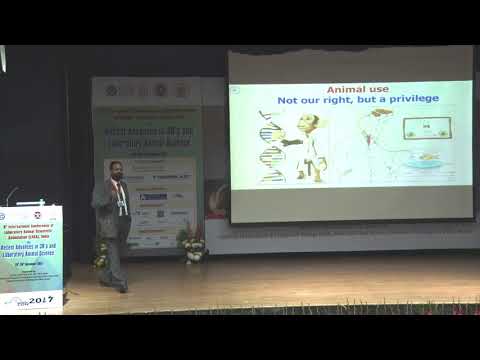
[7:22]But if you see the next slide, then we can say the use of animal is not our right. Because if you see that is a privilege. Because we cannot communicate with the animals in their language, so that no consent form is required. Like human ethics committee, we needed to have a consent form. But here we can't take consent. So that's why we are using them without taking their consent. So it's a privilege, so that we must adhere to whatever the Indian or local norms are there. Country specific norms. So we must adhere to them just to avoid the cruelty and just to use or trade the animals very humanely. Now, we come that how we can reduce the number of animals or refined the protocols. So what the Indian initiatives are and in what way we can move, that what should be the strategy. So we followed many strategies. And if you see that, we are beyond three hours. Now instead of these three hours, the replacement, reduction and refinement, we have many hours in place that reduce the cost of experiment also, because in a country like India, the cost also matters. And the reproducibility of the result, because if even you are doing with the inbred animals, even then biological systems are different. If you are doing in vitro system, then all protocols are standardized. That you are using CO2 incubators, the synthetic medium, then all protocols are established, so no effect of weather, no temperature, no pH change, nothing. So that means the reproducibility of the data is competitively better than the other one and the rapidity. Because if you see that in last five years, we don't have any new antibiotics in place. For the tuberculosis, we are scarcity of the drugs because the total resistance is there. So that means we have to screen molecules very fast. So that what the essay we have in place that should be very rapid also and the relevance to the human subject, because ultimately, whatever data we are getting, that we have to populate, or we have to accelerate that data to the human beings, so that should be relevant. And finally the responsibility of the human or the scientist, because if suppose that five scientists are working on a setup, so that we can just sit together and discuss the protocol, if we are to work in brain and somebody has to work in kidney, liver, blood, so that all tissues can be utilized in one go, in the same set of animals with the same protocol, if we just sit together beforehand and discuss the protocol before. So that means the responsibility towards the animal is at most required. And if we are following all these, then definitely new alternatives will come out, but not on the cost of human safety. So that is the strategy we have to have. And towards to that, what we are doing, that in research and training, in 2012, UGC has completely banned the use of animals in undergraduate and post graduate basic sciences. Now there is no dissection, nothing, it's only software based, so it has already banned in 2012. As far as the education in medical sciences, veterinary and pharmacy, on undergraduates, the only demonstrations are there with the animals. While for the post graduation, different colleges are following different practices. A uniform policy and protocols are still not there in our country. We are trying to best that it should be uniform through the PCI, through MCI, through DCI, so that there should be a common protocol at place, so that means whatever colleges are doing, those should be followed same practice. We are more concerned about the application research because by doing this research, we have to develop new vaccines, we have to develop new biosimilars, biologicals, new drugs, new formulations, new diagnostics, new veterinary drugs. For this, how we can reduce the number of animal without losing the entity of the data. So that is another point where we are working. So the towards to that, one step India has done on third March 2011. India became the signatory country for OECD and signed the mad agreement. What that mean, that if in India any data generated in GLP certified facility, for the preclinical safety and toxicity of any chemical, that data will be accepted as such in 34 member countries and other associate countries. So that means all countries which are following the OECD norms, they will accept the data as such without any reproduction to that. If the data is generated in any GLP certified facility. So by that doing, that we are just reducing the number of animal drastically and reduced the resources to be used for the purpose. So by that we have done and if you see on the site of N G C M A, you will find that now in India we have 45 GLP certified laboratory in place. Out of that around 20 facilities are doing bio safety and toxicity studies. So that means you can imagine that how much number of animals we have cut down by doing this exercise. Now the other strategy we followed, that OECD has the 200 series of guidelines, 300 series of guidelines, 400 series of guidelines and 500 series of guidelines. Which are already adopted and approved universally followed by the member countries and associate countries. So what we thought way back in 2000, just 17 years back, if we simply established those models at our facilities. No science, nothing. Simply just pick up the protocols and try to establish those models in our facilities in India. So that means again we can reduce the number of animals. Then the second side by side what we can do that we can develop new models. That can be a innovative science, which is which has a different steps to become a guideline that we will discuss in later part of my presentation. But the first strategy was to establish already approved models in the country. And the third strategy what we are trying to establish, that a uniform national SOP for the use of animals and alternatives in the country that is at most required. Because every organization is doing its own way. No way that how many numbers are required and why you are taking this much number, why this model you are taking, why this route of exposure is required. Many things. So that we have to make aware of everyone that if you are doing toxicity then the force feeding is the only way to give. Why you are taking oral route, why you are taking intraperitoneal, why you are taking dermal route, why you are taking inhalation route, so that we have to decide before hand that what the route we are taking for giving exposure that should be justifiable. Many of the study we personally found that for toxicity study, they are mixing the test item in the feed. So that means you are just living on the wisdom of organism whether that organism is eating that material or not. And how much compound is being eaten by different animals, nobody knows. So if from oral route if you have to see the toxicity study or bio safety study, the force feeding from the cannula, it is required because it is required by many means. We cannot put chemical directly to the mouth of latter mouse. Because taste buds are there, it will induce a lot of hormones and other secretions. So that may interfere with the results. So simply we are bypassing the taste buds and directly putting chemical to the upper part of the esophagus. So that many things are there and we know that how much amount we have given to that animal. So that means this is the national SOP is required, so that we have taken initiative. And I must say that in a drug development, if you see that, what is the process of drug development right now?
[16:24]That even before synthesizing a compound, we have a databases. So just design a molecule of drug and put that on database, the database will tell us whether this molecule is already existed as a drug or not. If not, then this drug is better than the existing one or not and what is the pharmacokinetics, what is the dynamics, what is the possible interaction with the other body biological system and I think when this compound passes from this, then only we will synthesize it in the laboratory scale. So that means thousands of molecules can be funneled down in few in a week time by using this kind of softwares, without synthesizing the molecule. Then even this compound cannot be synthesized in kilograms for the animal use. So that we will synthesize it in micrograms or milligrams and use in the cell lines of the primary cell lines culture or the immortalized cell lines of animal and human origin. If the found showing some activity, then it will go to the rodent model, then primate model and then go to the clinical phase one, two, three. But what happen most of the time the compound showing a good activity up to preclinical stage fails in clinical trials. Because anatomical, physiological and many kind of differences are there between animals and human beings. So one way what we thought if we just take the stem cell from human beings and grow them and differentiate them into the desired organism or the desired kind of tissues. And then see the effect there itself of a drug. So whatever results we are getting here, that is from the human subjects without transformation, so that the failures at later stage can be minimized. So that approach we are also using, that instead of taking the immortalized cell lines, transform cancer cell lines or primary cells from the animal origin, we are taking cell from the human being and those are stem cells and those stem cells can be differentiated easily to the specified kind of cells and the results we are getting, that are more extrapolatable and they have more predictive value to the human subjects. That we will discuss later part. Okay. So that so far in 15 years of our efforts at my organization that is Indian Institute of Toxicology Research. So that name itself spelled out that essentially we are doing the toxicology research. So that means these are the 400 series alternative models we have already established at our place for toxicity series, for genotoxicity series, these models or these systems are already in place.
[19:26]And these for the ecotoxicology. So almost all, all the guidelines for 200 series, they are there in my place as an alternative. So that towards the first strategy to establish the already approved models that we have established these. So that means we have cut down the number of animals. So one, this is for the cytotoxicity analysis of the biomedical devices or the drugs or some other kind of thing which are come in contact with the human subject, this ISO 10993 guideline is already there and United States Pharmacopia has already been replaced. This rabbit loop essay with the Lal test, Limulus amoebocyte lysate essay for the pyrogenicity. And we further miniaturized it because if you see in the guidelines for the pyrogenicity essay, Lal essay, Lal test, they are suggesting 2ml of the test item. While we have just miniaturized it into 50 microliters. So you can simply take 50 microliter of test compound, add with the 50 microliter of Lal compound and just mix it and place it at room temperature for 30 minutes, if gel is there, the test compound is positive for the endotoxin, if gel is not formed, so that means test is negative. Simple yes or no test in 20 minutes time with minimum resources, without animal use. So that is there and this L929 a mouse fibroblast cell line is approved cell line by ISO 10,000 also as well as the other OECD guidelines. That we can use the cytotoxicity primary screening test. So that is routinely being used. Other this ocular irritancy testing, this is the rabbit cornea and this is the Epi-Ocular layer. That this 3D model we have generated in our place. Simple because this is already approved guidelines in OECD. So that we have established and it is showing at par results what we are getting with the cornea.
[21:34]So that means by this mean complete eradication of animal use for this, for sorry. In the same way epidermal skin for cytotoxicity, if you see that this is the created in the laboratory. Simple by culture method and that is strictly functional. So that means human reconstructed membrane map model is also in place and that in our organization we have and we are using it and the results are quite optimum and at par what we are getting from the natural skin system. So that means again we have completely removed this animal use from this part also. This is one example. Now this I am just discussing the second part where we are trying to develop new models. Okay? After that establishing the OECD approved protocols, now we are establishing new models without animal. For neurotoxicity studies, when we say neurotoxicity, there is a confusion in the people, if you are doing MTT essay and RO essay and saying RO essay in any neuronal cell line and saying the neurotoxicity, it is not neurotoxicity. Unless until you take any end point related to the brain system. And what should be the end points? The neurotransmitter, because in our brain we have 52 different regions. Why those 52 different regions? Because that these regions secretes a different kind of neurotransmitters and those neurotransmitters govern the different functions. Okay? So that means if we just see the levels of these neurotransmitters in the different regions of brain, so we can say that this compound is just interacting with this or depleting this or increasing this or whatever so. So that the standard procedure is that we are treating to the animal and just taking out the brain and making the membrane and just after making the membrane, this is the high throughput system, the cloning system where we can screen. Seven or eight neurotransmitter in one go for 100 of compounds, because 380 384 well played format is there. So you can put the membrane protein and just put the ligands and allow this machine to work. Just push the button and make this protocol, this is a platform and go away. That machine will do everything and in the morning you will get the data for the seven receptor for the 100 compounds. This is the high throughput, but for this you have to sacrifice hundreds of animals that we used to do in past. But what we thought that instead of doing this if you use the cell system. So we started with the human stem cell, growing in the culture medium, differentiated into neural types and glial types and just expose them with the test chemical and just made the membrane and do the experiment in the same way. What we found? Exactly mimicking results, what we were getting from the whole brain and what we are getting from the membrane. So the same kind of results we are getting for the receptor. So this high throughput system we have developed and now we are validating it with the other way. Okay. Now I will just tell a long story in very brief, in three slides only that it is a well demonstrated in the literature, that the drugs and chemical, or you can say that the developing brain cells in the fetus and in other stage of life are vulnerable towards the chemicals and drugs. At a dose, which is non toxic to the adult brain. I will give you one example, a small example, that all we are using the mosquito repellent. Okay? That mosquito repellent is on and we are getting exposure of pesticide. This is for six to eight hour in a day and not for day or two. It's a months and months. Okay? So if in a room that a, an adult male is there, adult female is there and a five year old child is there. So to the male that concentration is not sufficient to induce any sort of damage in the brain. But if that lady is in the family way. So the what the concentration of pesticide will populate to the fetus brain from that lady is sufficient to induce long lasting disability in the brain cells or in the brain of that fetus. And that affect may come at the age of four, five, six or seven years of age. At the time of birth that child will normal. But at the age of seven, at the age of 10, that the symptoms will appear, that the low IQ and other kind of deformities are well reported. So that we thought that there is no way to make any system that prior to put any drug into the market, we have to screen it, whether this drug is a developmental toxic or not. So with this thought, we started working with the stem cell and we took the cord blood stem cell, hematopoietic stem cell from the cord blood, because the cord is a waste material after the birth of a child and we have to throw it. So from a waste material we are getting stem cell and ethical clearance is comparatively easier for that. Even that it took eight months time to get the ethical clearance for this waste material. So from hematopoietic stem cell, we are dragged out the stem cells and just purify them, characterize them. And when we got the around 99% purified population of one type of proliferating stem cell, then we just established the pluripotency of that and then allow them to differentiate into neuronal subtype and glial subtype. And all through the differentiation, we looked at that which stage specific markers are getting expressed. Because we know that gestation period in human being is the 40 weeks and that is divided into three trimester, 13 week, 13 week, 13 weeks. And those trimester, all 14 weeks are mapped now in terms of the neuronal activity. If we take the sample of 14th week, we know that in this time, what kind of activity or what kind of growth factor, what kind of neurotransmitter should be there in the brain of so in fetus. So all is mapped. So what we are trying, we are just translating this all into the culture medium and we did it. It took a lot of time to just establish protocols and all this thing. I have put it in two slides only. So that means, this is the electromagnetic separation. After that, we could get around 75 to 80% purified population. Again we put that so with the cocktail of 12 antibodies for the positive and negative selection and by positive and negative selection by fifth around 99% purified population were there of one type which were showing CD 133 positive, CD34 positive and CD45 negative. Which is a true hematopoietic stem cell. Further we just establish the pluripotency and then we went through a series of experiment for transcriptional level, translational level, post translational level. Hundreds of markers we have studied. And finally we found yes there are stage specific changes. Then we expose these differentiating neuronal cells and glial cells with the known developmental neurotoxins. One pesticide and one drug and then see that which genes are getting up and down regulated with the significant level. And then we put all these deals together in a chip and then we just see with the unknown drugs whether this response is a monotonous response or the chemical is positive response. We found that this response was chemical specific response. And what the cells we are going, those were metabolically active. They are capable of handling variety of chemical, because the xenobiotic metabolizing people, Phase 1 and Phase 2 enzymes were expressing there with their receptors and all controlling mechanism. And one very important aspect was there, because our body is not neutral. That body is charged. We have negative charge in our body. But the charge in our neuron cells is different from rest of the body charge. What impulse is conducted from your finger to brain, such a fast manner, because of sodium channel, potassium channel, calcium channel. That channels are running because of electric current which are different from other cell. So the other challenge was what the cells we are growing in the culture medium, those were having this much of current or not.
[31:29]If the current is not like that, then all experiments are useless. Then we just went through the experiments and we found with the patch clamp essay, yes, the electric current is as good as in the natural system. So that means our system was wonderful, wonderfully working. And this is another slide just to show that all triggering mechanisms were there. So, Dr. Pant, you have two minutes to go. Please. Okay, sir, but in the morning, Dr. Vijaypal Singh said we have positive everything except the time. Anyway, I'll take five minutes. Not two minutes, five minutes. Thank you very much, Dr. Pant for your informative talk and the highly significant tests using.
[37:45]So, very nice talk, Dr. Pant, and uh really impressed to see the 2D, 3D model development what you have done at your institute. Just a quick question, Dr., Dr. Sahab, if uh have you when you were talking about metabolism have you measured uh, SIP expressions and activities? And uh and if you can also talk about, if there are any expressions of transporters in your thing. Thank you. Even I can send you my publication, because the time will not allow me. We have just screened the whole battery of the CYPs, all classes of CYPs, with their regulators. We just use Rifampicin as a universal inducer, seven as a universal inhibitor and Monocrotophos as a positive compound. Then many of the drugs, we have screened in those environmental pollutant. So that means we went through the series of experiments. And we found yes, those cells which are differentiating at different levels, they are capable of handling these chemicals. They are capable of metabolizing these and all transporters. So that we have done a lot of studies. That can be a separate lecture, so I will send you the papers. We have published. Then I would really like to congratulate, Dr., because trust me on that, if if you have done that, and if you have model can address, then actually speaking, we can reduce quite a lot of number of animal usage very much early in discovery. So great job. Because in every platform I used to say that whatever models are already approved, first establish them. At my place, you will not believe that more than 100 such model which are already approved, we have established them. And we are using and we are ready to just give the training to everyone. Whatever wants to get the training, then we are ready to give the training. And we are giving training. That's why we are GLP certified. All 200 series, 300 series, 400 series that we are doing. Thank you. Thank you, doctor. So thank you very much, Dr. Thank you. You can discuss it during the time please. I'm very sorry, we are running short of time. We have another speaker. Now I would like to invite Dr. Pankaj Sharma to hand over a present to Dr.


