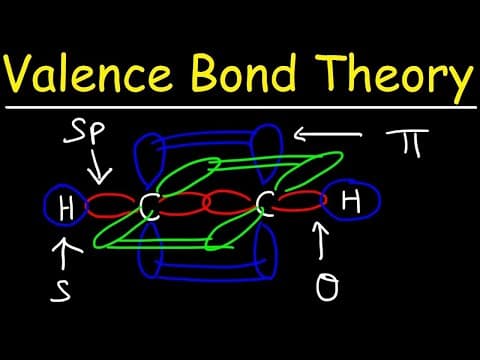
[0:01]Now, let's say if we have two hydrogen atoms.
[0:08]And if these two hydrogen atoms approach each other, what's going to happen? As you know, they will react and form a covalent bond. And a covalent bond is basically a bond where the electrons are being shared. And so you can write the bond with a single bond or you can put two electrons between the hydrogen atoms. And this concept makes sense if you think of electrons as particles. But what happens if you begin to think of electrons as waves? In that case, a covalent bond is formed from the overlap of atomic orbitals, and an orbital is a region where electrons are located, where you have a high probability of finding an electron.
[0:54]So, let's think of electrons as waves. If we have two waves in phase with each other, what's going to happen? They will interfere constructively to create a bigger wave with a larger amplitude. So, if you have two atoms approaching each other, and if their orbitals are in phase with each other, they will overlap constructively, and so you're going to get a bond, particularly a covalent bond, because the electrons are being shared. But what happens if the two waves are out of phase with each other? Well, destructive interference will occur, and instead of getting a bond, you're going to get a node, which is a region of zero electron density. So basically, the probability of finding an electron in this region is almost zero.
[1:47]Now, according to Valence Bond Theory, a covalent bond is basically the sharing of electron density between two atoms as a result of the constructive interference of their atomic orbitals. So, let's consider hydrogen again. Hydrogen has one valence electron. The electron configuration of hydrogen is 1s1. An S orbital has a spherical shape. So this is going to be hydrogen with its spherical orbital, and let's react it with another hydrogen atom. So when these two get together, their orbitals will overlap, and you're going to get something that looks like this. And so what we have in the middle is a covalent bond. Whenever two atomic orbitals overlap head to head, it's known as a sigma bond. All single bonds are sigma bonds, so keep that in mind. Now, what about when carbon mixes with hydrogen to create methane? In order to do this, carbon has to hybridize its atomic orbitals, it has to create hybrid atomic orbitals. And let's talk about the electron configuration of carbon. It's 1s2 2s2 2p2. Carbon has a total of six electrons, two of those electrons in the first energy level are core electrons, and they don't participate in most chemical reactions. The other four in the highest energy level are known as the valence electrons, and the valence electrons do participate in chemical reactions. So let's draw an energy diagram for a free carbon atom. So we have the 1s level, the 2s level, and the 2p sub-level. So we have two electrons in the 1s level, two in the 2s, and two in the 2p sub-level. This is the ground state electron configuration for carbon. In the excited state, an electron here could jump into this empty orbital if it's given energy. Right now, we're going to just talk about the ground state electron configuration. So during hybridization, the 2s orbital and the 3 2p orbitals, they're going to mix together to form a hybrid SP3 orbital. So the 1s level is going to stay the same. Now, we're mixing together four atomic orbitals, and so we're going to get four hybrid orbitals. And they're going to be degenerate orbitals of the same energy. So if we mix an S and 3 P orbitals, what are we going to get? We're going to get a hybrid orbital called an SP3 orbital. And because we mix four atomic orbitals, we're going to get four SP3 orbitals. Now, what should be the energy level of an SP3 orbital? Should it be close to the 2s level or to the 2p level? What would you say? Because an SP3 orbital is produced from mixing 3p orbitals and 1s, it has more P character than S character. In fact, it has 25% S character, 75% P character. We have 1s out of four atomic orbitals, so 1/4 is 25%. We have 3p orbitals out of four atomic orbitals, so 3/4 is 75%. And so, because it's mostly P, the energy level should be close to the 2p sub-level, but a little bit lower than it.
[5:53]So we get four hybrid orbitals, these are known as degenerate orbitals because they have the same energy level.
[6:03]As a result, we're going to place all four electrons equally among those four orbitals of equal energy. So the 1s level is unhybridized, it was unaffected. But these four atomic orbitals were hybridized into these four SP3 hybrid orbitals. And hybridization is basically mixing. If you mix water with orange juice, you're going to get something in the middle, you're going to get a hybrid. Or let's say if you mix orange juice and milk, you're going to get something in between. And that's what hybridization is, you're just mixing atomic orbitals. So if you mix S and P, you get something that's in between S and P. And so these are the four hybrid SP3 orbitals. Now, let's go back to methane.
[6:56]Methane has four single bonds, and so it has four sigma bonds. And as we said before, the carbon in methane has four SP3 hybrid orbitals, highlighted in red. And hydrogen can only form an S orbital because it has one electron in its 1s sub-level. So, let's say if you have a test question and it asks you, what is the hybridization of the central carbon atom? The hybridization of carbon is SP3. Now, how can we describe the hydrogen orbital? We can say it simply S. And so if we want to describe the CH bond, once again, we can say it's a hybrid of S and SP3 atomic orbitals. Those orbitals in red are SP3 hybridized, and hydrogen is simply an S orbital. So when you mix an S orbital with an SP3 orbital, you could say it's a hybrid of S SP3. So that's how you could describe the hybridization of the bond. And so anytime you have an overlap of atomic orbitals, you're going to have a sigma bond. So this whole thing is one sigma bond, this is another, and so methane has four sigma bonds or four single bonds or four covalent bonds.
[8:38]Now, let's talk about ethane, C2H6. How many sigma bonds are in ethane? As we said before, a single bond is a sigma bond, so 1, 2, 3, 4, 5, 6, 7. So we have seven sigma bonds.
[9:04]Now what is the hybridization of the carbon atoms in ethane? Like methane, the hybridization of carbon will be SP3. And each hydrogen atom will have an S orbital. So to describe the CH bond, once again, we can say it's a hybrid of S and SP3 atomic orbitals. Now, sometimes you need a simple way to quickly determine the hybridization of carbon. So, anytime you see a carbon attached to four atoms, the hybridization is going to be SP3. If you add up the exponents, 1 + 3 is 4. Now, let's say if you see carbon attached to three atoms. Let's say this is X, X, Y or something. What do you think the hybridization of carbon is going to be? It's going to be SP2. If you add up the exponents, 1 + 2 is 3. Now, let's say if carbon is attached to two elements. Let's say this is N and this is R. Or let's say if it's in this arrangement, like in carbon dioxide. The hybridization of carbon will be SP. If you add 1 + 1, you get 2. And for hydrogen, you could describe the atomic orbital as S. It's only going to be attached to one thing.


