[0:03]I'm gonna lose it. That would've been hilarious if I just broke that right away.
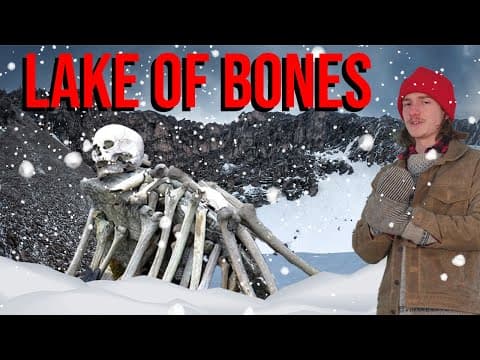
[0:17]I feel like we need a quantifiable way for you guys to see how much I'm freezing to death in this room. Is that in frame? Please tell me I hung that in frame. I gotta say though, this is probably the perfect set to discuss a story about a whole bunch of people dying of attrition. Okay. 38 degrees and dropping. Freezing to death. Anyone who does any sort of backpacking or hiking has probably had the same interaction. So how long do you think it's going to be before we find a body out here? Dude, what the Well, I'll tell you that the only thing worse than hiking with a friend and finding a body is hiking by yourself and finding 800. Today, we are going to be discussing an infamous archeological mystery. And one that you may even be familiar with. But the reason I was inspired to make this video is because of two papers, one published in 2019 and one in 2023 that completely change everything we know about this site. So today we are going to go over this mystery from top to bottom. From its discovery to the theories surrounding it, to the new genetic evidence that proves once again that the truth is often much, much stranger than any theory could be. Howdy friends, my name is Milo Rossi and today I will be slowly freezing to death while I tell you the story of Roopkund Lake.
[1:32]This T is going to be cold really fast. Oh, we're down to 30 degrees. Oh, this even has Celsius on it. I don't even have to do translations in post. I'm going to get a black Sharpie and cover the Celsius side. Oh, 30 degrees, it's like fucking summer in here. Most sources that you will find on this topic will tell you that the lake was discovered in 1942 by a forest ranger. But this is not entirely correct. Waiting for the one commenter with a Punisher Skull profile picture to cry about this mug. The discovery of the skeletons at Roopkund Lake actually date back much further. A British mountaineer by the name of TG Longstaff reported finding human skeletons at this lake in 1907. Frankly, I don't know how I feel about anyone with the name T G Longstaff doing literally anything. But if any of you out there are looking to get into the industry and need a pseudonym, I would like to toss T G Longstaff out there for your consideration. Would also make a wonderful drag name. But T G and his long stuff aside, the discovery of the lake itself actually dates back a little bit farther. The first reports from British investigators come from 1898. Now, this is a very important note because all of these discoveries from the Indian forest ranger to T G and his long stuff, all took place during the colonialism of the British Raj, which lasted from 1858 to 1947. But like everywhere in the world that had people living there before the British discovered them, the oral history of this lake goes back much farther. And there are actually local legends about the skeletons at Roopkund Lake that are found in many of the surrounding villages and communities. We are going to get into those a little bit later. But before we do, let's talk about this forest ranger. The reason that this is attributed to being the primary discovery of the skeletons is because this discovery is the one that really drove research to the site. And the story goes a little something like this. A forest ranger by the name of H K Madhwal was doing a hike up the side of the mountain on September 2nd, 1942. He was working at the Nanda Devi National Park and was on assignment to collect alpine wildflowers. His route would take him to the Junargali pass, which is a remote notch in the Himalayan mountains. And despite it being September, it would have been freezing. Speaking of which, Okay, yeah, we're down to 28 now. That's respectable, that's respectable. I'd say it's like mid-spring. At an elevation of 16,000 feet, he came to this small glacial lake just below the rocky spine of the mountain range. And as he skirted the almost fully frozen body of water, he noticed something. Staring up at him from the shattered chunks of Diorite at his feet, were the hollow eye sockets of a human skull. Digging through the snow, he found the remains of ribs, vertebrae and limb bones all frozen to this rocky substrate. And slowly, the horror dawned on him that what he was looking at was much more than the remains of one unfortunate hiker. In a panic, he descended the mountain in order to report what he had found. But at the time, England and by proxy, India, were locked in the grips of World War II. And so this mystery remained buried in the snow for another 14 years before archeological surveys were able to re-approach it.
[4:26]Multiple teams were assembled and sent to collect samples from the skeletons at Roopkund Lake. With three major ones being sent between September 4th and September 18th of 1956. But there are three primary research teams who were responsible for much of the early information that we have about this site. Those being a team from the Anthropological Survey of India, led by Dr. N. Dutta Majumdar, a team from Lucknow University, led by D. N. Majumdar. I don't know if they are the same person. But that one caught me as a little unusual. And Swami Pranavanda And Swami Pranavanda and Swami Pranavanda, a fellow of the Indian Institute of Science. When they made it to this now thawed body of water nestled in the Himalayan peaks, they were met with a nightmarish scene. The valley before them was littered with human bones. Some still wrapped in tattered shreds of clothing and others clinging to strips of dried flesh and hair. The carnage before them was certainly not just the remains of a few hikers. Louie, you can't come in here. I had to go tell Louie he's not allowed in the studio. This place is not not for baby. The carnage before them was certainly not the remains of just a lost group of hikers. But instead, it was the scattered remains of several hundred. Estimates say that Roopkund Lake is home to the remains of between 3 and 800 individuals. The three teams were successful in retrieving artifacts and human remains for study. Among the tattered clothing, they found the remains of leather sandals, some broken pieces of wood, which some believe to have once been musical instruments, and a single isolated iron spearhead. Along with this, they also found luxury items, such as beads made of glass and seashells. As well as the broken remains of parasols made out of bamboo and birch bark. It was hard to piece much else together because many of the remains at the site were fully disarticulated, the archaeological word for scattered. So instead of finding full skeletons, it was more that the ground was just littered in miscellaneous bones. At this time, this was most likely due to the fact that this was an area that was prone to rockslides and avalanches, being incredibly steep and alpine, this is a ever shifting terrain. And so the team gathered pieces of bone, flesh and clothing and returned to their labs to see if they could finally unlock this mystery. That actually reminds me. Speaking of clothing, In the last episode of Awful Archaeology, which if you haven't seen it, you should go check it out, episode 7, finally out after a year and a half. I got a lot of comments of people saying that they really liked the hoodie I was wearing. And they were like, man, that's sick. Where can I get that? And now, I I I hate to be the bringer of bad news, but this is a limited one of one print that was made by my lovely girlfriend. Uh this is a screen print actually that she did. This is the only hoodie that she's printed on, so this is uh there is only one of these in existence. But her and I both saw how much you guys liked the hoodies and so we were talking and I was like, do you want to actually put some of these to print? And so I'm very proud to say that we are going to be selling some of these hoodies. Not only does it help me and the channel out, but it also helps out an independent artist. So your money will actually be going right into the hands of the person that designed it. It also kind of works with my theme of making merch that doesn't just suck. Like it's not just some ugly thing with my name, you know, slapped across it, like it's actually a really lovely piece of art. So if you would like one of these hoodies, um they are on sale now. Link is in the description. Uh I cannot believe I transition to that from, yeah, they were found with tattered clothing and dry strips of flesh. I'm sorry, honey, your hoodie is beautiful. Thank you. Testing these artifacts would be crucial because even before testing, this site was surrounded with a lot of speculation.
[8:07]Oh, yeah, we are down to 23 degrees. In the years leading up to the 1956 expeditions, there were a lot of theories about what 800 dead people were doing in a lake. Now, because India had had their asses dragged into World War II by the British, the initial concern was that the bones were the remains of a secret Japanese invasion force that had tried to cross over the Himalayan mountains to invade India and then all died. I don't think you need me to unpack how stupid that is. But in case you do, I'm going to do it in just a couple minutes, I swear. But there were a couple other running, slightly more reasonable sounding theories. Firstly, was that it was a trade caravan that had perished in the mountains on their way to the Silk Road. Secondly, a mass grave of plague victims. The mittens and trying to do numbers just doesn't work. Second video in a row with mittens. I wonder how long it's going to take before I'm not wearing mittens in this studio.
[9:02]August. Thirdly, ritualistic suicide. That's a great band name. Ritualistic suicide. Maybe we could also have that be a drag name. Little off color, but I don't know. Yeah, ritualistic suicide. Long staff. And fourthly, pilgrims who died on a pilgrimage route. So with the information I've given you so far, you can probably already start to piece together which of these seem probable and which of these seem deluded. So, with these running theories, the team's returned to their labs to finally test the materials. At the time, radiocarbon dating was a brand new cutting edge technology, only being pioneered in the mid 1940s. And it was actually used uh during this investigation to date the skeletons at the lake. The 1956 study concluded that the skeletons dated to about 800 C E. These dates have been refined with modern studies, but by and large, that is still a pretty accurate timeline. So this study proved that these unfortunate souls had perished in the mountains at some point in the 9th century. So this quickly ruled out the Japanese invasion force theory, as if a lack of guns and uniforms wasn't enough. Whoever came up with that theory must have been losing their absolute mind. Obviously, there's the logic of, you know, guns and uniforms not being present. But you're also 16,000 feet up in the Himalayas. That is like that is like somebody dying in a meat locker. So if it was a Japanese invasion force that died in the last like, I don't know, 3 to 5 years, I promise you that they probably wouldn't have been just scattered everywhere with their parasol. Anyway, that one was stupid, but we all know it's stupid. I I don't need to explain that one any further. But what these studies didn't rule out was the caravan, the plague burial, the ritualistic suicide and the Pilgrimage. Mostly because the site was just too chaotic to piece together. It was just a jumbled pile of bones. Even though it only told a little bit, this first study was crucial because it propelled Roopkund Lake into academia where it could actually be researched by more professionals who could help unlock the story further. And it wasn't long before new studies turned up new information.
[11:04]Oh, we are at 23 degrees. Oh, I did say earlier that this has Celsius on it and I could just read from there, didn't I? Subsequent studies at Roopkund Lake continued to turn up new pieces to this puzzle. So let me throw a couple more pieces at you. Firstly, it was found that the lake contained the remains of men, women and children. Secondly, most of the bones showed absolutely no signs of trauma. Thirdly, there was kind of two populations that seemed to be present at the lake, one slightly taller and one slightly shorter. Fourthly, some of these skeletons had an indentation along the front of their skull. These likely have nothing to do with the individual's deaths and are rather an indentation left behind by a trump line, which is you've probably seen it, a big pack on your back and then you have a strap or a rope of some kind around your forehead. And if you do that year after year, it'll eventually leave an indent in your skull. So these are probably the remains of Sherpas or guides or hikers who would accompany people up the mountain. And lastly, while none of the skeletons showed any signs of violence, several of them had evidence of blunt force trauma to the skull. So, with all these pieces in mind, why don't we reassess our theories? Let's talk about that trade caravan. Seemed a little bit possible at first, but it fell apart pretty quickly here. Women and children would likely not have accompanied a trade caravan. Not to mention the fact that there were no evidence of trade goods found at the site and on top of that there was no evidence of the beasts of burden, you know, mules, horses or anything like that. I saw somewhere in an article that they found the remains of a horse there, but I didn't find that in any of the academic papers. And even if they did, it wouldn't add any credibility to the trade caravan theory. And lastly, and probably most definitively, is this is a shit place for a trade caravan. There are no evidence of any trade caravans traveling through the middle of this part of the Himalayan mountains to get to the Silk Road. Did I say that they thought it was going the Silk Road earlier? They thought it was going to the Silk Road. That's what they thought the trade caravan was. Okay, so what do we think about the plague victims? Um, I'm kinda doubting it. I know that when I'm sick, I hardly have the energy to drag my ass out of bed to go take a piss, in so far as to climb 16,000 feet into the Himalayan mountains and die in a lake. Did I use that right in so far? If I didn't, I'm going to look like a real idiot. That's a really long pretentious word to use incorrectly. But you know what? I'm not even going to Google it. I'm going to just roll with it and the comments can shred me for it. Furthermore, there were no records of furthermore. Jesus, okay. And there were no records of, you know, mass plagues or any sort of burial involving 800 people from this region. So there wasn't much historical evidence of it either. But the true answer to that wouldn't be unlocked until years later when we could analyze their bones. All right, so that brings us to ritualistic suicide. Everybody still in? This also seemed pretty unlikely. Again, there was only a single weapon found at the site in the form of an iron spearhead and almost none of the skeletons showed any evidence of having met a violent end. Those of you that know this site though, know that there were six skulls that were found with blunt force trauma to the head. Now, when I heard about this site and I kind of thought I knew the way that this story ends, I thought all of them had blood force trauma to the head. They only ever found six skulls with evidence of this. So, keep that in mind. So, that is fair. Perhaps the blunt force trauma to the head was the ninth century equivalent of the CIA award for outstanding journalism. Yeah, yeah, no, um, yeah, he walked off into the woods and bludgeoned himself, uh, eight times in the head to death. We think it was um, suicide. So the ritualistic suicide option also didn't seem all that likely, which brings us to the final option, a pilgrimage route. Now, this option made a lot of sense, because the lake is on a pilgrimage route in the honor of Nanda Devi.
[14:41]Mythology and local storytelling says that she lives at the top of Trisul Massif, which is a three-peaked mountain in the Himalayas nearby. And as she resides at the top of that mountain with her husband Shiva, So the pilgrimage in her honor is one that takes place once every 12 years and is incredibly dangerous. For the sake of brevity, I had to cut out of my script the whole part where I talk about how uh difficult it is to get to um this location. But it's a five-day hike to this lake from the nearest town through incredibly Alpine Himalayan environment where the weather can change in an instant. Oh, it's also along a um an edge, like a knife edge, so, you know, really safe to do that. So what do the pilgrims do on this pilgrimage? Well, one of the things they do is they bring offerings with them, things like beads and even to this day, they bring umbrellas or parasols with them. Although in modern times, the images of it show them all carrying, you know, nylon, colorful umbrellas, but back in the day, they probably would have been taking umbrellas that were made out of bamboo and birch bark. So that means that the pilgrimage option seems really, really likely. In fact, it almost is hands down the best option. And that's great. We cracked the code there, but that only answers half the question, because we still don't know what killed them. And this is where archeologists and anthropologists have to turn to local storytelling. Because as you won't be surprised to know, the local people have been familiar with this place for hundreds of years. And there is even an oral record of it passed down in local legend and storytelling. The story goes like this. Oh, kind of leveling out there at 23 degrees. The story goes that Nanda Devi went to pay a visit to the king and queen of some distant land. And while she was there, uh, they did something to upset her. They treated her poorly, they didn't treat her with reverence and respect, and so she got pretty pissed off. And so being, you know, a deity, uh, she went all plagues of Egypt on him and uh, just messed their life up a whole bunch. She made the crops wither, she made the milk spoil, and she made, you know, the grain infested with maggots. And so the king and queen were like, oh, damn, dude. Kind of dropped the ball on that one. And so they decided out of the goodness of their hearts that they were going to try and do something to make amends with the goddess so that uh she would stop making all of their food uh go bad. And so they saddled the wagons, and this fun-loving king brought with him his jesters and his concubines and his his minstrels and they hiked off into the mountains towards the trisul massive in order to make amends with the goddess. Now, Nanda Devi could see from the top of the mountain that they were making an effort to come up to her, but they were bringing all of the worldly pleasures with them. And so as punishment for daring to bring, you know, booze and and babes with him up the mountain, Nanda Devi smote them. She whipped up a furious blizzard that blinded them and forced them into the lake where they were pelted to death by iron balls from the sky. And there their skeletons would remain as a warning to anyone else who would disrespect the goddess Nanda Devi. Wow, so that is a awesome story. It's like a Himalayan Esop fable. Fuck around, you find out. So this story says that the cause of death is iron balls from the sky. And as a proud owner of a pair of iron balls myself, I think that that's a little bit unlikely. But as with every legend, there is always a shred of truth, which led anthropologists and archaeologists and probably even you at home to come to the same conclusion. The skeletons at Roopkund Lake were the remains of pilgrims who had been killed in a violent hailstorm. And there you have it. If you know this story and you came into this video having already known it, that's probably where it ends for you. You've seen someone else do a video on it or you've seen a post about it online or it just boiled down to a meme. And there you go, 800 people smoked by hail in the mountains. And for years, that's exactly where the story ended.
[18:32]Yeah, okay. I think I think we've we've we've hit homeostasis. A homeostasis of 23 degrees. And do some fucking jumping jacks. Oh my God, there's snow in the fireplace. No shit. Really dirty, ashy snow. It's beginning to look a lot like Christmas. How long do you guys think it's going to be before I sell out and make a Christmas album? Maybe I should make a Christmas album like before I have to sell out so I can just get it out of the way. Toys in every store. The modern investigations from 2019 to 2023 are the reason I was compelled to make this video. Because I was very familiar with this story and I had even considered making a video about it back when I first started on YouTube and chose against it because I thought it was something that a lot of people already knew about. Instead, wanting to focus on things like Sea Henge and cyber bullying. But these two recent papers add a treasure trove of new information that I think all of us should know about. So firstly, let's talk about the 2023 study because it's only a short note. Now, like seriously, it is literally called a short note. Roopkund Lake Human Skeletal Remains: A Short Note on the Signs of Nutritional Stress and Anemia on the Cranial and Orbital Surface. By Barthwal et al. Yes, I did see the H bomber guy video and it was phenomenal. I fucking adore that man. So just so you guys know, all the links to everyone I stole from will be in an unorganized paste bin in the bottom of this video so that no one can ever question me. The 2023 study looked at 27 different skeletal samples that were recovered from Roopkund Lake between 2004 and 2007. And another interesting note is that this paper estimates that there are only about 200 individuals at the lake. Now, this could be due to better counting methods today, but it could also be due to something I'll talk about later, which is that this site is being rapidly destroyed. First and foremost, this study looked at the age dispersal of the skeletons at the lake. Of those 27 skeletons, it was found that there was one young adult, who was between 20 and 35. The middle-aged class was the largest distribution and showed that there were 10 individuals between 35 and 49, and the 50-plus category contained six individuals. Along with that, there were several whose ages were not able to be fully determined, such as six who were just categorized as adults, and four who were completely impossible to determine in the first place. Now, another interesting thing that this study did was determine the sex of the individuals at the lake. And this is a really beautiful study that I think all of you should keep and show next time you hear a turf on the Internet say, oh, when they find your skeleton, they're going to know that you were a man. Uh because, uh with our cutting edge modern technology of 2023, of the 27 skeletons found at Roopkund Lake, there were only to decisively determine the sexes of two of them. There was one confirmed male and one confirmed female. And then with that, there were four probable males and five probable females. And 16 individuals remained completely unidentified. So take that bone powder in your J K Rowling pipe and shove it up your ass. So this shows that there were an even distribution of biological males and females found at Roopkund Lake. Now, up until this study, even in the 2019 one that I'm about to go to, it was believed that most of them were all in good health. And that still seems to be the case. It wasn't, you know, a health problem that caused all of them to die together on this mountain. But this study found that many of the skeletons were suffering from anemia. By analyzing the porosity of the bone in their skulls, they were able to find that many of these people had some level of malnutrition. Which could be from lack of sun, lack of iron, uh, you know, anemia. So, interesting, worth noting. But now we gotta move on to the meat and potatoes of this thing. And that is a paper whose name pretty much gives it away, but my God, it's amazing. Ancient DNA from the skeletons of Roopkund Lake reveals Mediterranean migrants in India by Harney et al. published in 2019. Again, linking this paper below. I really suggest you read it for yourself and, uh, you know, draw your own conclusions and then appreciate the immense amount of research that went into doing this. So, this paper focused on doing genome wide DNA sequencing for 38 skeletons from Roopkund Lake. And it found a treasure trove of information. Until this event, it was believed that all of these skeletons were the remains of a pilgrimage party that were killed in a single event in 800 C E. But again, only six of the skulls actually had evidence of being damaged by hail. So the cause of death death was still only about half confirmed. This 2019 study also found the bones of everyone to be in mostly good health. Again, this was before the anemia study, but it ruled out the idea that they would have been a plague burial. They also found no relation between any of the skeletons that they found, which begins to diminish the idea that these were family groups. But by far the most groundbreaking piece of evidence that they found in this study was that this was not one group. Instead, the remains belong to three distinct genetic groups that had perished in two separate events hundreds of years apart. The three groups were separated into group A, B, and C. You got damn, you learn fast. Group A was found to have South Asian descent. The paper defines this as being from places like India, Pakistan, and Nepal. But group B was found to be part of a genetic group from West Eurasia. The paper defines this as being from Europe, the Near East, and Iran. And by looking at modern genetic groups, it was found that group B most closely shares their DNA with modern populations of Greece and Crete. The paper clarifies that this doesn't mean that these individuals came from Crete, but rather that their ancestors and the people of Crete shared one genetic body. And group C was represented by one single individual, who was found to be of East Asian descent, with a very close genetic match to the Malay people. But what's even more bizarre is that none of these groups share really any genetic material with any of the currently existing modern groups that live around this region, meaning that most of these people weren't locals. So with all this modern technology, they decided to use mass spectrometry to re-date the bones. And they found that groups A and B had died about a thousand years apart. The original sample that was tested in the 1950s was probably from one of the individuals in Group A because it was found that the Group A individuals perished in around 7 to 900 C E. But group B perished between 1700 and 1900 C E. So just like 2 to 400 years ago at most. And that one lone individual in Group C had perished in the same event that killed Group B, so he was with all of the Eurasian people. They also did femur bone collagen testing to figure out what their their diet was. It blows my mind that we can do with modern technology. As you won't be surprised, they found that both groups had pretty distinct and separate diets. Group A showed signatures of either eating millet or eating animals that had been fed with millet. And Group B, as well as the little lone C guy who traveled with them, had more signatures of things like wheat, barley, and rice, or animals fed on wheat, barley, and rice. Now, the bone sample from femurs can test the last 10 to 20 years of diet. So, this is a pretty broad span of what they have been eating for a prolonged period of time. So, we kind of know that these were people from inland at least for the last 10, 20 years of their lives. There's no evidence of eating fish or seafood. But we also know that they didn't all live nearby and we know that their diets were different enough that they would have had to have come from different places inland to all die at this lake. So, the mystery of Group A seems to be completely solved. A pilgrimage of people from all across the Indian region of the continent who came to this place, went to the mountains and were pummeled by hail. The story of which was likely told by survivors and has persisted in oral memory for over a thousand years. But group B and the lone Group C that traveled with them is really unusual. They have Indo-Greek roots from the Mediterranean region. They were fed on inland foods and they have no familial association with one another. At the time that this group would have lived, the region they hailed from would have been under the control of the Ottoman Empire. And we have no idea what they were doing at this tiny isolated lake in the middle of the Himalayas, thousands of miles from home. So far, anthropologists have turned up no local oral history of a group of foreigners perishing in these mountains. Which seems like it would be a pretty memorable event. But as for what happened to them, I think it's pretty obvious. Probably met the end that you would expect. A group of people who are unprepared for the environment they were in and froze to death. I think that they were claimed by the same thing that claims hikers and climbers even to this day, attrition. We know that the weather in these mountains can change in an instant. And I think it's more than likely that this group was caught off guard by a massive snowstorm. Even in a warm month, the temperature can drop so suddenly that people can be caught completely unprepared. And I think that the most likely option is that this entire group froze to death together at the top of this mountain with no survivors to tell the story. The only thing that can make that story even more grim is whether or not they knew that just below their feet were the bones of several hundred people who met the same fate. But that's just guesswork. Freezing to death leaves no signature on the bones, and the remains are so scattered that we can't piece together any of the context of the site. At the time of this video, we were tantalizingly close to unlocking this mystery once and for all, but it seems to have only gotten more strange. It's pretty logical to think that these people would have died of attrition in the mountains, that doesn't really take an archeologist to figure out. But the bigger question now is why were they there? But unfortunately, our window to answer that question is closing rapidly. Because as for archaeological survey of the site, time is running out.
[28:10]Roopkund Lake is a modern phenomenon. It has been covered by news outlets published in papers and has made its way into the psyche of Pop Science. And because of that, it has put this remote lake on a map. So, in the modern day and age that we live in, where if you just have some money, you can kind of just do whatever the fuck you want, it has seen a huge amount of tourism. And it is this tourism that is actively destroying any hope that we will ever have of unlocking this mystery. Tourists and hikers who visit this lake will rearrange the bones in piles, which is why so many of the images I've been showing through this show the bones arranged in unnatural ways. Every bone moved is removing it from the context that an archaeologist would need to actually piece this story together. If a skeleton was found huddled under a rock, it could contain crucial information to unlocking this story, but the moment that a tourist goes, oh, look at that and you know, grabs it and rips it out to make a fucking sculpture out of it, it suddenly loses pretty much all of its meaning and everything you can learn from it is gone. Not only are the bones being rearranged and scattered by tourists, but, as I'm sure you also could have guessed, they are being stolen. It's easy for a tourist to hike up to this mountain and, you know, see all these bones lying around and like, huh, what's one going to do? And then everybody says that, and before you know it, there's nothing left. This is the archeological concept of context. I've talked about it on this channel before, and it is probably the most important principle in archaeology. At the moment that an artifact or human remains is removed from the place where it was naturally deposited, it loses about 90% of its informational value. And so, the remoteness of this lake, combined with how rapidly it is being destroyed by tourists and hikers, mean that there is a very good chance that we will never know what happened here. And that's part of it. That's part of archaeology is that it's the study of a topic of time, an idea that runs through your fingers like sand. And so maybe someday I will have another video to make. Maybe someday we'll finally unlock the mystery of who these people were and what they were doing in this remote mountain. But until then, this is all we know. And so this is where my wonderful viewer, it is now your turn. I give you all this information and I linked to you all these resources so that you can be the next detective to look at it. So that you can try and draw your own conclusions, so that you can apply your knowledge base to maybe be able to lend a little bit more light onto this story. If you have any theories or ideas, I would love to hear them in the comments, or you can shoot me an email. But for me, that's all I have to tell you. I'd like to thank you all very much for watching this video. It feels really good to finally be back doing YouTube and finally be doing it full-time again. I have the foreseeable future is me just doing this, and so I'm looking forward to actually getting a post schedule. The next video I'm going to be filming is episode 8 of Awful Archaeology. If you haven't caught seven yet, go check it out. And uh, and as a reminder, if you want one of these awesome hoodies or a T-shirt or something, um, the link to this is going to be in the description. So you you'll be supporting my uh lovely girlfriend, the artist herself and you'll be supporting me and my channel. Um, and one last note, I've done an overhaul of my Patreon. So now, um, the big ticket item is offering early ad free access to all my videos, but in the higher tiers, I now have a bulletin as well as a weekly video log and finally a ultra early access where you get to see my videos before I do any of the post-production on them, containing clips, videos, jokes and tangents that will never end up making it to the final print. So if you want to support me on Patreon, you can check that out. And everyone on my Patreon gets their name in the credits of these videos. So, ladies and gentlemen, I'd like to thank you all very much for watching. Uh my name is Milo Rossi. Remember to stay curious, stay inquisitive. And remember that it is 22 degrees.


