[0:00]Unless you want your readers to abandon your book before they get through chapter two, then you should definitely go through this eight-step checklist of what needs to happen in the first 20 pages of your book. Now, I often hedge in my videos and say, you know, six out of the 10 of these should apply to you. This is one of those rare videos where I think all eight of these steps apply to say 99.5% of novels. So you really need to look very closely at your book and see whether it hits all eight of these. I'm John Matthew Fox of Bookfox, and I'm an editor who helps writers write better books. So, if you're down to invest in your book, let's get started. The first thing you should make sure that you do in your first 20 pages is bond with the main character. If your reader doesn't feel kinship with one of your characters or the main character in your book, they're just not going to keep reading. But let's look at a variety of ways that you can have a reader bond with a character. One way is to create sympathy for that character, like in Kristen Hannah's The Nightingale. The mother dies and the father gives his daughters away. Okay, right away we're like, oh, these poor, poor girls. Like, of course, we're on their side. Or in Kitchens of the Great Midwest by Ryan Stradal, there's a kid who's dubbed the Fishboy. Because he, you know, smells like fish. And then his wife falls in love with a somo, yay, and she leaves him. So, right off the bat, we're like, oh, poor Lars, like, poor smelly fishboy whose wife left him, like, of course, we're rooting for you now. Even in a book like Frederick Backman's A Man Called Ove, where the main character is kind of like grumpy and raly and ordinary. You still like him because he's endearing in kind of this grandfatherly way. And, and because he's funny, right? So a character doesn't have to be nice for us to bond with them. Don't think that your character has to be likable. Your character just needs to be investable, like the reader is willing to invest their time to go on a journey with them. Or look at Eleanor Oliphant is completely fine by Gail Honeyman. So this main character's a little weird, a little socially awkward. But at one point, she gets a call from this, you know, spam caller, and she just whispers back to the spam caller. I know where you live. And and as a reader, we're like, all right, I'm on this girl's side, like props, mad props to you. So really, your goal is to get the reader to identify with the main character, to feel like they're on the same team or to emotionally bond with them. The second thing that pretty much every novel needs in the first 20 pages is show off your character. So, your goal is to showcase your character being active. So make them action-based, make them do something in the world that helps us to get to know them better. If they're smart, then show them doing something smart. Like Ryland Grace in Project Hail Mary, you know, he's figuring out all sorts of science problems on his spaceship. Or check out Six of Crows, which was made into a series called Shadow and Bone on Netflix. If your characters are physically capable or dangerous in some way, then, yeah, you want to show them sneaking up behind a sharpshooter and placing a knife to their neck. Now, in your novel, showing off a character doesn't always have to be so competence-based. It could also just be listening to the character's voice. Are they sassy? Are they sarcastic? Are they super intelligent? Are they a little depressed, right? If we can get a sense of who they are from the way that their voice appears on the page, then it will be showing off who they are. Now, the biggest mistake to avoid for this one is just to follow the advice to like establish whether your character's good or evil right at the beginning of a novel. For instance, you have them, I don't know, kick a puppy or you have them help an old grandma across the street and the reader's like, okay, now I know which side they're on. Like, yes, those sort of generically noble things, they're not always bad and they can help the reader to get a sense of who this person is. But I'd encourage you just to go a little bit further than that, push a little further and to try to come up with something a little bit more original that shows the reader who this character is. Although sometimes you do have characters who both establish goodness and establish competency at the same time. And just a little reminder that if you want full length courses that take you through the process of writing your entire novel, I have 230 extra videos in Bookfox Academy that will guide you through sentences and dialogue and how to write a novel and all sorts of other really wonderful topics. So subscribe to Bookfox Academy, check that out, see if it's right for you, see if it'll help you along the journey. So the third thing that you need to do in the first 20 pages of your book is to establish the norm and violate it. Think about how in the Matrix, we establish Neo's normal job, right? He's in a cubicle, he's doing like really boring cubicle type workplace stuff. And then we get agents coming in and Morpheus and Red Pill and Blue Pill, and you know, all the jazz that is the Matrix. So we violate that norm of the cubicle life. I think the main mistake that writers make here is that they spend too much time establishing the normal because honestly, the normal's not that interesting, right? That's the boring part of the story. You're only showing the norm, so you can violate it as soon as possible, so we get the story actually going. But I'll also say that the norm doesn't automatically have to be boring or mundane. So Station Eleven by Emily St. John Mandel, starts with a bunch of people watching a performance of Shakespeare's King Lear, and then a man dies on stage. So this is kind of the normal world, but it's an exciting part of the normal world, like, oh, like an actor dying on set. But then right after that, we see the violation of the norm because, you know, a pandemic sweeps across the entire world, and, you know, most people die. The most important thing I can tell you about this piece of advice is that you don't have to establish the norm every time. Think about Franz Kafka's The Metamorphosis. The very first line of that is, you know, him waking up in his bed transformed into a cockroach. So the very first line is the violation of the norm. We don't spend any time seeing like what his family was like before he was transformed into this cockroach. No, we just go straight into the transformation. The next step is one you should definitely not miss for your novel. It is number four, tease us with your genre's pleasures. So your goal is to deliver the main pleasures of your genre right at the very beginning of your book. Because it's like a sort of contract with the reader, like you're letting them know, listen, you bought this book because you're expecting a certain sort of pleasure from the text, and guess what? I am going to meet those expectations, and I'm going to meet them very quickly. So Red Rising by Pierce Brown starts right away with a drilling competition on Mars, and these rigid cast systems. Plus right in the very beginning, we're getting these sciency details about helium 3 and, you know, pit vipers, which are related to snakes back home, but also like evolved in certain ways. So it's doing a lot of world building, and it is convincing the reader that, oh, like, what you want from a sci-fi novel, this is going to deliver it. Or think about Jurassic Park where the very first scene is that raptor inside the cage who attacks a man. Now, we don't actually get to see the raptor, so there's some element of tease going on. But at the same time, it's delivering dinosaurs and danger, which is what people want from this sort of story. If you're writing a horror novel, then look at the beginning of Get Out. We have a young black man walking alone at night and he's sort of an easy because a car's following him. Then the driver attacks him, throws him into the trunk and abducts him. So right away there is some strong fear going on and this is a great setup for the rest of the story. Or look at the first book in the Bridgerton series, The Duke and I. So fans are coming for romance, right? That's why they're reading this. So right from the very beginning, we're hearing about Daphne, how she wants to marry, and how it doesn't even have to be true love. We're hearing about four men who have asked for her hand so far, and she's turned him down because she didn't like him very much. So I think the biggest mistake is to open your book with pleasures that aren't directly related to the type of pleasures that your book is going to offer later on. If you open a literary novel with a thriller paste murder and then spend the next 200 pages sort of ruminating and naval gazing, then the readers who enjoy the beginning aren't going to like the middle. And the readers who are looking for that middle experience aren't going to like the beginning. Essentially, your opening needs to taste like the rest of the book. This next point seems obvious, but I honestly think it's probably the most forgotten point in this whole video. It's number five, start the inner journey. So of course you're going to start the outer journey, right? Like, of course, every writer knows to start the outer journey quickly. But you also need to start the character's inner turmoil. What is really plaguing them? What are they fretting about? And how are they going to go on a journey until they reach the end of the book where they learn something or they change in some way? Now, sometimes the outer journey and the inner journey end up being pretty similar or related to one another. For instance, in my Year of Rest and Relaxation by Ottessa Moshfegh, it opens with the narrator's plan to sleep for an entire year, you know, take lots of medications that just like zone out. Now, that would be the outer journey, but also it kind of signals the inner journey. Like, why is she doing this? Oh, this is her way of dealing with grief. Her father died from cancer, her mother died from suicide, and she's trying to hibernate so she can reset herself. Another book that starts the inner journey really quickly is Klara and the Sun by Kazuo Ishiguro. So this little robot sitting in a store unbought and unwanted, goes on a journey of self-knowledge, going from really low self-confidence to a place of feeling loved and appreciated. We could also say the inner journey is one of this robot not really understanding human relationships and gently moves toward a more deeper and fuller understanding of them. Hey, I'm going to be real with you, subscribing is free, it only takes half a second and honestly, it's probably the biggest thing that you can do to support this channel. It tells YouTube that this content matters. So please take a second and subscribe and like. The sixth thing that you should do in the first 20 pages of your book is to introduce the antagonist. So here's a really interesting question. Should your antagonist appear before your protagonist in your story? It sounds crazy, but there's actually precedent for this. Think about how in No Country for Old Men by Cormac McCarthy, he introduces the antagonist Anton Chigur in the very first chapter. He strangles a deputy with his handcuffs. Then he uses a bolt pistol to shoot a man and steal his car. And then he uses a gun to shoot an antelope. That is quite a death-centric introduction right there. Another good example would be Star Wars, A New Hope, where we see Darth Vader boarding that vessel and, you know, that iconic walk before we ever see the protagonist Luke Skywalker. Now, let me just clarify, introducing them doesn't always mean that they need a full on scene. Sometimes an antagonist can be introduced by someone referring to them in dialogue or someone mentioning a rumor about them. If you remember, Voldemort is introduced as, you know, the name that people won't even say. Voldemort! And that sort of terror really builds the legend before we actually get a scene with him present in it. And I should also say that remember that an antagonist is not the same thing as a villain, right? If you're writing a, I don't know, a novel about a marriage or something like that, the antagonist may be the spouse, even though they're not evil. They're just, you know, at odds with the protagonist. The seventh thing that you should definitely have in the first 20 pages of your book is ask the MDQ. Now, the MDQ is the major dramatic question. And if you begin your book well, the reader should be able to sense what the MDQ is. You don't need to like say it explicitly, the reader should be able to formulate it if they thought about it half a second. So Gone Girl asks its MDQ in the first 20 pages for sure. Like it just is saying, hey, what happened to Amy Dunne? She is missing. We got a bit of a mystery here. And in Big Little Lies by Liane Moriarty, the MDQ is who died? We don't even know, you know, who exactly died, and then also who killed them. So the MDQ, it's not the theme, and it's also not the inner journey. It's more like the main plot engine that makes people want to read the book to find out how this question ends up getting answered. And if there's one mistake that you should definitely, definitely, definitely avoid, it would be asking the MDQ too late in the storyline. Like if you're not getting there in the first chapter, in the first 20 pages, the reader's not going to be interested enough to keep on reading. It doesn't really matter if there's minor level questions going on in the book. You really want that major dramatic question to hook the reader and make them want to read the rest of the book. All right, now let's look at our very last one, number eight, threaten the downside. So, what happens if your character fails? What sort of deep, dark downside is there? This is really something that the reader needs to know in those first 20 pages, because otherwise, they're going to feel like, uh, nothing's really at stake in this book, you know? Things could go wrong and there's no consequences. Now, even if your book opens in a terrible situation like Margaret Atwood's The Handmaid's Tale, you know, she's already living in a dystopia, right? Things are terrible already. You can always find things that could be even worse, right? There's also an internal downside where, you know, she could forget the memory of her child and of her husband. Or she could lose hope. There's also a physical downside, she could be forcibly impregnated. And then lastly, there is a life and death threat. She could be sent to the colonies where women are forced to clean up radioactive waste until they die. Okay, yeah, yeah, all three of those things are actually worse. I think the mistake to avoid for this one is just to make sure you're not having abstract downsides, like, oh, the world's going to end or, oh, everything's going to fall apart. So those are really like broad, big picture downsides. What we really need is a downside for your particular character. The character we already care about to see like what could get worse for them. Because that makes the reader worried that that will happen and they will continue reading hopefully to find out that that doesn't happen to that character. Hey, don't forget to sign up for Bookfox Academy, take my 10 courses and just level up your writing skills. Check that out, the link is in the description and hey, thanks for watching. I hope you feel like you have a better sense of how to pull off the first 20 pages of your book, and if you've already written it, you have a better sense of how to revise it. Happy writing.
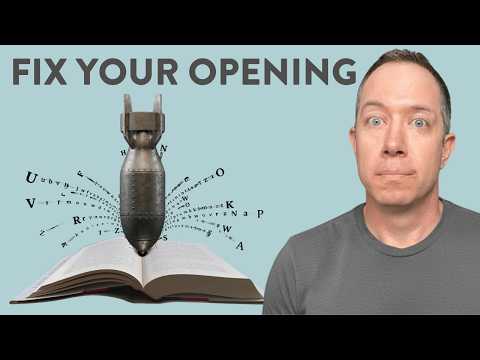
Unless you want your book to bomb, do THIS in the first 20 pages
Bookfox
14m 2s2,906 words~15 min read
YouTube auto captions
Transcript source
YouTube auto captions
This transcript was extracted from YouTube's auto-generated caption track. The transcript below is server-rendered so it can be read, searched, cited, and shared without opening the original YouTube player.
Pull quotes
[0:00]Unless you want your readers to abandon your book before they get through chapter two, then you should definitely go through this eight-step checklist of what needs to happen in the first 20 pages of your book.
[0:00]Now, I often hedge in my videos and say, you know, six out of the 10 of these should apply to you.
[0:00]This is one of those rare videos where I think all eight of these steps apply to say 99.5% of novels.
[0:00]So you really need to look very closely at your book and see whether it hits all eight of these.
Use this transcript
Related transcript hubs
Watch on YouTube
Share
MORE TRANSCRIPTS


