[0:00]We were talking before we started recording about what's on your mind and what's been bothering you.
[0:06]And so the floor is yours. What is front of mind for you, Dr. David?
[0:09]What's front of mind for me is the the idea that each of us has a number of different health futures. So you have.
[0:19]So in your future, uh, I don't know, there could be cancer, there could, uh, be multiple sclerosis, or there could be many futures.
[0:27]What I'm interested in is how do I get you to pick a lifestyle that will get you the future you want.
[0:35]And I think that's very difficult in the world now to know what is the best lifestyle because you're given so much conflicting advice.
[0:43]And the particular focus for me in terms of picking health futures is around young people.
[0:50]Because they've got the longest time to make a difference, and it's getting harder and harder and harder to make good health choices in your lifestyle.
[1:03]It's really hard. I'd say it's a pandemic of poor metabolic health.
[1:09]Yesterday in clinic, I saw two people under the age of 25 who had poorly controlled diabetes.
[1:17]And one of them was too heavy for me actually to weigh.
[1:21]And this situation is completely new. So when I, when I was a young doctor, and just starting off in practice, that was in 1986.
[1:31]Wow. A long time ago, just north of Liverpool in the practice I'm still there now.
[1:37]Obesity was rare, and we didn't have a single case of type two diabetes in anybody under 55.
[1:47]Not a single case, it was quite unknown. And in fact, type two diabetes had a different name. We've had to change the name because of the epidemic.
[1:54]It used to be called maturity onset diabetes. That meant old people, right?
[1:59]Now we call it type two diabetes because we have to include so many young people.
[2:04]It's really, really serious because people are losing their life expectancy and I'm witnessing this.
[2:14]We're all sleepwalking into a metabolic disaster, and the people praying the greatest price in my opinion are young people, and it's a scandal, and I'm hopping mad really.
[2:26]I think we've started to normalize the dad bod.
[2:32]You know, the big tummy and haha without realizing that maybe that isn't how you're supposed to be.
[2:38]So that, that's what's on my mind. Young people and their future, and they don't even know.
[2:44]You say young people there, because they've got the biggest opportunity to change the trajectory of their health future.
[2:51]Yes, but for the audiences listening that might be in their 50s now, is this advice also applicable?
[2:56]Absolutely. So we know from government figures, UK government figures, that for every year that you have poorly controlled type two diabetes, you're losing 100 days of life.
[3:10]That's about a third of a year, isn't it?
[3:13]So, whatever age you are, if you, uh, have poorly controlled diabetes, you're losing life expectancy, and and maybe a third of all the people in the world with type two diabetes don't even know they have it.
[3:26]Because they haven't take a test, so they don't know.
[3:29]What do you think kills people with type two diabetes?
[3:33]Um, is it some cardiovascular issue?
[3:37]Yeah, well done. Well done. You've not been to medical school, what are you doing on that? That most doctors, that's what they'd say, because we know that a high blood sugar over time damages your arteries.
[3:53]So it's an accumulative thing over time, but what you may not know is that actually a rising cause of mortality for people with diabetes is cancer.
[4:05]Oh, really? Yeah. So eight forms of cancer are strongly associated with diabetes.
[4:12]I want to just define that term diabetes, because I think I went through a lot of my life assuming that diabetes was a disease that some people are born with, and because I didn't have it, I thought I don't need to worry about that.
[4:22]Well, that's really important. Yeah.
[4:25]So, first of all, there's type one diabetes and type two, but before I can explain about diabetes, I need to explain about insulin.
[4:36]This is absolutely key to our whole discussion.
[4:40]So, I've already said that a high blood sugar damages your arteries, and in fact, there's work to show that a very high blood sugar damages the non-stick lining of your arteries within six hours.
[4:53]Oh, wow. Really quick, it's called a glycocalyx, the non-stick lining, and, uh, damages occurring very quickly.
[5:00]So I'm going to ask you a really stupid question. When you say high blood sugar, I get high blood sugar when I eat lots of sugar.
[5:08]Okay. So first of all, we're actually talking about glucose.
[5:11]Yeah. And sugar can mean table sugar, or it could mean many different things, but we're actually talking about blood glucose.
[5:19]Which comes from lots of foods. Which comes from many foods. Carbohydrate heavy foods. Yes, yes, it does, it does. So that, that's right, but you have the hormone insulin to defend you from poor dietary choices.
[5:35]So the question is, what does insulin do with the sugar you just ate? And here's the answer.
[5:41]Insulin, the hormone insulin produced by your pancreas gland, it pushes the sugar, and it pushes it out of the bloodstream inside cells where it can be used for energy for you to run around.
[5:58]But what if you take in, uh, more carbohydrate than you need to run around?
[6:04]Well, then that sugar is turned to fat inside cells because it's safer for you to turn that sugar into fat than it is is to have it damaging your arteries.
[6:18]So I am somebody with type two diabetes, so we can talk about me.
[6:23]So I had a really heavy biscuit habit.
[6:27]I was senior partner of the practice and it's stressful and I had patients used to bring me biscuits all the time as a gift because they, you know, they want the doctor to be happy.
[6:36]So in the drawer, in the top of my desk, was packets and packets of biscuits.
[6:42]So I'm taking in more sugar and I didn't run around, and gradually my waist got bigger.
[6:55]And what was actually happening was, as I took in more sugar than I needed to run around, my insulin was working to get rid of that sugar, and it was giving me two things.
[7:04]One, a belly. So my, you know, and I thought it's just middle-aged spread, you know, and the other was I didn't know, but my liver was filling with fat.
[7:15]And that's, um, that is very common now.
[7:20]So we have, well, it's a third of everybody in the developed world has fatty liver now.
[7:26]Here we've got the wonderful props. Let's talk about these.
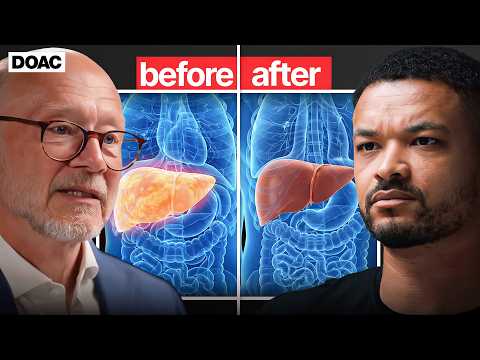
[7:29]Great. So fatty liver, this is the healthy liver here. And you see the color. Look at this one.
[7:38]It's yellow, it's the wrong color, and it's because of fat.
[7:44]So in that case, like has happened to me, over years, my liver began to fill with fat.
[7:53]Because it was essentially overworked and the glucose was being stored there.
[7:56]Yes. So I was taking in too much glucose. Insulin was doing its good job of taking it out of my bloodstream and forcing it inside cells in my belly, but unfortunately in my liver.
[8:10]Okay. And so there's a progressive laying down of fat in the liver.
[8:16]So if we look at actually some proper liver. So this is the, put on your seatbelts now, because this is somebody's, uh, somebody's actual liver.
[8:20]Oh, gosh.
[8:24]So then, that's the normal liver. But look at this, it's larger.
[8:28]That's a real human liver? Yes, these are human livers and that's as it should be, but this look at this liver, it's larger and it's larger because of so much fat in it.
[8:37]Now, the twist in the story is fatty liver interferes with the good work of insulin.
[8:46]So you develop a thing called insulin resistance, which means your insulin is no longer as powerful as it was.
[8:52]It's beginning to become difficult for you to deal with carbohydrate and sugar, because your insulin isn't working as well.
[9:00]And the only way to deal with that is the next twist in the story.
[9:06]You have to start producing more insulin.
[9:10]Do you see, because it doesn't work as well. So your pancreas has to crank up the supply. We need more insulin.
[9:19]So now you have two things. You have insulin resistance, your insulin isn't working as well, but at the same time, you're trying to produce more insulin in the pancreas.
[9:32]This bit's called the long silent scream from the liver, this is work by Professor Roy Taylor, a friend of mine at Newcastle University.
[9:41]And he pointed out that you've, you've got fatty liver for about 10 years, you don't even know.
[9:47]You wouldn't know that your liver's gone fatty and yellow like that, but unfortunately, this is another twist.
[9:54]Fat is being laid down in the pancreas gland, the very gland that your life depends upon producing insulin, and your ability to produce enough insulin collapses.
[10:08]And at that point, you can't regulate blood sugar anymore.
[10:11]But upstream of that, you have a problem. You've got that, but you don't even know.
[10:17]You're talking about what's in my mind. Why are we waiting until you actually have all the problems of type two diabetes?
[10:26]So since 2013, I've got hundreds of patients and I'm monitoring the baseline and latest follow-up. So what happens to them?
[10:35]It's really important, and now I have a huge data set that I can interrogate and and answer questions.
[10:43]So, number one question, let's think about prediabetes. So this is in the long silent scream.
[10:50]Well, I can tell you that the people with prediabetes in my practice north of Liverpool, 93% of them will get a completely normal blood sugar if they go low carb.
[11:04]93% resolution, and that will last for years, because I've checked. Okay.
[11:11]How about we wait for the 10 years and Stephen, until Stephen you've got type two diabetes and then you go low carb?
[11:20]At that point, if I can get you early, I've got a 73% chance of you having a normal blood sugar.
[11:27]Let's wait another few years because you don't want to give up bread and you don't want to give up chips and pizza.
[11:32]Fair enough. I'll wait. But, you know, if we wait five years, you only stand a 50% chance.
[11:40]So do you see it goes 93 over 70%, 50%. So the chances of me not needing drugs and be able to do a good job for you are diminishing.
[11:53]So really, it's a stitch in time, and so much of this you don't even know.
[11:58]You don't even know it's going on. One of the things that shocks me is, um, is how little we know about what's in our food.
[12:03]Yes. You know, because I think we all know that like biscuits are a food that has a high glycemic index.
[12:09]Well done. Which is a term that I've learned from this podcast, which means, yeah.
[12:13]Some carbohydrates are more sugary than others.
[12:17]And then, so that's the glycemic index. What that is doing, it's comparing different carbohydrates with pure glucose.
[12:25]Oh, okay. So you see pure glucose is 100, and then other sugars come further down, but there is there's something better than the glycemic index, and that's called the glycemic load.
[12:40]The glycemic load takes portions of food and predicts how will that portion of food actually affect your blood sugar.
[12:52]And am I right in thinking the glycemic load would factor in the amount of nutrients in the food? Exactly. So like protein, fiber.
[12:59]Yeah. Because if you took watermelon, well, it's mainly water, isn't it?
[13:04]So you have to factor in you can have quite a lot of watermelon, uh, to equal a chocolate bar.
[13:11]So the density, you're all, you're looking at the density of sugar in it as well. Okay.
[13:15]So that's why the glycemic load is better.
[13:19]Was there, was there a moment in your career where you started to question what you had been told?
[13:26]Yeah. You know, so you start as a young doctor. I wanted to be part of a small community and stay there and make a difference.
[13:35]And then comes the sad bit really. So I for the first 25 years, I was trying to do what's in the guidelines.
[13:43]I was trying to be a good doctor, but what I noticed, I noticed two things.
[13:50]Number one, I noticed what I've already said to you, that the health of the population I cared for was deteriorating. It wasn't getting better.
[14:00]So if I'm the doctor in charge of the practice looking after these people, and health is deteriorating, am I not responsible?
[14:10]And where's, where is all this difference I was hoping to make?
[14:15]It just wasn't panning out. At the same time, I'd always in my heart felt that prescribing lots of drugs felt a bit wrong.
[14:25]It felt like a mini failure because how is somebody well if they're taking six tablets a day?
[14:32]Was there one particular patient that you met? There were two. Two things happened. Both to do with very powerful women.
[14:41]The first powerful woman was a lady I'd known for over 10 years. She and her husband had cared for them both.
[14:47]They both had poorly controlled diabetes and they were both very heavy.
[14:53]At the time, I could monitor how my how compliant my patients were with their medication, and if I'm to be truthful, in part, that was how I was paid.
[15:15]Part of your payment?
[15:19]Yeah, yeah. Well because there's a, you're supposed to, the government approve of the fact that we give drugs that are needed for type two diabetes.
[15:27]So that you're given a sort of quota where it's ex it's regarded as good practice that such a certain percentage of your patients will be on Metformin.
[15:35]What?
[15:43]Yes, that would be true. But I think we should also be fair to say that the body of evidence at the time would say, uh, that it's good practice to give Metformin to people with type two diabetes.
[15:57]And conversely, poor practice not to use Metformin, but we'll develop that.
[16:03]So the, the backdrop is, we're we're monitoring the patients who stopped taking their Metformin, because that, uh, is number one poor practice, and number two actually cost me.
[16:14]So I wrote to the person. Dear Mrs. So and so, I'm concerned that you're not, you don't seem to be taking your Metformin.
[16:21]Please make an appointment with me at your earliest convenience.
[16:26]Very British, very polite. Anyway, nothing prepared me for what was going to happen that morning, and it's changed my entire life on that point.
[16:38]So, the lady, we let's call her Mrs. Jones.
[16:42]That wasn't her name. She marches in, and, uh, she said to me, you think you're going to tell me off, don't you, Dr. Unwin?
[16:50]Well, I've got news for you. I'm going to tell you off. I was scared like, what's going on?
[16:55]She's never been like this before. She's a polite person.
[17:01]Anyway, she went on to explain. She said, when you do my blood tests, you will find that my blood glucose is completely normal despite not taking your Metformin.
[17:44]And she went she made it worse. She said, this is schoolboy biology.
[17:50]You should have learned that when you were 16. I was dead scared because, you know, complaints as a GP is really bad.
[17:58]They go on for years and years, but mainly I was scared because every word she said was true.
[18:05]And one thing I had learned about when you're an older doctor is you've got to listen to people properly.
[18:11]If they're complaining, don't deny it. Don't defend yourself. Take it.
[18:18]So I said, okay, I've got I want to learn what you've, you know, if this is true, will you meet me again?
[18:25]Let's do the blood tests. So we did the blood test. It was true. It was the first case of drug-free type two diabetes I'd ever seen.
[18:34]I'd never seen a single case in 25 years where people came off medication. I was fascinated, because she'd done it, like a miracle.
[18:45]But there was another detail I just share with you.
[18:48]She was one of 40,000 people online, learning from each other, how to do it.
[18:57]And when I looked, they were being rubbished by the healthcare professionals.
[19:03]So people like me were telling them, you'll die. What you're doing is dangerous.
[19:10]And I was ashamed, really ashamed, and it's complete coincidence, but in the same month, we have to introduce my wife, Jen.
[19:23]Is there a photo? Come on, let's see Jen. This is Jen. Oh, she's probably the cleverest woman in the world.
[19:30]She's so clever. I love that woman. So Jen, uh, so her back she is a, um, a clinical health psychologist and she specializes, she's fascinated by the role of hope in disease, and the difference it can make.
[19:47]She spent her life researching the difference that hope makes to clinical outcome.
[19:52]So it just so happened that she was in a supermarket, and she saw some a discounted diet book.
[20:00]That one that's the book. Escape the diet trap by Dr. John Briffa.
[20:05]Yeah, Dr. John Briffa. What a lovely guy. So Jen bought that book just around the time I'm telling her about this patient.
[20:14]So she said, you have to read this book about the low, a low carbohydrate approach to, um, insulin resistance, to type two diabetes.
[20:26]And in the book, everything that my patient had told me was there, and but it was done in a medical way, and I understood.
[20:37]She said, David, why, why are you sort of failing? Why don't you do one thing before you're retired?
[20:47]Why can't you do a cheerful something you really believe in?
[20:52]Why don't you have a go at this low carb? Yourself. Yeah. She said, why don't you and me go on this diet, see if some patients would volunteer and do it with us.
[21:05]And I mentioned it to the partners, and they said no.
[21:10]These are other doctors. Yeah, so I'm senior partner. I'm supposedly the boss, uh, but the time low carb was not respectable, and they didn't like it.
[21:20]And they said, we don't want you to do this, and partly because they said, well, how, you know, is that a good use of the resources of the practice?
[21:34]Because if you're doing this, David, maybe you're not treating chest infections or other things, and there's pressure on the health service. So this felt a bit, they felt it was a bit self-indulgent.
[21:42]So go back to my wife and said, the partners say no. And she said, I I'll tell you what we're going to do.
[21:50]We're both going to work for free and we'll do it. Why don't we do this in our own time, in on in an evening when the practice is no resources?
[22:02]So that's exactly what we did. We found 18 volunteers who were interested amongst the patients, and then Jen and I, so that was 20 of us.
[22:12]We started meeting every Monday night, talking about low carb, learning, how'd you cook stuff? How'd you do it?
[22:20]We did it together. And one of the nurses was so excited. Heather is her name. Let's give her, you know, thumbs up to Heather.
[22:30]Heather said, I'll work for free. I'll help you. I'd love to do this. I want to, I want to believe in what I do.
[22:40]And then the magic begins. The results, I couldn't believe it. I could not, you know, I'd never seen anything like it.
[22:47]And the first thing, the first thing I saw was the liver function improving.
[22:53]You see, because I'm doing blood tests because I know I'm doing something weird.
[22:58]I'm doing something that I would be criticized for.
[23:03]So if you're going to do a weird thing, you need to measure stuff. You can't, you know, these are patients, so you can't just experiment and not be am I doing harm?
[23:12]If you love the Dr. CEO brand and you watch this channel, please do me a huge favor, become part of the 15% of the viewers on this channel that have hit the subscribe button.
[23:21]It helps us tremendously and the bigger the channel gets, the bigger the guests.


