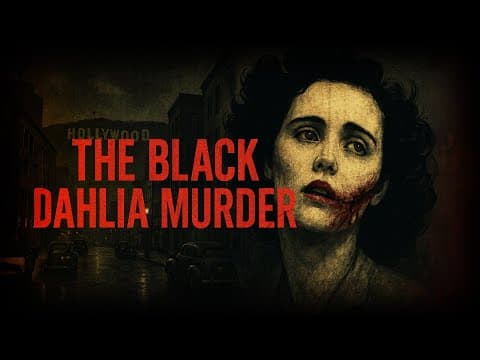
[0:07]She was found in a vacant lot, sliced clean in half, drained of blood and arranged like a broken porcelain doll. Her face carved into a sadistic smile. There was no blood at the scene, only silence and questions. She was rumored to be an aspiring actress drawn to the promise of Hollywood. What she found instead was a nightmare that would echo through history. It was 1947. There was no DNA testing, no surveillance cameras, no digital trail to follow, just fingerprints, shoe leather and intuition. And in this case, none of it was enough. The investigation would become one of the most infamous in American history. Dozens of suspects, hundreds of confessions, and still no one brought to justice. So who was the Black Dahlia? What really happened in the days leading up to her murder? And why after all these years does her case continue to haunt Los Angeles like a ghost that refuses to rest. Hello, I'm Colin Heaton, former history professor, Army Marine Corps veteran, and welcome to this episode of Forgotten History.
[1:37]The Black Dahlia murder refers to the 1947 killing of 22-year-old Elizabeth Short in Los Angeles. A case that remains one of the most infamous unsolved crimes in American history. Elizabeth Short was an aspiring actress who had moved to California seeking opportunities in Hollywood. She was born on July 29th, 1924, in Boston, Massachusetts. Later dubbed the Black Dahlia by the press for her rumored penchant for sheer black clothes, and for the Blue Dahlia movie out at that time. She grew up in a suburb of Boston with her parents and four sisters. When she was six years old, the family was financially wiped out following the 1929 stock market crash. And her father mysteriously disappeared. His car was later found abandoned on the Charlestown Bridge where he was believed to have taken his own life. At age 16, Short suffered from respiratory condition and had surgery. Her doctor believed that a milder climate would help improve her health and recommended that she leave for a warmer climate. As a result, she spent the winters in Florida with family friends. Short dropped out of high school and continued to visit her friends in Florida where she stayed for a while. The family received a great shock when Short's mother received a letter from her father in 1942, apologizing for leaving the family. He told them that he had moved to Northern California and started a new life there. Elizabeth Short decided to go to California to join him after she turned 18, but their relationship fell apart and she moved out in early January 1943 and relocated to Santa Barbara, where she applied for a job as a checkout clerk at the Camp Cook commissary in California in January 1943. In July, she was arrested by the Santa Barbara Police for underage drinking and sent home to her mother in Boston, but she briefly returned to Florida for her health before she decided to return to LA, where the weather was less humid but still warm in the hope of becoming an actress. Before her death, Short lived in multiple locations throughout the city while working various jobs. The post-murder investigation produced several men who stated they enjoyed Short's company, taking her on as dates and offering her gifts. She always struggled financially, never having a steady job but somehow managed to pay her rent on time. No one really knew her, as she had no one she called a friend. Those who did know her to some degree did not know much about her life. Her roommates, the bartenders, and the hotel clerks all came up with the same story that she was secretive, never wanted to confide. She never said what she was really doing, or who she was really going out with, or where she was really going. In December 1946, she told friends that she was afraid to stay there but never explained why. She left LA for San Diego and met another young woman named Dorothy French, who allowed her to stay with her family. During this period, Short explained that she was hiding from an ex-boyfriend out of fear without any other explanation. French later stated to police that several weeks into Short's arrival, two men and a woman came to the home looking for her. Upon hearing about the visitors, Short became very frightened and panicky, refusing to see them. They eventually left, and then she decided to relocate once again. On January 8th, 1947, Short left San Diego, headed back to LA with a traveling salesman she had been seeing. She was dropped off at the Biltmore Hotel where she told the man she would be meeting her sister. Although later her sister Virginia told authorities they had not arranged to see each other and had not even spoken. According to the investigation, hotel employees stated that Short made several telephone calls in the lobby that very evening and appeared to be extremely panicked. Then she left the hotel around 10:00 PM, and that was when the last confirmed sighting of Elizabeth Short being seen alive by the hotel staff. Where she went and if she met anyone is still unknown, although police officer Merle McBride reported afterward that he had seen her on January 14th before she was killed. McBride related that the woman, whom he believed to be Short, approached her sobbing in terror and claimed that someone threatened to kill her. Short appeared too shaken up to return to a bar she had been in to retrieve her purse, so McBride accompanied her. By then, the man she feared was gone, and McBride then left Short alone. Later McBride said that he saw Short exiting the same bar with two men and a woman, and the officer checked in on her and she appeared to be fine at the time. Other people claimed to have seen her as well that night after the story broke, but nothing was confirmed. The next morning, January 15th, 1947, a mother taking her child for a walk came across the body of a young naked woman in a vacant lot in the Leimert Park neighborhood. Just a few feet from the sidewalk, the corpse was sliced clean in half at the waist. The internal organs were removed and posed in such a way that the mother reportedly thought it was a mannequin at first glance. Nearby was an empty bag of cement. The police responded to the gruesome scene. What they saw defined explanation. Being so disfigured, authorities knew that they would be unable to share photos of the body with the public. But despite the massive mutilation and cuts to the body, there wasn't a drop of blood at the scene, indicating that the young woman had been killed elsewhere and left at the present scene. Soon, the paparazzi arrived and had to be kept away from the crime scene. When the coroner later examined the body, he ruled that the cause of death was due to hemorrhaging from the lacerations to Short's face and the shock from the repeated strikes to her head. The severity and nature of the crime captured widespread media attention, and newspapers dubbed her The Black Dahlia in reference to the 1946 film noir The Blue Dahlia and her preference for black clothing. The ensuing investigation was led by the LA Police Department, but the FBI was asked to assist. Being fingerprinted and photographed in the past, the FBI quickly identified the body after just 56 minutes by getting blurred fingerprints via sound photo, a primitive teletype fax machine used by news services from Los Angeles. Short's prints appeared twice in the FBI's massive collection of more than 100 million on file at that time. From when she applied for the job on the Army base in California, and when she was arrested for underage drinking. They also had her mugshot from the LAPD and provided it to the press and also allowed an artist from the Los Angeles Examiner to sketch a recreation of the unidentified woman. The day after Short was found dead, and the story was printed, the Examiner sold the most copies it ever had since World War II ended. Although the LAPD had several leads into Short's death, including handwritten notes delivered from the supposed killer, no one was ever charged. In support of LA Police, the FBI ran record checks on potential suspects and conducted interviews across the nation. In the early days before forensic investigation, authorities had early suspicions that the murderer may have had skills in dissection such as a surgeon or a butcher because the body was so cleanly cut. FBI agents were also asked to check out a group of students at the University of Southern California Medical School.
[9:31]Some suspects seemed better than others, and one was nightclub owner Mark Hansen, no relation to detective Mark Hansen, who knew Short. The police and FBI thought that they had a potential break in the case. Fingerprints were found on one of the anonymous letters. So the FBI searched for a match to fingerprints, but the prints weren't in FBI files. Despite extensive investigations by the Los Angeles Police Department and assistance from the FBI, months passed and the investigation continued and the police continued to rule out suspects. Still, the media continued to extensively cover the murder with baseless claims just to sell newspapers. In 1949, a grand jury was convened to discuss the the inability of LAPD's homicide unit to solve many unsolved murders in the city. During which Short's death was further investigated. In front of the grand jury, Detective Harry Hansen, who was assigned to the case, said in a sworn testimony that he still believed a medical man was behind the crime because of how Short's body was severed. The case quickly became a cold case and it was officially closed in 1950. But occasionally cold case detectives would open the evidence folder and take a crack at it. But newspapers would go on to cover the case in a sensational manner for months following the investigation with various slants on the story and related items making front page news for 31 consecutive days on the cover of the Los Angeles Record. Over the many decades, dozens of individuals have been considered suspects, and for some insane reason, more than 500 people have confessed to the crime. Although none of these confessions have led to a conviction due to various conflicts with the evidence. One of the most discussed and viable suspects is Dr. George Hodel, a physician and gynecologist with his practice in Los Angeles at that time. His own son, Steve Hodel, himself a retired LAPD detective, spent years conducting extensive investigations into the cold case and believes his father was the murderer. Steve Hodel's reasoning was his father's medical knowledge, which would have been required for such a complicated procedure. Hodel firmly believed his father was responsible due to many other unsolved crimes that sort of fit the mold of the Black Dahlia murder, but not as gruesome. Dr. Hodel was known to throw lavish parties for Hollywood's rich and famous and was rumored to have dated Short before her death. Hodel was initially labeled a suspect in 1949 after he was arrested for allegedly sexually assaulting his teenage daughter. Although he was acquitted of that charge, he became a potential suspect in the Black Dahlia case and was listed as one of the few remaining primary suspects when the case was discussed before a grand jury later that year. During that time, authorities wiretapped Hodel's home and recorded him making jarring statements, appearing to even confess to the murder of his former secretary, Ruth Spaulding, whose death was officially ruled a drug overdose in 1945. As well as suspicious comments that Hodel made about Short's murder. In one chilling recording, Hodel said, "Supposing I did kill the Black Dahlia, they couldn't prove it now. They can't talk to my secretary anymore because she's dead." "I killed her? Maybe I did kill my secretary." Dr. Hodel being under intense public scrutiny eventually relocated to the Philippines, living there for the next four decades. Much of the information about his status as a suspect in that case was not publicly known until his son, Steve, a former LAPD detective himself, and later a private investigator, began looking into his father's involvement in the murder. When Dr. Hodel died in 1999, Steve found what he believed was a photo of Short in his father's belongings. While it has remained unconfirmed if the photo is actually Short, it began Steve's inquiry into her murder. In his years of research and investigation, Steve has come across other pieces of evidence tying his father to the murder including five witnesses in newspapers described him as Short's boyfriend. Steve Hodel also had a handwriting expert examine the old letters sent to the police and his father's handwriting, and discovered undeniable similarities between the letters and his father's writing. He also found receipts for bags of cement purchased by his father just days before Short's death, the same brand of cement as the empty bag of cement found near her corpse. Then, in 2018, Steve told the South Pasadena that he had uncovered a 70-year-old letter from a former police informant who had written that Short was killed by a man named GH. Although the LAPD looked into Steve's research, they never pursued his leads. He believes his father was friendly with certain officers and that they were protecting him during the investigation. Still, some officials believe that Steve may have cracked the case. It was enough circumstantial evidence in today's world to foul charges. I told Steve, if his father was still alive, I would have followed murder charges against him. Said LA Deputy District Attorney Steve Kay in a People interview. His evidence was very persuasive. However, despite his personal investigation, no definitive evidence has surfaced supporting the claims, and the LAPD has not pursued further action based on these claims. Despite the passage of time and various investigative efforts, the Black Dahlia murder remains an unsolved mystery and a cold case that detectives are still working on today, continuing to intrigue and haunt the public imagination. Through the years, people have continued to investigate this case, including Detective Hansen, who diligently searched for Short's killer for 23 years until his retirement. He then went into private investigation. As he stated, "My only regret is that I never solved the murder of Elizabeth Short," in his interview with United Press International. Thank you for watching this episode of Forgotten History. If you liked what you saw, please click like, share, and subscribe. And if you would like to assist with the ever-increasing cost of production, please consider becoming a channel member and joining our Patreon page.
[16:15]Please check out our merchandise store, and thanks for watching.


