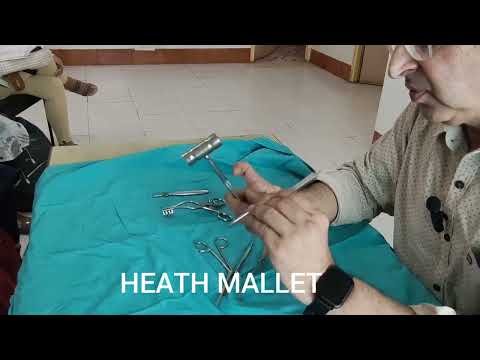
[0:01]Let's start the other session. Today we are going to talk mainly about the instruments that are used in nose and a few instruments that are important from exam point of view, that are commonly asked.
[0:18]Regarding the ear surgery once. Okay, so we'll first talk of the nose instrument. So this is the first instrument which is called as Killians long bladed self-retaining nasal speculum.
[0:34]This is again the same instrument. Killians long bladed nasal speculum. Name of the instrument. Then you are supposed to tell the function of the instrument.
[0:50]It is used for retracting the perichondrial and the periosteal flap in nasal surgeries.
[1:00]Like septoplasty, SMR operations. It is used for retracting the nasal cavity in surgeries like functional endoscopic sinus surgery.
[1:13]Okay, polyp surgeries. Alright, or any surgeries related to the nose and the, or the nasal cavity. Alright, so and the next point that you are supposed to tell is how it is held.
[1:30]So this is the way you are supposed to hold the instrument. If this is your nasal cavity, you are supposed to insert it in such a way that it retracts.
[1:43]And the long blade, this is for the adults. This is a smaller size, this is for the pediatric age group and it is got a screw which helps it to retain.
[1:57]So this screw will help in retaining it. So the full name of the instrument is Killians long bladed self-retaining nasal speculum used for nasal surgeries.
[2:12]I have already mentioned. Okay? So this is how it is held. It is not held like this. This is a wrong way. You are supposed to hold it like this in your left hand and you introduce it into the nose. Okay?
[2:30]So this is the first instrument, then another instrument which is very commonly asked is this Tilley's Nasal Packing Forceps.
[2:44]So it is a slender instrument, it's got an angulation for specially doing anterior nasal packing.
[2:53]When you in patients of epistaxis, or in patients who have been operated for a nose surgery like septoplasty, SMR or functional endoscopic sinus surgery, you put a hemostatic pack.
[3:07]So it is held for introducing the ribbon gauze or merocel pack inside the nose. Alright, other uses of this instrument is that if you have some thin foreign body like paper or some animate foreign body like caterpillar or something lodged inside the nose, you can use it to take it out.
[3:31]It can also be used in the oral cavity to express pass from the tonsillar crypt.
[3:41]It can also be used as a cotton applicator for applying any medicine inside the nose or in the oral cavity. Alright, or it can be used for in nasal surgeries, it can be used for removing broken pieces of cartilages or bones.
[4:02]For holding it. So it is a instrument that holds objects which are thin and it is to be held in this manner.
[4:12]You take your ring finger and you support it with your first and the second finger and the thumb is in the other loop and the angle is like this when you have to go inside the nasal cavity.
[4:26]Okay? So you cannot hold it in any other manner, reverse, you cannot.
[4:36]That is a separate issue that if you have to go in the oral cavity and you have to reach to the upper pole of the tonsil and open the upper crypt then you can go like this and then open it up and express out the pus from it. Alright, so this is Tilleys Nasal Packing Forceps. Okay?
[4:57]Another instrument which is commonly used in the nose which looks quite like a this is a forceps, which is called as Lucs Forceps or the Lux Forceps. This forceps is very commonly confused with the Dennis Brown tonsil holding forceps.
[5:17]So you must identify it that it has got a long hinge, slot is big. The ends of it is very small and sharp.
[5:29]Okay? Whereas in Dennis Brown as I showed you in the previous videos, it was large and there was a big hole inside it. That's why it was that was a bigger one.
[5:43]Okay? Tonsil is for a bigger opening. And this is Lux. So this is Lux Nasal Forceps. Okay? So this is for breaking chips of cartilages and bones in surgeries like septoplasty, SMR operation or even avulsing nasal polyps.
[6:10]When you have to avulse a nasal polyp, take out and pull out a nasal polyp or any necrotic tissue from the nasal cavity.
[6:18]Right, or hypertrophied mucosa in cases like Caldwell-Luc operation. Okay? Caldwell-Luc surgery where you are where you are removing diseased mucosa of the maxillary sinus, you remove it with this.
[6:36]Another, it can be used in place of the tonsil holding forceps in fibrotic tonsils which are very hard and very small to hold, which the tonsil holding forceps cannot hold.
[6:54]So in those cases of tonsillectomy you can use this, or even in pediatric cases where you don't have a small size Dennis Brown tonsil holding forceps, you can use this. Right, the Lux forceps. Are we clear?
[7:07]You must know the identification that it is got a long slot. Big slot in it and the ends are sharp and small. There is a small dot in it. That's about it. Okay? And it is sharp.
[7:27]Alright, are we clear? Then another common all detail of the instruments, the steps of the surgeries I have talked in my previous videos. So you please go through it, you will be able to understand it better. Okay?
[7:43]Another common instrument used is this Killians nasal gouge or gauge. Now this instrument is there to remove the deviated part of the nasal bone.
[8:00]This instrument is always used in conjunction with the mallet. So you have one hand is there to fix the anterior part of the deviated part of the septum.
[8:15]It locks on to the bony part. It's not used for the cartilaginous part. It's used for the bony septal deviations.
[8:23]Okay? So it will hook on to it with this slot and your assistant, you hold it and your assistant will in tapping movements, one two, one two, one two, break the deviated bone and then you rotate it to remove it and then you take it out with your Lux forceps, once it has been disarticulated, or with your Tilleys Nasal Forceps, if it is a small chip.
[9:00]If it is a larger chip, you can rotate it and take it out. Understood? So this is Killians Nasal Gouge or Nasal Gouge. And it is held in this manner.
[9:14]Again pointing downwards. All nasal instruments have an angulation to prevent for better visualization and to prevent the light from obstructing it. So their bend is always there in most of the instruments that are used in the nose.
[9:33]And they all have to be kept at an angle of 15 to 45 degrees, anything based on the angle that is required. Alright, and this this mallet is not held by the surgeon. It is held by your assistant and you ask the assistant to give firm gentle taps.
[10:00]Care is to be taken that this thing doesn't move anywhere else. Otherwise it will tear the flaps. So you have to keep the flaps well retracted with this. So your hand is one hand is engaged in retracting the flaps.
[10:24]The other hand is engaged in engaging the deviated part of the septal bone. So the other hand has to be used by the assistant. Okay? Then another instrument that is used for removing the cartilaginous part of the nasal septum is this Ballengers Swivel Knife.
[10:46]Again if you see, it is an angulated knife instrument which is got a 360 rotatable blade at its end.
[10:57]So you can see it rotates by 360 degrees. So simply, and it is more commonly used in taking out bigger pieces of cartilage.
[11:08]Where you are wanting it to harvest for doing rhinoplasty, or even in SMR operations where there is bigger, where there are larger septal deviations of the cartilage. So it needs to be removed in totality. So you just engage the blade like this on the deviated part of the cartilage and leaving approximately 1.5 cm of the dorsal part of the cartilage and 1.5 cm of the caudal part of the cartilage of the septal cartilage.
[11:44]That is the important area which has to be left to avoid the drooping or the sagging of the nose.
[11:53]It will cause a saddle deformity if you remove too much of the roof, or it will cause a retraction of the columella if you remove too much of the caudal part, or it may cause the drooping of the nasal tip.
[12:08]So these complications have to be avoided. So you have to remain in the central part of the nasal septum. So one flow, you go back, down, again back and up.
[12:21]So this is the movement if the examiner asks you how you are removing it. Understood? If this is your cartilage, it will go like this back, it will go down, then again you withdraw it and then you take it up.
[12:40]So it will create a 360 angulation and the blades keep rotating accordingly. And once that piece of cartilage is out, again, you can use this Tilleys or your Lux forceps to take it out. Okay? Gentle handling of the cartilage is very important to avoid its damage.
[13:01]Okay? If the perichondrium is damaged too much, then the cartilage will necrose. Especially if you are wanting it to use it as a harvest to do maybe, uh, some people use it in ear for doing ossiculoplasties, or it can be mainly used for doing rhinoplasty for putting spreader grafts.
[13:25]Okay? So these are the important uses of the cartilage which is harvested with this instrument called as Ballenger Swivel Knife. Alright, then another important instrument which is used initially is this Freers elevator.
[13:43]This is a double ended sharp elevator for elevating the perichondrium or the periosteum over the nasal septum, generally.
[13:56]Okay? So before you incise the cartilage or you remove the bone, you are supposed to elevate the flap of the perichondrial flap and the periosteal flap.
[14:09]So you, how it is used, you hold it in a pen holding manner with the convex surface towards the perichondrium or the periosteum and the sharp surface towards the cartilage and you give gentle pressures and you move it in an up and down manner.
[14:28]And you gradually sweeping manner, up and down, up and down and up and down, you elevate the flap. Forceful movements will cause tearing, so it should not be done.
[14:42]It is to be done in a pendulum sweeping manner, so that the uniformly the flap is elevated. Okay? And both sides are used for the same purpose.
[14:55]It is also used for elevating the periosteum in mastoidectomy surgeries. It is also used for elevating the temporalis fascia from the temporalis muscle in doing, when you are harvesting the graft in tympanoplasty surgery or mastoidectomy surgeries.
[15:17]Okay? It can also be used for elevating the periosteum while doing Caldwell-Luc operation.
[15:27]And you elevate the periosteum and from the gum margin of the maxilla. Okay? So this is Freers double ended elevator for elevating the perichondrium and the periosteum. Understood?
[15:43]Then you have got this long bladed turbinectomy scissors. So this is a sharp instrument. Again, since it has got an angulation and it is slender, it is used inside the nose for cutting the inferior turbinate partially or maybe the middle turbinate partially.
[16:05]Right? So in nasal surgeries where we require to reduce the size of hypertrophied inferior turbinate or have to open up the concha bullosa of the middle turbinate, there you use this instrument called as turbinectomy scissors.
[16:23]It can also be used for cutting or making small cuts on the cartilage in septoplasty surgery. So soft instruments or if you need to refashion your perichondrial flap you can give small incisions to straighten it.
[16:43]If it is angulated and has got a memory. So you can just snip it and then you align it. Right? It can be used for cutting soft tissues. It can be used for cutting small pieces of cartilage and it can be used for removing hypertrophied mucosal issues over the inferior turbinate or the middle turbinate.
[17:07]Okay? So this is the turbinectomy scissors commonly called. Then this winds up our instruments that are commonly asked in the exam for the nose surgery. And these two instruments are commonly used in ear surgery.
[17:23]The first one is this where you got these teeth and this ratchet system and the holder system to block it. This is called as Mollisons self-retaining mastoid wound retractor.
[17:39]Understand? You must be able to tell the complete name. Mollisons self-retaining mastoid wound retractor. It does not retract the bone.
[17:54]It retracts the soft tissue and the skin while doing mastoidectomy surgeries, tympanoplasty surgery, or myringoplasty surgery in postoral incision when you give.
[18:07]So you have to retract the skin, the subcutaneous tissue to expose the fascia or you have to expose the mastoid bone before you start drilling.
[18:20]So the retaining part and the teeth gives compression, so it causes hemostasis. It compresses the vessels. And once you retract it, the lock this is the locking system.
[18:35]So once it is locked, like this you retract it and it will lock. So it will retain, so it is self-retaining and you get a clear vision of your site to be operated. And the soft tissues are retracted in it.
[18:52]And compression of the soft tissue causes hemostasis. Understood? So this is Mollisons self-retaining mastoid wound retractor. You always introduce it in the area of the wound site.
[19:08]And you gently retract it as per your requirement to get a, to retract the tissues, to get the vision of the bone or the fascia which you want to harvest. Understand? Are we clear in it?
[19:24]Then and if you want to release it, you just pull this thing back and it will be released and you can withdraw it. So this is the way it is used. You use your thumb and your ring finger and with this you with your middle finger, you press on it and you retract it and you leave it and you lock it.
[19:44]This instrument can also be used in head and neck surgeries when you are doing tracheostomy or larygo fissure operation where you want both your hands to be free.
[19:56]So when you just open it up in tracheostomy, then you can operate with both your hands because it has retracted the flap. Okay? So another use of it is in tracheostomy, larygo fissure. It can also be used in Caldwell-Luc to open up once you have given an incision in the sub-labial area.
[20:20]Open up and you expose the anterior canine fossa area of the mastoid antrum. Okay, the maxillary antrum, sorry. Not mastoid, maxillary antrum. So once it is exposed, then you can open it with the drill or the hammer and the gouge. Understood? So this is Mollisons self-retaining mastoid wound retractor.
[20:53]You always introduce it, it's used to elevate the periosteum. It's got a thumb rest and a sharp elevator. Okay? So this is where it is used to elevate the periosteum.
[21:05]This is the way it is supposed to be held on the periosteum elevation. For mastoidectomy surgeries or for Caldwell-Luc surgeries. So this is where it is used to elevate the periosteum. Even in hemi-mandibulectomies when you have to elevate wherever you have to elevate the periosteum, you will use this sharp instrument.
[21:31]Okay? And it has to be used at an angle of 15 to 25 degrees from the horizontal plane to elevate it.
[21:42]You cannot and you have to give gentle firm pressure to elevate it in proper. You cannot give like this, like this, like this, otherwise it will cause a shaky incision. So it has to be gently elevated in a uniform manner.
[22:01]Okay? So you go all the way up then you withdraw and you go all the way up and you withdraw. So this is called as Farabeufs periosteal elevator. Method of holding is in this manner you put the thumb rest here and you hold it like this at an angle. Alright, to elevate.
[22:23]Are we clear? So last before I conclude, very commonly asked instruments is this Mollisons self-retaining retractor. The Farabeufs, then this Killians gouge and then you've got this Nasal Retractor. Okay?
[22:48]So these are the common ones which are very commonly asked and of course this Lux forceps where you get confused with the Dennis Brown tonsil holding forceps. It will be invariably kept along with it and you have to differentiate the two instruments and then identify them well and hold them properly and tell the uses. Okay? So with this we conclude. Thank you very much.


