[0:00]皆さん、おはよう、こんにちは、こんばんは。 JBです。 なにです。 ようこそ。 I go podcast. I go podcast. Yeah. Wow, it is finally here. Okay, guys. I've been wanting to do this for a long time. A podcast episode where we just answer all kinds of questions, questions from the audience. And this time we'll be answering questions in regards to learning Japanese, isn't it? It's all about languages. Languages. Language podcast or AIgo podcast. So this is probably an unexpected collaboration. But the reason why I started this podcast essentially is to give everyone else more insight as to how we, because Nani also is a self-studied, self-taught Japanese speaker. Okay, so we'd give more insight into the methods that we use to learn, how effectively we're able to learn. What do you think? Yeah, just give different point of views. So JB probably studied a bit differently than me, and there's other people out there that have their own style of studying. Yeah. Well, we just want to give some insight, right? On how you could go about it. And even more so is that Nani has a YouTube channel. She actually teaches it, so she probably teaches the material that she wished she could have had when she was studying the first time with Japanese. And then therefore she created this Kuwagi channel. I mean, look at the mascot. I think Is that a mascot? No, it's a plushy. A little mascot plushie. There we go. Very cute, very cute. Yes. ありがとうこざいます。はい。 So should we start? では始めましょうか。 始めましょう。Let's go. 最初の質問は 何ですか? どうやって日本語、言語を勉強していますか? どうやってかな。これは困りますよね。難しい。 そうです。以上です。 Yeah, I think when learning any language it's quite a challenge, especially when maybe you don't speak any other language at all and it's literally a blank canvas, so you have to fill in all the gaps. But what's the most effective way that I've noticed is immersion. 効率的ですね。 うん。効率的な方法ですね。Immersion. What is immersion? Immersion essentially is to immerse yourself. So everything around you just becomes Japanese, basically. So maybe you change the language on your phone, you watch drama, you listen to music, you listen to podcasts, movies, anime, in the case of Japanese. There's a lot of material there for you to watch with anime. News even. When you're driving, when you're sleeping, when you're... No. Any chance that you get, just have Japanese playing in your ear. Because your brain, funnily enough, is able to absorb language way better than you give it credit for, so you can have it while you're doing your chores. Just listening to a Japanese podcast and driving to work, and then that's literally it. It's like in the background. Exactly. Exactly. And another thing that you may notice is that when you listen to a new language at first, they sound very fast when they're speaking, right? But if you listen to the material long enough, your brain starts to be able to sort of differentiate the words that, 'Oh, this is a word, this is a word,' and it sort of makes more sense the more you listen to it. So it's definitely worthwhile doing immersion. Yeah, and I think if you combine immersion with studying vocabulary on Anki or any spaced repetition app. You'll be able to recognize the vocabulary that you learned. Yeah. When you listen to... So when you immerse yourself, you listen to the radio or YouTube, you're like, 'Wait a second, I've learned this word before. I've heard it, or I've seen it before.' Yeah, I've had that experience quite often, right? You just just some random word that you just hear, and then you hear it somewhere else, like, 'Wait, I know how to use this word,' but I don't know really what I'm saying. It feels, it feels right. Right? And that's also so important about immersion. Right. Like you know how it feels like the context of the word, you know, in which it can be used. It feels right, like you said. Exactly. So this immersion method is a sort of a popularized technique known as AJT. So basically, All Japanese All The Time, where you have yourself surrounded completely by Japanese, everything Japanese to learn the language and it's for you to sort of simulate yourself being in the country in which the language you're trying to learn is spoken. So in this occasion, Japanese. That being said, all this is great in having input, but what's also important is output, so to speak the language that you're actually practicing. Okay? To speak, right? Yes. It's important, isn't it? Very important. Right. So immediately, as soon as you possibly can, speak the language. Even if you make mistakes. 間違っても。It's okay. It really is okay. Because you're studying it. うん。でも、今も間違ってるんですね。 私も。That's true. It's normal. 普通ですよ。普通ですよ。Yeah, native speakers. Exactly. That's why there's nothing to worry about. I'm a native English speaker and I make mistakes. It's normal. You're going to make mistakes. So there's no need to be so strict. 厳しい。Yes. Just relax, take it easy and just speak. And people will appreciate that you're actually trying to learn the language and speak their language. So whilst you're having a lot of input and you have a little bit of a grasp on the language, output straight away, speak. Speak to people. Just have a conversation. And if you're not able to find somebody that's a native in your area or not, you can find people online. If not, find people that are also learning the language with you. You could sort of grow together. You can watch materials, anything to sort of encourage you to speak. Yeah, you study together. Yeah, just straight away, as soon as you possibly can, speak the language. And if you don't have anyone to talk to, let's say you're very shy, you don't want to go on those language exchange apps and stuff like that. You can also try speaking to yourself. No matter how crazy that sounds, right? But I used to do that a lot. Wherever I'm at, and I think something in English or my native language. I'm like, 'Oh, what would that be in Japanese?' For example, you look at an object, at an object, and you're like, 'Oh, what is this in Japanese?' Right. Do I know it or not? And if you don't know it, you can, if you have time, you can look it up or write it down, and then you add another word to your vocabulary. Exactly. You just little by little. Yeah, common expressions as well. You can say them as well. You try saying them in Japanese. Yes. For example, eh? Oh my God. So these are very, very good ways to get yourself encouraged to do more output. You start feeling more confident and you just keep trying. Yes. And when you're doing it, you'll notice that you're improving, so you feel kind of this rush of dopamine, I guess, right? Right. Do you have any idea how good it feels when you just say a sentence, you get off that sentence, and then they respond to you, and you actually understand the words that were coming out of their mouth. I'm like, oh, I was able to make a sentence. So you feel like the hard work you put into the language, it pays off at the end, right? Yes. That's true. So that's why, but you got to do it consistently. Yeah. So all this that we're talking about, output, input, consistently do it every day. It's necessary to study every day for the best results. So you can also do it every second day or two times a week, three times a week. But personally speaking, the best result, every day, a little bit. It can even be like 10 minutes, but if you don't use the language, you'll forget it. So just study a little bit please. Awesome guys. So that's the first episode. Basically what we did, it's nothing crazy. It's um, I think just remember that in order to actually improve at it, you need to be consistent with it. Even when you're sad or when you're mad, do it anyway, okay? So just keep doing it every day, even if it's 10 minutes like Nani said, 10 minutes, 20 minutes, 30 minutes, whatever time you can, as long as you do it regularly. Input, output. You will, you will improve 100%. If you have any more questions, because I'm sure we forgot something. Yeah, then do let us know in the comments below, any questions that you have, anything related to language learning. Keep it respectful, guys. Any language learning related questions, let us know and we'll do our best to answer it in the next video. Thank you for watching. あ、そうだよ。見てくれてありがとう。ありがとう。またね。バイバイ。
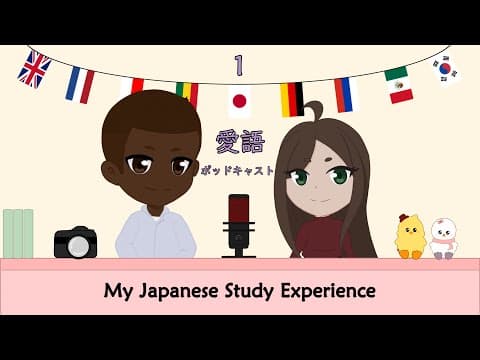
How I Self-studied Japanese In 1 Year! | AiGo Podcast Ep.1
Justafiable
9m 24s1,464 words~8 min read
YouTube auto captions
Transcript source
YouTube auto captions
This transcript was extracted from YouTube's auto-generated caption track. The transcript below is server-rendered so it can be read, searched, cited, and shared without opening the original YouTube player.
Pull quotes
[0:00]A podcast episode where we just answer all kinds of questions, questions from the audience.
[0:00]And this time we'll be answering questions in regards to learning Japanese, isn't it?
[0:00]But the reason why I started this podcast essentially is to give everyone else more insight as to how we, because Nani also is a self-studied, self-taught Japanese speaker.
[0:00]Okay, so we'd give more insight into the methods that we use to learn, how effectively we're able to learn.
Use this transcript
Related transcript hubs
Watch on YouTube
Share
MORE TRANSCRIPTS


