[0:15]This is the story of a mother called Mrs X. Mrs X could have come from anywhere. But she is most likely to have come from a low-income family in a poor country. Mrs X represents a universal mother.
[0:37]Mrs X died in a small hospital eight months pregnant. The doctor had no doubt about the cause of her death, a hemorrhage. Her placenta had been too low down in her uterus and hadn't been identified in time. The doctor recorded her death, closed her file and added it to a growing stack of similar cases locked away in a cupboard. Over time, these stacks grew and grew. Some years later, worried about the high numbers of mothers dying in their hospital, the staff reviewed the cases to learn lessons and make improvements. They reopened and reviewed file after file. One of these was that of Mrs X. When they read it, they found two striking points. First, Mrs X had arrived at the hospital bleeding heavily, yet she only received half a liter of blood. This was all the hospital had available, and it was not enough. Second, Mrs X and her baby needed a cesarean section. But resources were limited and the operation took place three hours too late. Both Mrs X and her unborn baby died.
[1:56]The group then visited Mrs X's village and spoke with her family, neighbors and community leaders. They found that there were other reasons for her death. Mrs X had a history of bleeding early in pregnancy, but wasn't aware that this was a danger sign needing attention. She also had had only one antenatal visit. If she'd gone regularly, her problem may have been picked up. She would have been referred to a specialist and she and her baby could have survived.
[2:30]Mrs X was also severely anemic, so the loss of even the smallest amount of blood, as little as a cupful, could have tipped the balance between life and death.
[2:42]The team discovered that it had taken six hours to collect enough money to pay for her transport to the hospital. As a result of these findings, the hospital improved their blood supplies, updated their emergency procedures and cesarean sections could now be performed as soon as was necessary. The local health department provided more midwives in more places to enable more women to have access to good maternity services throughout their pregnancy and birth. Mrs X's file was closed again.
[3:23]A year later, a group of visiting health professionals came to the hospital as part of a national inquiry into maternal deaths. They wanted to understand what lay behind the statistics, beyond the numbers, and discover the wider social and economic reasons for the deaths of women like Mrs X and their babies and what could be done about it. The aim of their work was to recommend changes to the national or regional policies and strategies to improve women's health and to save mothers' lives. When they reviewed all their data, common patterns emerged. They found most mothers' stories were similar to that of Mrs X. Like many women in developing countries, Mrs X worked day and night to care and provide for her family. She was illiterate. She lived in poverty in a remote village. She was unable to choose when and if to become pregnant. Mrs X was also weak and unhealthy. In her society, the male members of the family came first in the queue for food, for education, and for health care. Mrs X often went without. For women like her, death or complications in pregnancy were and still are a real threat.
[4:46]By uncovering the stories of women like Mrs X, the national team were able to put pressure on the government to provide more education for girls, more resources and staff for maternity care, and better reproductive health services. They also pushed for raising community awareness about health, nutrition, family planning, and the benefits of skilled maternity care.
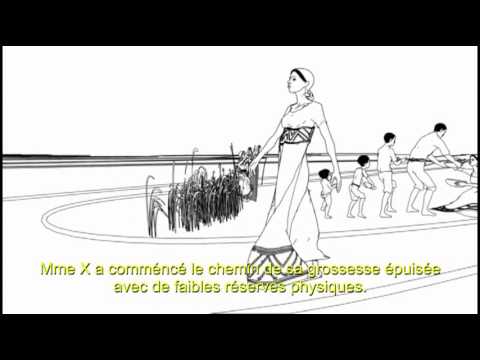
[5:11]Mrs X started on the pathway of her pregnancy exhausted with few physical reserves. She hadn't chosen to become pregnant, it was her destiny. The only value she had to her family and community was her ability to produce children. However, Mrs X had been lucky in a way. At least she'd had a childhood. In some societies, girls are married off while still children themselves, not physically or mentally prepared for childbirth or motherhood.
[5:55]If Mrs X had been treated as an equal to her brothers while she was growing up, she could have been healthier and better educated. If she'd had more control over her adult life, she may have been able to choose when she had children. As Mrs X continued her walk through pregnancy, her prospects would have been better if she had visited a skilled professional health worker, a midwife or doctor. Even if Mrs X had known the importance of antenatal care, her midwife was many miles walk away. If only Mrs X's problems had been recognized and her anemia treated. If only she'd had specialist care in time.
[7:06]Mrs X had also planned to give birth at home, but then she developed a life-threatening complication. She started to bleed.
[7:27]If Mrs X had been referred and had transport in time to go to a hospital with facilities for providing comprehensive emergency obstetric care, such as equipment, well-trained staff, and enough medicines and blood, her life and that of her baby might have been saved. Mrs X could have lived to raise her children. After the long delay in finding transport, Mrs X was eventually admitted to the hospital, where due to the lack of resources, she and her baby died.
[8:08]Along the pathway of her pregnancy, Mrs X faced barriers that prevented her from receiving the care she needed. Each could have been removed. And yet, many or all of these barriers remain along the roads taken by women today.
[8:36]Mrs X could be any woman, your sister, your wife, your mother, your daughter, you. It is up to all of us, no matter where we live, who we are or what we do, to help remove these barriers for Mrs X and for the millions of pregnant women like her. As individuals, we can lobby for better health care and equal rights for girls and women. As communities, we can make sure our pregnant women are informed and cared for. We can organize local education, support and transport for our mothers. As health care workers, we can provide quality care in a respectful environment, and we can continue to open the files and learn the lessons from mothers like Mrs X. As local health planners, we can provide high quality maternity and family planning services that reach out to more women. And as politicians and policy makers, we can strengthen human rights. We can improve education for girls and women, and we can provide the resources for better, more effective health care services across the world, wherever they're needed. Now.


