[0:00]In 2009, deep in the sweltering Cerrejón Coal Mine of Colombia, a team of paleontologist sifted through layers of ancient rock. They were pulling out the compressed remains of a rainforest that existed about 60 million years ago, right after the dinosaurs blinked out. But what they pulled from the Earth stopped them cold, a vertebra, massive, thicker than a human wrist. At first, paleontologists did what any reasonable scientist would do when they see huge broken bones in tropical Paleocene rock, they assumed they were crocodiles. Crocodilians were the giants of those ancient swamps, and the idea of a reptile the size of a bus already felt like pushing credibility as far as it could go. But something was off. The bones were the wrong shape. The curves didn't match the typical crocodile vertebrae catalog researchers knew so well. Then came the shock. These weren't crocodile vertebrae. They were snake vertebrae. And not just any snake, this was Titanoboa. See, Cerrejón isn't just any fossil site, it's a time capsule, a complete Paleocene rainforest sealed by a sudden burial of mud and ash. Leaves, fish, turtles, entire snapshots of an ancient world preserved in stunning detail. And in that muck, the biggest snake remains anyone had ever seen. As the team recovered more vertebrae, dozens of them, along with ribs and associated fauna, one thing became undeniable. This wasn't a fluke or an exaggeration. The fossils were consistent, enormous, and unlike anything in the record. What emerged was a portrait of an animal so large that it instantly reset the upper bound of what a snake could be. News hit like a Thunderclap. When the research team first measured the vertebrae, they ran the numbers again and again, convinced the calculations had to be wrong. But they weren't. The measurements pointed to a snake more than 15 meters long. Researchers were stunned. If those numbers were real, Titanoboa wasn't just a big snake, it was the largest land predator on Earth after the dinosaurs. Its size implied Paleocene ecosystems far hotter, far denser, and far more competitive than scientists had imagined. A creature this massive could only exist in a world pushing biology to its limit. What kind of planet grew monsters like this? Titanoboa was absurdly large. The most conservative estimates put it at about 42 ft long, but some estimates go as high as over 50 ft. And it weighed somewhere between 2,000 and 2,500 pounds. For context, the largest anaconda ever reliably measured was about 28 ft long and weighed around 500 lb. So, Titanoboa was nearly twice as long and four to five times heavier. But here's what I find fascinating. How do scientists even figure out the size of an extinct animal from just a handful of vertebrae? Well, modern snakes follow pretty predictable scaling laws. The size of their vertebrae correlates directly with their total body length. So paleontologists can measure a Titanoboa vertebra, compare it to modern constrictors like boas and anacondas, and extrapolate backwards. But there's a deeper question here. Why was Titanoboa so much larger than any snake alive today? The answer hinges on temperature. See, snakes are ectotherm. They can't regulate their own body temperature. They rely entirely on their environment to stay warm. And that shapes almost everything about them, their metabolism, their growth, even the upper limit of their size. Think about it this way. The warmer the environment, the faster a snake's metabolism runs. Faster metabolism means faster growth, more efficient digestion, and the ability to sustain a much larger body. So when scientists uncovered Titanoboa, they weren't just looking at a giant predator. They were reading a climate record, a biological thermometer from 60 million years ago. And it pointed to a world far hotter than the one we live in now. To understand Titanoboa, you have to understand its world. Step back about 58 million years into the Paleocene Epoch, just a few million years after the dinosaurs vanished. Earth is recovering, ecosystems are rebuilding, and the tropics are turning into something almost unrecognizable to us. Global temperatures were far higher than today. In what is now Northern Colombia, estimates suggest average year-round temperatures of at least 32 degrees Celsius, with almost no seasonal relief. Imagine a rainforest that never cools down, not even at night. A world where the air itself feels like a constant sauna. No ice caps, no winters, just relentless, steaming heat stretching from pole to pole. Forests sweated, waterways steamed in the sun. And life grew large, because for cold-blooded animals, warmth removes the biggest constraint of all. But today's tropical forests, the Amazon, the Congo, Southeast Asia, are actually too cool for a snake like Titanoboa to exist. Modern anacondas and pythons press against the upper limits of what our current climate allows. To push beyond their size into Titanoboa territory requires a world turned up several degrees warmer, consistently for millions of years. Titanoboa couldn't hack it. Its massive body needed that hothouse blaze to kickstart metabolism, to pump blood through 50 feet of coils. The Cerrejón site reveals this world in detail. Layer after layer contains plant fossils. There are giant turtle shells, some the size of pool tables. Early crocodile relatives with blunt crushing teeth suggest a diet of hard-shelled prey. They were not sleek river racers, but heavy-jawed ambush predators. This was not a clear, fast-flowing river system. It was a humid swamp rainforest, murky, slow-moving water, tangled roots, and dense vegetation. Visibility would have been poor, sound muffled by constant rain and buzzing insects. In such an environment, size could be a massive advantage. A giant snake could lurk in the water, its bulk supported by buoyancy, its body hidden by tannin-stained currents. Heat and humidity would keep its muscles warm and ready, allowing it to move when it needed to, then sit, digesting enormous meals over weeks or months. Titanoboa, in this context, is not an accident. It is a direct, logical outcome of an extreme world. High temperatures, abundant prey, and a swampy labyrinth perfect for slow, patient ambush. So here's the question everyone wants to know. How did Titanoboa actually hunt? Well, forget everything you've seen in movies. Titanoboa wasn't some hyper-aggressive monster chasing down prey on land. This wasn't a land-racing python or a tree-dwelling boa. Titanoboa was simply too big for that. 40 plus feet of muscle doesn't glide quickly over forest floor. It sinks, drags, fights gravity with every inch. But in water, everything changes. In the Paleocene swamps, Titanoboa behaved less like a modern snake and more like a crocodile. Slow, silent, half submerged. It used the swamps murky water as camouflage, slipping between fallen logs and root systems with only the faintest disturbance on the surface. For an animal this size, invisibility wasn't a trick. It was a lifestyle. It didn't chase, it didn't sprint, it waited. Hours, maybe days, almost motionless, until something wandered close enough. And when it struck, the force was terrifying. Biomechanically models estimate that Titanoboa could exert well over 400 PSI of constriction pressure. More than enough to crush a crocodile's ribs in an instant. Modern boas and pythons rely on blood flow restriction to subdue prey, but at Titanoboa size, the distinction barely matters. The result was the same. Whatever it wrapped around wasn't getting out. Based on the ecosystem we know existed at Cerrejón, Titanoboa's diet likely included giant turtles. Slow-moving, abundant, and packed with calories, perfect prey for an ambush predator. Early crocodiles. Smaller than Titanoboa and not yet evolved into the apex predators they are today. Large fish. Common in the river systems, easy to catch in confined channels. Possibly early mammals. Though mammals were still relatively small in the Paleocene, any that ventured too close to the water's edge would have been fair game. Water wasn't just its hunting ground, it was its lifeline. The buoyancy of water supported its massive weight. Without it, Titanoboa would have struggled to move efficiently on land. Its internal organs would have been compressed by its own body mass, making breathing difficult, digestion slow, and movement exhausting. And perhaps most importantly, water helped regulate its body temperature. Snakes absorb heat from their surroundings, and in the sweltering Paleocene climate, water provided a way to stay cool when necessary, while still maintaining the high metabolic rate needed to sustain such a large body. So when you imagine Titanoboa, don't picture it slithering across land like a nightmare serpent. Picture it gliding silently through dark water, eyes just above the surface, waiting for the perfect moment to strike. So if Titanoboa was such a successful predator, perfectly adapted to its environment, why isn't it still around? Well, the answer is both simple and tragic. The world changed, and Titanoboa couldn't. After the Paleocene Epoch, Earth began to cool. Gradually at first, then more rapidly. Average global temperatures dropped by several degrees Celsius over the course of a few million years. And for an ectothermic giant like Titanoboa, that was a death sentence. Here's the thing about being cold-blooded. Your metabolism is directly tied to environmental temperature. When it gets colder, your metabolism slows down. Digestion takes longer. Movement becomes sluggish. Growth rates plummet. For a creature as large as Titanoboa, this was catastrophic. It needed an enormous amount of food just to maintain its body mass. But with a slower metabolism, it couldn't hunt as effectively. It couldn't digest prey fast enough, and it couldn't grow large enough to compete with other predators. Essentially, Titanoboa starved in slow motion. But it wasn't just the temperature. The entire ecosystem was shifting. Mammals, which had been relatively small and insignificant during the age of the dinosaurs, were beginning to diversify and grow larger. They were warm-blooded, which meant they could remain active even when temperatures dropped. And they were competing for the same resources that giant reptiles depended on. Meanwhile, the lush, swampy rainforests of the Paleocene were drying out. River systems became more seasonal. The dense, humid environment that Titanoboa thrived in was disappearing. And perhaps most importantly, other large reptiles were also dying out. The giant turtles, the massive crocodiles, the entire food web that supported Titanoboa was collapsing. And yes. Titanoboa died, not from predation, not from disease, not from competition. It died because the planet cooled by just a few degrees. That's all it took. A small shift in global climate and the largest snake that ever lived simply stopped existing. And that should make us think. Because climate doesn't just shape ecosystems, it defines the upper and lower limits of what life is even possible. Titanoboa was a creature that should never have existed. It was too big, too heavy, too dependent on a world that was always destined to change. But for a brief moment in Earth's history, all the conditions aligned perfectly. And for millions of years, the largest snake that ever lived ruled the swamps of ancient Colombia. And then, just as quickly as it appeared, it vanished, leaving behind only bones, and questions.
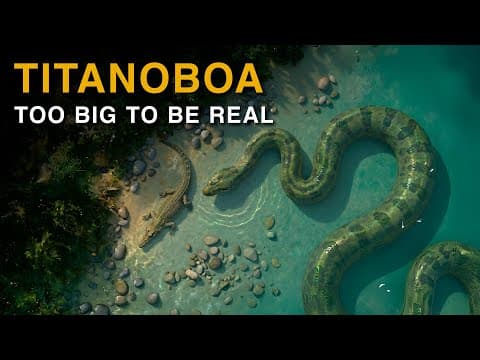
Nothing About Titanoboa Was Normal… Here's Why
Mr. Science
17m 6s1,849 words~10 min read
YouTube auto captions
Transcript source
YouTube auto captions
This transcript was extracted from YouTube's auto-generated caption track. The transcript below is server-rendered so it can be read, searched, cited, and shared without opening the original YouTube player.
Pull quotes
[0:00]In 2009, deep in the sweltering Cerrejón Coal Mine of Colombia, a team of paleontologist sifted through layers of ancient rock.
[0:00]They were pulling out the compressed remains of a rainforest that existed about 60 million years ago, right after the dinosaurs blinked out.
[0:00]But what they pulled from the Earth stopped them cold, a vertebra, massive, thicker than a human wrist.
[0:00]At first, paleontologists did what any reasonable scientist would do when they see huge broken bones in tropical Paleocene rock, they assumed they were crocodiles.
Use this transcript
Related transcript hubs
Watch on YouTube
Share
MORE TRANSCRIPTS


