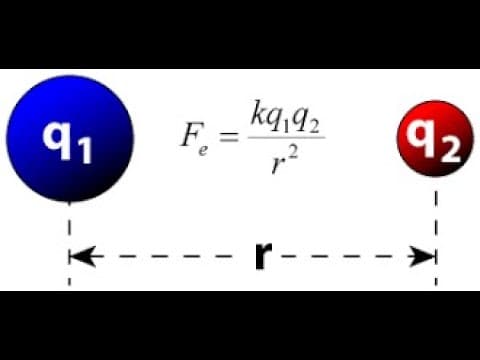
[0:18]Physics 2. The first chapter electrostatics Right, guys? Okay, when I tell you what? The first part we will talk about is called Coulomb's law. Coulomb's Law. Coulomb told you what? Coulomb is one of the first scientists who established the inverse square law that we will talk about now. Do you remember Newton's law when he told you that if you have mass M1 and mass M2 and the distance between them is R, then a force of attraction is generated between them equal to G * M1 * M2 divided by R squared? Who doesn't remember it? It's still on you, okay? Okay, Coulomb, and this was called the inverse square law why? Because there is R squared here. It is inversely proportional to R squared. Coulomb, he established a law that is similar to this. He told you what? Instead of having masses, he told you that if you have charges like this, the charge is denoted by the symbol Q, we will call it Q1 and Q2. Do people see? Okay, and the distance between them is R. This charge, by the way, is called a point charge. What does point mean? A point. And this is what we will talk about first for simplification. It assumes that the charge is concentrated at a point. That is, this charge was decreased, decreased, decreased until it became a point. It's called a point charge. It has no dimension, just one point. Is this natural? No. That is, the charge can be distributed on a pen like this. Didn't the charges distribute on the pen when I did this? Or it can be distributed on a ring. Or it can be distributed on a surface. For example, I can charge this wall. Or it can be distributed on a volume, like a sphere that I charge. This is the real situation. But this is just for simplification. So I will talk first about the point charge. I will understand it, understand its laws, and then I will go one more step. What if the charges are distributed? Okay, so I will talk now about Coulomb's law. Coulomb's law told you what? He told you that if you have two charges like this, then a force is generated between them. This force, just as the force here was proportional to the product of the two masses, here the force is proportional to the product of the two charges. If you are talking about the magnitude value, then you will put the magnitude value of the two charges. And just as it was inversely proportional to R squared, it is also inversely proportional to R squared here. And just as there was a constant here, there is also a constant here, which we call Ke, the electric constant. This is Coulomb's law, called Coulomb's law. So Coulomb's law tells you what? If you have two charges, these two charges generate a force between them, which is directly proportional to the product of the two charges and inversely proportional to the square of the distance between them. So Q1 and Q2 are the charges, and R is who? R squared is the square of who?
[4:16]Of the distance between them. Focus now. What is this constant? He told you that this constant K is equal to 1 divided by 4 * pi * epsilon nought. And epsilon nought is also a constant. Okay, good. So you can write the law like this: that the force F is equal to Q1 * Q2 divided by R squared, and here 1 divided by 4 * pi * epsilon nought. This is your law. So what is epsilon nought? Epsilon nought is something called the permittivity of free space. It is called the permittivity of free space. Focus now, in electricity and magnetism, you will take symbols that are similar, but they are different in symbol but their idea is the same. What are they? Epsilon nought is called the permittivity of free space. Permittivity of free space means the vacuum.
[5:30]Okay. Imagine that the electric field, for example, this wall has positive charges, and this wall has negative charges, there will be a field going from here to here, right? Okay. The ability of the field to penetrate the medium, which is this air, has a certain ability, right? Okay. What if I filled this with water? Will it penetrate the field with the same ability to penetrate the air? It will differ, right? So if I built it entirely with bricks above and below, the field strength will also differ. What if I put concrete and so on? So the permittivity of free space, or the permittivity of free space, is what? It is the ability of the field to penetrate that medium. This is a number that expresses that. Okay, free space means what? No air. No air means no air. It means the pressure is very low. You keep sucking the air out of this chamber until the pressure is very low. What is its value then? Its value is 8.854 * 10^-12. This is the number. Who can tell me what its unit is? Quickly. What is it equal to? Newton per meter squared. No, no. Who said no? Say it.
[7:21]Go ahead. Bravo. Look, to get the unit of something, put it on one side and the rest of the law on the other side. So you will just bring epsilon nought here and F here. So epsilon nought will be equal to 1 divided by 4 * pi * F * Q1 * Q2 divided by R squared. So Coulomb squared divided by Newton * meter squared. So Coulomb squared divided by Newton * meter squared. There are some basics, as I told you. It builds your character as an engineer. Among them is what? Units of measurement. You can't be standing among artisans or workers or young engineers whose boss you are, in a field, and say a wrong unit, and you don't know it. Your reputation will be like a bell.
[8:13]No, I know these things, and I know what a unit means, and I know what an SI system means, and what an international system means. And the people who work. If you worked in America, you worked anywhere else, you find people working with inches and pounds. No, my mind is working. These things don't matter to me.
[8:35]You see? The one who is well-educated, you put him anywhere, he works. You just wind him up and put him, and he works immediately. You see? But the watermelon... Exactly. Okay. So this is called what? You come now and do what? If you calculated this calculation, 1 divided by 4 * pi * 8.854 * 10^-12, you calculate this, it will be approximately 9 * 10^9 * Q1 * Q2 divided by R squared. And this is our law that we will work with in problems and in Newton.
[9:20]So this is what is called Coulomb's Law. So Coulomb's Law tells you what? It tells you that if you have two charges, these two charges generate a force between them. This force is equal to 9 * 10^9 * the product of the two charges divided by the square of the distance between them. Of course, I don't need to tell you what? If the charges increase, the force increases. If the distance increases, the force decreases, right? Depending on whether the relationship is direct or inverse. Is this difficult, guys? Is there a problem, guys? Is there a problem? Okay, so what did I learn now in the second part of our lecture? A law called Coulomb's law for charges. What if I think like this? You are now an engineer, and the engineering sense sometimes hits you a little. You tell me, engineer, is this force not a value and a magnitude? So this is the value and the magnitude. Where is the direction? Who, guys, determines the direction of the force? Newton, in the first chapter we took, told you that this force is attraction and it's done. But here, what is it here? Oh, this can be attraction and it can be repulsion. Right, guys?


