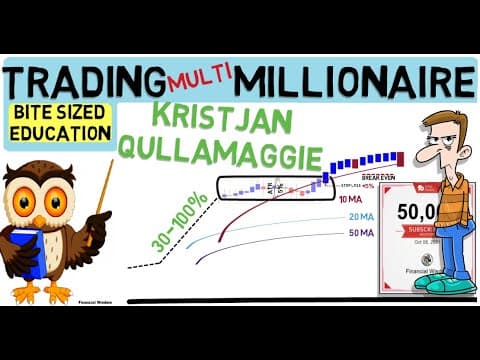
[0:00]In this review, we review the trading strategy and concepts from the Swedish swing trader Christian Kumagi. Christian is a self-funded independent trader who has amassed tens of millions through his breakout strategy. To measure the magnitude of Christian's success, we found that his trading account in 2013 stood at $9,100. By 2018, this grew to 1.4 million, and in July 2019, it grew further to $4 million. As of March 2021, Christian's account stood at 82 million, an astonishing achievement by anyone's standard. Today, we look at his specific setup criteria and concept. If you find value, please hit the like button and consider subscribing. Like most of us, Christian's path was far from plain sailing. He started in 2011 as a day trader and managed to blow up his trading accounts on four occasions during the first two years. He later moved away from the lower time frames and viewed the action from further out to become a swing trader. Christian said, "I started moving away from day trading to swing trading since I realized the potential is so much bigger there. Before we look at the strategy which has netted Christian a fortune, let's first determine what he says about position sizing and risk. Christian says that you should never have more than 30% of a position held overnight, suggesting that his position sizes fall between 10 and 20% of account size. And his risk per position ranges from 0.25 to 1%. Therefore, if we assume an account size of $100,000, the position size would be between $10 and $20,000, and the risk per position would be between $250 and $1,000. Christian does, however, point out that when his account was less than a few million dollars, he used a slightly higher risk of between 0.5 and 1.5% risk per position, a risk percentage I tend to use myself. Alluding to his failures in the early years, Christian said, "At the very beginning, I risked more still, but honestly, I had not a great grasp of the concept risk and position sizing." Now, let's look at the setup he uses. The breakout trade is Christian's preferred strategy, and he lays the foundation for his approach by saying, "If you study thousands of the biggest winning stocks over the past 100 years, they tend to move in stair steps. Meaning they will make a 20-50% plus move, pull back and go sideways for a while, then make another move." Christian uses the daily chart, initially looking for a big move within the last 12 weeks, ideally moving between 30 and 100%. The next step is to look for an orderly pull back into a consolidation, and the consolidation can run between 2 and 8 weeks. During the consolidation, the price surfs a rising 10 and 20-day moving average with the 50-day moving average not too far behind. Christian's advice is to enter the long trade as the stock starts to break out of its consolidation. He uses the low of the day as the stop-loss position, also considering the range of price movements to ensure the risk-reward metrics remain sensible. For example, if the average true range of a stock is 5%, then the stop loss should never be greater than 5%. In terms of managing the trade thereafter, Christian suggests selling between 1/3 and 1/2 of the stock between 3 and 5 days after entry and then move the stop to break even. The remainder of the position should then have a trailing stop governed by the 10 or 20-day moving average, depending on how fast the stock moves. The trade would be closed if the price closed under the moving average. That is the concept behind Christian's approach, but before we move on to some of his real chart examples, I would like to take the opportunity to say a huge thank you to those that have subscribed to the channel. Today, we reach the 50,000 subscriber milestone, and thank you to everyone for their support. Christian says, "I am a swing trader and use the daily chart to find these setups, but these setups also work on the weekly chart and the intraday charts. I tend to agree with this statement, and I use a very similar concept in our group using the weekly chart. Ultimately, the fundamental concept regardless of time frame is to achieve minimal risk with maximum reward, a concept which is so important. Let's look at Christian's concept in practice. We are provided with the daily chart of Axon Enterprise. By using his checklist, we look for the initial price increase of between 30 and 100%, and in this instance, price increased closer to the 100% mark. Next is the orderly pullback of consolidation, which we see here. The consolidation falls within the 2 to 8-week duration, with this example lasting around 3 weeks. Next, we need to see support from the moving averages, and again, here we can see the price being respectful of the yellow 20-day moving average throughout, not forgetting the trailing support of the 50-day moving average. Next, we see the breakout. Once again, in this example, we can see the breakout, but instead of waiting for the candle to complete, which is my preference, Christian suggests entering the trade as it breaks out of the consolidation period. The stop placement is underneath the low of that day at that moment.
[5:38]Once we have all setup criteria checked, we move on to the management of the trade. Remember, Christian says he likes to sell either a half or a third of his initial position 3 to 5 days into the trade and then move the stop to break even. The balance of the trade is then sold when the daily candle closes under the moving average line. In this example, we saw the yellow 20-day moving average as having the most merit, and we therefore sell the position here at the close of the offending candle. What I like most about these types of trades is the risk-reward element we mentioned. The rationale provides the logic for low risk and the potential for high multiples of reward. Christian says, "It's all about finding tight, high probability areas to enter, so you can have high risk/reward on your trades." Christian says he uses numerous popular trading setups including his other favorite, the flag breakout. Named a flag because of its shape, and just as before, it's based on the same principle, a prolonged increase in price followed by a consolidation period. Christian then looks for the breakout, enters soon after the break, and places a stop accordingly. Summarizing the technical setups Christian looks for, he simply says, "It's pretty much flat channels, symmetrical and descending triangles." Before moving on, if you do find value in any of my videos, please do consider hitting the like button or consider subscribing. It really does help the channel. Thanks. Christian provides an example of a flag trade he took in May 2020 against the popular stock Tesla. As with many chart patterns, there are elements of subjectivity, but we can see here how we get the rise in price, which is soon followed by the consolidation, and this forms a flag, or arguably an ascending triangle. Christian would have entered somewhere here at the break, and soon after, watched the price rise considerably whilst respecting the 20-day moving average along the way. Again, the concept remains: minimal risk and maximum reward. Christian says, "It's all about making 5-20 plus times your initial risk. You can be wildly profitable with having just a 25-30% win rate. It's all about having small losses and big winners." Although we don't know Christian's exact exit point on this trade, we can comfortably say that he achieved at least a 20 to 1 risk-reward ratio based on the moving averages.
[8:17]It's fair to say Christian's primary focus is on money management and the concept of risk and reward. The setups themselves are secondary and not groundbreaking. In fact, Christian says, "A lot of great traders trade the same setups because they work and have done for 100 years." Fundamentally, trading is a numbers game, a game of odds, and the more that we can move the odds in our favor, the more margin of error we can absorb, and this is where risk-reward becomes the major factor. Let's look at how risk, reward and the margin of error have an important correlation. Christian suggests his win rate is 30%, meaning seven of his trades will be losers and three will be winners, often coming in clusters. From what we know already, let's assume Christian's loss for each of his losing trades is 1% of equity, and the gains for winning his trades are 10% of equity. We can calculate that he lost 7%, but gained 30%, equating to a 23% profit overall. Such an approach provides considerable margin for error. For example, let's assume Christian's batch of trades only had a win rate of 10%, meaning he had nine losing trades and one winning trade. We now have losses equating to 9% and a winning trade equaling 10%, providing an overall profit of 1%. Therefore, even underperformance can be profitable. The key is keeping losses small and allowing the winning trades to run.
[9:54]Now let's look at a strategy which also relies on the same 30% win rate, but has a lower risk-reward. For example, we risk the same 1% on the losing trade, but target 4% on the winning trades. This would provide a 5% profit overall. The problem, however, with a lower reward is that the margin for error is far less.
[10:17]Just like we did previously, if we hit a longer losing streak, again providing a 10% win rate, the strategy loses its margin for error and returns a loss. The message here is not just about the overall return, but how an improved risk-reward ratio allows for the accommodation of more losing trades. Christian says, "My trading journal at times is mostly a sea of red, and then there is a big winner here and there. This is what trading is all about, you can be wrong 8/10 times and still make money." Overall, I like Christian's approach, and much of it resonates with my philosophy. It's all about risk-reward and using a particular chart pattern to provide rationale for improved probability. Thanks for watching, and as always, if you found value, please hit the like button and consider subscribing.


