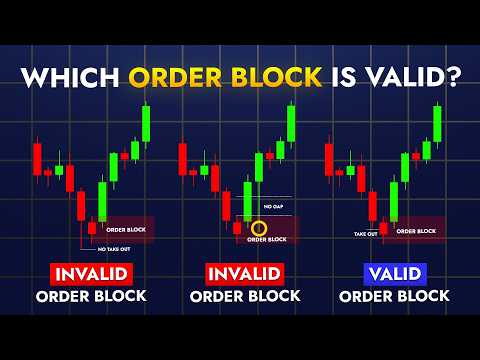
[0:00]Order blocks, everyone's talking about them. Bro, just wait for the order block. Price tap the OB, easy 5R. Institutions are buying here.
[0:10]But here's the uncomfortable truth. Most traders are marking random candles and calling them order blocks, without understanding what actually makes one valid.
[0:19]So today, I'm going to break this down properly. We'll cover what an order block really is, where the name comes from, why price comes back to it, how to filter high probability ones from traps.
[0:33]And finally, I'll show you a complete structure-based strategy using order blocks the right way. Let's get straight into it.
[0:39]What exactly is an order block? At its core, an order block is the last opposing candle before a strong impulsive move that breaks market structure.
[0:49]If price breaks below a previous low with force, the last bullish candle before that drop becomes a bearish order block.
[0:58]You might be wondering why are order blocks so important? Because they tell us exactly where to enter.
[1:03]Every trend has pullbacks. The question is, where will the pullback get rejected and the trend resume? That's your order block.
[1:11]It's the zone where price is most likely to react and continue in the direction of the trend. That's where we enter.
[1:18]Now, where does the name come from? The term was popularized by Michael Huddleston, also known as ICT, in the smart money concepts community.
[1:27]The idea is that institutions cannot enter massive positions in one single click. They execute orders in blocks, clusters, segments.
[1:37]So that last opposing candle before displacement is interpreted as the block where institutional orders were placed or accumulated before the move.
[1:47]Now let's talk about why price goes back to order blocks. Imagine price aggressively breaks structure to the upside.
[1:54]That move represents imbalance and displacement. But large players rarely get their entire position filled instantly.
[2:02]There are often remaining orders, inefficiencies, unbalanced delivery. When price retraces, it often revisits the origin of that displacement.
[2:13]That origin is your order block. But here's the key, not all order blocks are equal.
[2:18]If you just mark every last position candle, you'll get destroyed. So let me give you the filters that actually matter.
[2:25]Rule number one, liquidity sweep. Before an order block can even be considered legitimate, price has to take out the high or low of the candle that came before it.
[2:37]No liquidity sweep, not an order block, simple as that. Rule number two, there must be an imbalance. Price needs to leave a gap behind, an inefficiency in the zone where the order block formed.
[2:48]Look at the candles that follow the potential order block. If their wick's overlap and there's no clean space between them, you don't have an imbalance.
[2:57]And without an imbalance, the order block is invalid. Rule number three, one-time use only.
[3:03]Order blocks are not support and resistance levels you can trade over and over. They are a single use opportunity.
[3:09]We are only interested in the first time price comes back to test that zone. Once it's been touched and price has moved away, it's done.
[3:17]We don't revisit it. That order block is now mitigated and no longer part of our trading plan. Rule number four, it must cause a structural shift.
[3:26]A valid order block has to lead to either a break of structure or a change of character.
[3:33]These structural breaks are critical because they tell us whether the market intends to keep moving in the same direction or if a reversal is coming.
[3:40]Without that structural confirmation, you're just marking random candles on a chart. Now let's look at some examples so you can see exactly how this works in practice.
[3:48]Look at this sequence of candles. The market was bearish, then we get this bullish candle right before three strong green candles push price higher.
[3:57]That candle dips below the previous candle's low. It sweeps the liquidity, good start. But here's the question, is there an imbalance?
[4:05]Look at the three candle sequence after it. The upper wick of the first candle and the lower wick of the third candle don't overlap with the body of the middle candle.
[4:13]There is a gap, that's your imbalance. And did price break structure? Yes. It took out the previous high. Break of structure confirmed.
[4:22]This order block is valid. Now look higher on the chart. Another aggressive move up.
[4:28]This red candle is the last bearish candle before the push. It swept liquidity below the previous bearish candle. Price then breaks above the last high.
[4:39]Another break of structure. And between these three candles, clean gap, no mitigation. All criteria met.
[4:47]This is a textbook valid order block. If price pulls back and taps it, we have a high probability setup. But here's a counter example.
[4:54]This bearish candle right here is the last one before another bullish move. Looks good at first glance, and it took out the previous low for liquidity sweep. But no break of structure.
[5:04]Price never took out the previous high. That immediately disqualifies it. Not a valid order block. Let's look at another scenario.
[5:13]Price sweeps the low with this bullish candle, then pushes higher. It breaks structure, looks promising. But when you check the three candles that follow, there's no gap, no imbalance.
[5:25]And the order block gets mitigated by the lower wick of the next bullish candle. It fails the test. This is not a valid order block.
[5:31]Here's another example. Price takes the low, sweeps liquidity with this bullish candle, then pushes higher.
[5:38]But again, no clean gap between the candles. And the order block is mitigated by the wick above it. Invalid, not usable.
[5:47]Now contrast that with this move. Red candle here is the last bearish one before a strong push higher.
[5:54]It swept liquidity below the previous bullish candle. Then boom, price breaks the previous high. Break of structure, clean three candle gap.
[6:02]No mitigation, every box is checked. This is a textbook valid order block. And remember, these same rules apply in bearish scenarios.
[6:12]Flip everything. Last bullish candle before a bearish break, liquidity sweep above, imbalance created, unmitigated, valid order block on the sell side.
[6:21]These principles work across all time frames, whether you're on the one minute or the daily chart, the logic is identical. Price action doesn't lie.
[6:30]Now let me test your understanding with a couple of scenarios. Take a look at this chart.
[6:35]We have price creating what looks like a perfect order block right here. Last bearish candle before an upward move.
[6:41]The question, would you trade this order block or not?
[6:48]If you said no, I wouldn't trade it because there's no break of structure. You're absolutely right.
[6:54]This order block doesn't qualify because price failed to break the previous high. No break of structure means it's just noise. Not a valid setup.
[7:02]Here's another scenario. Check out this order block that looks absolutely perfect at first glance.
[7:08]It's clean. It formed after a break of structure. It's unmitigated. Textbook setup. Now the big question, would you take this trade or pass on it?
[7:20]If you said pass on it, you're thinking like a pro. Even though the order block checks most of our boxes, when you look at the three candles that follow, there's no imbalance.
[7:29]The wick's overlap. No gap between the candles. And we just said it, no imbalance equals no valid order block.
[7:38]It fails the test. Now here's where it gets really interesting. Order blocks work under certain conditions.
[7:44]And when those conditions are present, the probability of the trade working increases dramatically. The first thing to look at is the market structure around the order block.
[7:53]Here's one of the most common and dangerous patterns you'll encounter. You have a valid order block. Looks great.
[7:59]But when you look to the left, you can see there's a gap, an imbalance sitting exactly below it, along with another valid order block even further down.
[8:09]When this happens, there is a high chance price will break through your first order block, fill that gap, collect the liquidity sitting below it, and only then reverse from the deeper zone.
[8:20]That first order block is a trap. On the other hand, if the move that created your order block started with a sweep of the liquidity under equal lows or above equal highs, that tells you something very different.
[8:31]Smart money has already cleaned out the stop losses they needed. There's nothing pulling price lower. This is a high quality setup.
[8:40]The second factor is the concept of extreme zones. When a price move leaves behind multiple imbalanced zones, the furthest one from current price, the extreme zone, tends to carry the most weight.
[8:52]That's where the deepest unfilled orders live. In situations like this, it's very unlikely that the market will travel all the way down to that extreme zone because it still has inefficiency to fill.
[9:03]Use limit orders at extreme zones for the best risk to reward. Use confirmation entries at any of the closer zones if you're less certain.
[9:12]Third, look at the strength of the impulse. Not all order blocks are born equal.
[9:18]If a zone produced a slow, choppy, sideways price action before eventually pushing up, that's a weaker zone.
[9:25]But if a zone produced a strong, fast, directional move that broke structure and pushed into new territory, that's where the real institutional pressure was.
[9:34]Focus on the zones where the impulse was strongest, especially when that impulse directly caused the break of structure. Fourth, always trade order blocks that align with the dominant trend.
[9:45]Order blocks have a significantly higher success rate in trending markets than in ranging ones. And along the same lines, trade fresh order blocks.
[9:55]The market is constantly shifting, and spending too much time waiting for price to reach an old order block often leads to a losing trade.
[10:02]The newer the order block, the higher its win rate. Fifth, check whether your order block zone exists on the higher time frame.
[10:11]This is one of the most powerful filters available. If you're looking at a trend visible on the four-hour chart, but you're only identifying zones on the five-minute chart, you're missing critical information.
[10:21]Jump up to the four-hour. If only one of your lower timeframe zones sits inside a major area on the higher timeframe, that's your zone.
[10:30]It simplifies the decision, cuts the losing trades, and dramatically increases your probability of winning. Let's go to a real life example.
[10:38]So here on this chart, we have a simple uptrend. We have higher highs and higher lows.
[10:44]During this trend, the chart created multiple zones we could potentially buy from. We have one demand zone right here.
[10:50]We have zone two right here, and we have a third lower zone down here. If you were analyzing this chart right here, which of these zones would you select to buy from?
[11:00]Would it be zone one, two or three? Well, right away when analyzing this chart, I can instantly eliminate zone one.
[11:08]The reason being is because there's an area of imbalance right below this zone. And like I said before, price is naturally going to want to fill this imbalance.
[11:21]Which means in order to do that, it's going to have to break this zone, which also makes this our inducement zone.
[11:27]So, in that case, we can remove this zone entirely. That leaves us with just two zones to select from.
[11:31]Now, you may be thinking, it's this one. Considering what I just said, there's an imbalanced zone right below zone number two.
[11:38]So price is naturally going to want to fill this zone, and it's the lowest zone, which probably means it's the strongest.
[11:45]It has an imbalance right here where price is naturally going to want to reach. It looks really good, but what if I told you you're wrong?
[11:53]Price has a low right here. We have a higher high right here. We came down, we formed this higher low.
[12:00]Then we came back up and created this high. But this high is not an actual high, or not a viable one.
[12:09]The reason being, while attempting to break this previous high, it barely just wicked over it. Which means this zone right here wasn't strong enough to really break this high.
[12:19]But if we look closely, the zone that actually did end up breaking this high was zone number two. So with this information in mind, this lower zone may not be as strong as it appears to be.
[12:29]But this zone in the middle is actually the stronger one. So now we can eliminate zone number three and truly focus on the strongest one.
[12:38]So what we are searching for is price to break this inducement zone right here. Having an inducement zone is such a powerful tool.
[12:47]Because it's adding liquidity to the chart. After breaking this inducement zone trap, we want to see price move towards our true zone.
[12:53]Once it does, you will need to drop to a lower time frame for confirmation. Right now, we are on the one hour time. So we're going to select the 15 minute time frame.
[13:03]Now that price is in our zone, we wait for price to play out. We want to see a break of structure showing a structural shift from a downtrend to an uptrend.
[13:12]Which there is one right here. Then we want price to move downwards towards an imbalance on our chart, which there's an imbalance right here.
[13:20]Wait for price to reach our imbalance, and this is where we enter. First, go back to the higher time frame.
[13:26]Place your stop loss below this low, and place your take profit at the previous high.
[13:32]Here's the trade. We let price play out, and just like that, we got a winning trade.
[13:37]If this practice feels unintuitive, and even after mastering this concept, you may find it tedious to manually mark each structure on your chart. Fortunately, there is a powerful indicator on TradingView that can automate this process for you.
[13:51]To add this indicator to your chart, simply open the indicator tab, search for price action toolkit by Flux Charts, and click on it.
[13:59]Once added, you'll notice that many of the core smart money concepts are automatically displayed for you. Market structure elements like break of structure and change of character, along with order blocks, fair value gaps, inversion FVGs, and liquidity zones, are all highlighted directly on your chart.
[14:15]But for now, let's enable the BOS and chalk in the market structure section to get these automatically identified.
[14:22]As you can see, BOS is displayed in green, and chalk in red on the chart. These two are the most essential concepts for mapping market structure.
[14:31]Next up, we have the order blocks. Let's check the box and see how they appear on the chart.
[14:37]Now we can see several order blocks displayed. As we mentioned, these marked zones are considered specific price areas on a chart where market reactions are likely to happen.
[14:46]So, essentially, when price comes back to these order blocks, we anticipate a potential rejection and look to enter a trade.
[14:53]The indicator applies a specific method to detect these order blocks, displaying only those validated by market structure and trading volume.
[15:01]However, we must search for the entry trigger and confirmation on the lower time frame. After we identify the order blocks on the higher time frame, drop down to two time frames lower to search for confirmations and trading entries.
[15:14]So when we use four-hour, one-hour, and 15-minute chart as our higher time frame, we search for entry signals in 15-minute, five-minute, and one-minute respectively.
[15:24]You could use multiple price action setups as confirmations for trading the order blocks. Here's one of them.
[15:30]In the first step, we wait for the market to tap our higher time frame order block and for price action to reveal its next move.
[15:38]Now, the first thing we are waiting for to appear is a change of character. A change of character indicates that the short-term downtrend is over, and the price can start to move to the upside.
[15:47]So, after the market makes a change of character, that is when we look to enter our trade.
[15:52]When the change of character move creates inefficiency and a valid order block, we place our order a spread size above the order block and put our stop loss a couple of pips below the lowest point of the zone.
[16:04]We use a simple technique for taking profits to capture big risk to reward ratios without even experiencing much tension.
[16:11]If we end up being right and the price starts pushing up, we will move our stop loss under the market structure every time market makes a new higher low.
[16:21]This way, we could let our trades run in profits until we reach a higher time frame supply zone and close the trade. If you wanna try the indicator, I negotiated the best discount ever for our community to have the complete price action toolkit with 20% off through the link in the description using this code.
[16:36]I do earn a commission when you use my link, which helps me continue creating free educational content like this video.
[16:42]But here's the thing, this indicator is genuinely valuable and something I would recommend even without any sponsorship. Thanks for watching and see you guys next time.


