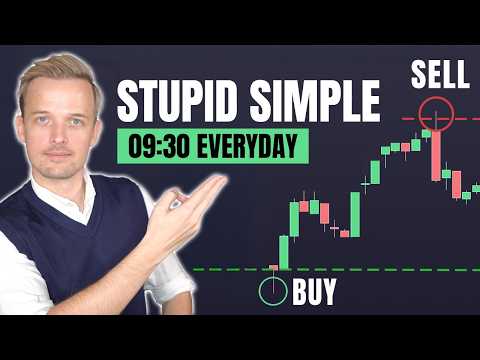
[0:00]Today I'm going to show you an amazing scalping strategy that takes advantage of the first 90 minutes of the market open. It's called the Quick Flip Scalper. It's repeatable, it's effective, and best of all, it is simple. My name is Carl, I've been trading for 20 years. One of the biggest things that I've learned is that the utmost majority of all the money that traders make will take place in the first 90 minutes. For us traders, this is our bread and butter. If you want to increase your chances of becoming a successful trader, you've got to master this market open. And to master it, you've simply got to have the right trading strategy, otherwise it's game over. In today's video, I'm going to show you how to use the Quick Flip Scalper strategy in just three simple steps. I will present it the exact same way it was shown to me back in 2011 and the same way I have taught hundreds of other traders. We have all used it day in and day out to make solid trades for years. Then after explaining the three-step strategy, I will take that process and I will trade the Quick Flip Scalper in a live market so that you know how to apply it. Let's get started. I love this Quick Flip Scalper. I've built a 15 plus year trading career off of this strategy. Most people I show it to like it as well because it's straightforward and it doesn't require any complex structure. Let's jump into the three steps. Step one is to box the opening range candle. Let me show you how. Open whatever asset you are trading on a 15-minute chart. For this example, I'm going to use NASDAQ 100, but it works with any asset, just make sure it's a 15-minute chart. From there, let the first 15 minutes of the market open pass, allowing that candle to completely close. Once that candle has closed, use the box drawing tool to connect the highest price point we see, so this very top of the wick, which says 24675. We are going to connect that with the lowest price point we see, which is 24502. And we're going to box that range in and we're going to extend it into the future. And that's all for step one. I told you it was going to be simple. So this is all you need to do, just box in the high to low range and then extend it. Now let's move on to step number two, which is a crucial step, and the step is to confirm that this candle is a liquidity candle.
[2:40]Most likely it is, and I will explain why soon, and if it is, we are on to something special. A liquidity candle is a fast, aggressive candle moving up or down, the direction doesn't matter. It's fast, it's aggressive, and it's moving in one direction. But it's more than just a candle, it's an emotional event and that is where the edge is. When traders worldwide see these, their very first instinct is to chase into that strength or weakness, fearing that they will miss out on that trading opportunity. And that's exactly what these candles and the price movements are designed to do, to pull in inexperienced retail traders to create liquidity for the big institutions to get in and out of their trades. This price movement actually needs to happen in order for those institutions to get in and out of their positions. And that is why you will see them almost every day. This often involves a a stop hunt where the price aggressively moves in one direction to trigger clusters of stop losses from us retail traders. These triggered stops will create a liquidity pool, a liquidity pool that the large institutions need in order to fill their positions without negatively affecting the price. Without this engineered liquidity, the big players wouldn't be able to execute their trades, at least not efficiently without negatively affecting their entry and exit levels. The best explanation comes from old school trader, Dr. David Paul. The best trades occur after the masses have been stopped out. And that's because the big fellas up there, they can't press the we button and get in. Because there's just not enough liquidity there for them to get in size. So they have to, in fact, engineer 100,000 guys like you, sir. Pull you one way, your stop loss gets hit that, in fact, sets off a sea of liquidity for them to get in. So yeah, these candles they are engineered, and that is why I like to call them manipulation candles, and they happen almost daily, so that these big players can get in and out of their trades. So the most important thing to understand how this Quick Flip Scalper takes advantage of this very phenomenon, is that when you see these candles, most of the time the candle is reversed. And right there, that's the strategy, that is the edge that we will be using. Now, if there is any doubt in your mind whether or not the candle you are looking at is or is not a manipulation candle, let me show you a quick and easy way to figure that out. So what we want to do is to switch to a daily chart of the asset that we are trading. And we're going to add the average true range indicator. You don't have to make any adjustments to it, just use the default settings of 14 days. This indicator will give us a numerical value, in this case for Nasdaq, it is 420 points. Let's go ahead and make the math a little bit easier and write 400 points. What does this 400 points represent? Well, they represent the average range of Nasdaq 100 in the last 14 days. So it's either up 400 points or down 400 points on any average day. So the trading range is one of the most important parameters for us as traders, whether you use this Quick Flip Scalper or not. Here is what we want to determine. Back on the 15-minute chart, if the size of the candle that we just boxed in is 25% or more of that daily range, then it is a manipulation candle. So here's the basic math to figure that out. We take these 400 points, right? And we multiply it with 25%, and you will have 100 points. So if the high of that candle to the low of that candle exceeds 100 points, it is, in fact, a manipulation candle. So you will see that the very low of this candle is 24,502 points, and the very high is 24,675 points. And yeah, that is well outside the 100 points range. So this is definitely a manipulation candle. So one thing to think about is that if it's at 95 points or 90 points, let's say that it's around 22, 23%, don't sweat the details, you can still use it. But if it's 25% or more, that is a dead giveaway that it's being manipulated. So that wraps up step number two, which also was pretty simple, right? Now let's move on to the third and last step, which is to make the perfect entry.
[7:36]This is going to be pretty simple too. So here is what we are going to do. We're going to go back to that 15-minute chart and we're going to move it to a smaller timeframe, and that can be the five-minute timeframe or anything below that. So we can do three minute, we can do two minute, and we can even do the one minute timeframe. I prefer to use the five-minute because that is what I'm used to. And that's what I'm going to use now for the rest of this demonstration. Now from here, what we need, which is the most important part of the video, we need one out of two types of candles to appear. They need to appear outside the range, outside the range that we boxed in in step one, and I say it's the most important part because if none of these candles appear, the price is not ready to be reversed. That movement could actually continue for 20 minutes, 30 minutes, 40 minutes, or an hour, or like the rest of the freaking day, it can just keep on going. And we want one of these two candles to appear again outside the box range, and we want them to appear within 90 minutes of the market open. So if that doesn't happen, the opportunity is lost and we will not take the trade. If you know about reversal candlesticks, if you watch some of my old videos, you already know what the two types of candles are. The two candles that I'm going to be looking for are going to be either the hammer or the inverted hammer candle, or the bullish or bearish engulfing candle. Here's why these two candles are important and why they must be used in this trade setup. Let's start with the hammer candle on the long side. So this must come after a clear red negative price movement. The confirmation comes from within the wick itself right here. This wick represents that the largest buyer took advantage of that liquidity and the institutions bought into that weakness. And I've said in past videos that you have to think about it this way, that if someone with that amount of buying power is going to step in here and buy that dip, it's not going to go lower in most cases. And that is where the edge is. They're just too big, they are too strong and they have announced their intentions, and most likely the price will go higher from here. Again, not all the time, but most of the time it will. The entry is going to be very simple, we're going to wait for the break of the candle and we're going to enter the trade in the opening of the next candle. So we're going to enter the trade here, and the stop loss would be set at the low. The inverted hammer would be something that comes after a clear positive green movement. You would have the wick coming from the top. Again, the confirmation comes from within the wick itself right here. The entry would be at the break of the next five-minute candle here, and the stop loss would be put slightly above the high here. Now, the engulfing candles have the exact same significance, but they look different. They are called engulfing because this large candle here fully engulfs the previous smaller candle. For engulfing candles, though, I like to set the entry level already at the high of the previous candle. So for the bullish engulfing candle, I would set my long entry already here at the high of this red candle, and I would place the stop loss at the low of the engulfing candle. And for bearish engulfing candles, we enter the short trade already at the low of the previous green candle. So that would be here. And we place the stop loss at the high. So if you didn't follow that, don't worry, we're going to go through this step by step now. So let's go ahead and open up the NASDAQ 100 chart again. So the day started with this positive green liquidity candle, which means that we are now looking for negative reversals somewhere above this range. So we're looking for inverted hammers or bearish engulfing above the boxed range. If today would have been a negative red liquidity candle, we would instead be looking for positive reversal candlesticks like the hammer or the bullish engulfing candle, and we would look for it below the box range. So let's see how this day continues. So this is on the 15-minute chart. We've confirmed that it's a positive liquidity candle, and we have drawn up the box into the future. So we're now going to go into a lower time frame to look for the reversal. I will use the five-minute one. Let's see what happens. We see that the price continues up from here for a couple of candles. It's not ready to be reversed yet, but around here, around 45 minutes after the opening, something happens. You should be seeing what I'm seeing now, which is an inverted hammer candlestick. So the entry would be very straightforward. We would enter the trade here at the break of the next candle. We set the stop above the high, and then we set the target profit at the bottom of the box that we've just drawn. So the box that we drew has another purpose than just showing where we are looking for the reversals. It actually gives us two irrelevant target profit levels. One is the high of the opening, and the second one is the low of the opening that I just used. So our trade is set, let's see how this plays out. By the way, I feel like I just have to mention this. So the win rate is actually higher if you include the 15 minutes prior to the opening. Not all brokers offer prices outside market hours, but if you are interested in that, there's a link to the description to the broker that I use. They are called IG, just register for a CFD account and you can get access to these instruments. So for the next minutes, we're just messing around this price level. Uh, we're not really going anywhere. We're not hitting the stop loss, but then as you can see, the price eventually goes lower. And if we go even further, we see that we actually reach the target profit here at the bottom of the range. So it was a successful trade. We entered the trade at 24872. We put the stop loss at 24,900. We set the target profit at 24,610. So the trade had a 28 point stop loss with a 212 points win. So that's pretty good, right? And this isn't cherry-picked. If we look back, we had this pattern here too. The day had a negative red liquidity open. It reversed down here and then finished higher. The day before that, we had a green open, but it reversed, and the day before that, we had a red opened. It reversed and it finished green. Almost every time it reverses. So the strategy works great with these liquidity events, and they appear because the big institutions need them to enter and exit their positions. Over 255 years of trading history and they are everywhere. Now let me show you how to trade this live. It's already 11 a.m. So I've missed the open, but I will be back tomorrow to trade this together with you. Okay, good morning guys. It's about 10 minutes until the market opens. Remember the steps, we are dialing in the 15-minute opening range. We are confirming that it's a liquidity candle, and we are looking for a reversal candle outside the range. If we don't get these three things today, then I will come back tomorrow. But if you are watching this, it means that I kept it and spoiler alert, it means that it is happening today. I forgot to mention this yesterday, but these liquidity events are often more prominent in in individual stocks than in these big indexes. The indexes often has more base liquidity, which means that these manipulation candles are sometimes not needed to the same extent for these big institutions. But as I showed you yesterday, they are there in the big indexes too. With that said, I'm going to trade this today on an individual stock instead. To show you that the Quick Flip Scalper works very well on that too, possibly even better. And I think I will do it with the highest volume stock these days, which is NVIDIA. So the market opens in about two minutes. Let's start by finding out what the average true range is. So I'm going to pull up the daily chart. I'm going to add the average true range indicator. The average true range is 8.07 bucks, so I will write that down. Let's go back to the 15-minute time frame. Now the market opens in a couple of seconds, and here we go. So, okay, it's opening with a small gap upwards, and now it's moving south. Remember, we are waiting for the candlestick to close before we can confirm that it's a liquidity candle. And for it to be a liquidity candle, it has to be 25% or more of the average true range of the last 14 days. While we wait for the 15-minute candle to close, we could actually already now calculate what that is. Average true range was 8.07 bucks, to make it easier, let's say eight bucks, and 25% of that is two bucks. So that means that if this candle will close with a range that is more than two bucks, then it is a liquidity candle. Okay, so now it's 30 seconds until this 15-minute candle closes. It's not a perfect looking liquidity candle. As we have this uh this wick here, but I think it's I think it's good enough. Preferably we wouldn't have it, but I think it's okay. The range is clearly exceeding two bucks, though. It's closer to five or even six bucks. And there it's closed, so it's confirmed that it's a liquidity candle. Okay, so now let's take the box drawing tool. Let's connect the highest price point and the lowest price point, and then we extend it into the future.
[17:48]And I'm only extending it for 75 minutes from here, uh, because after that, we don't want to enter the trade. So any reversal after these 90 minutes are irrelevant. We only enter trades within the first 90 minutes of the market open. So the low is at 176 and the high is at 182. Okay, so that's the first two steps. There is only one step left and that is to find the reversal. Okay, so this 15-minute opening range that we just made a box out of will be of big significance for the rest of the day. Now, the only remaining thing, the last and third step is to wait for the reversal candle outside of this range. As this liquidity candle was negative, we are looking for one of the two bullish reversal candlesticks at any place below this range. And if we remember, we do that on a lower time frame. So I'm changing the chart down to a five-minute time frame. And now we just wait. So if we don't get this reversal candlestick within 90 minutes, then we don't trade it. We will get another chance tomorrow. So there's nothing to do but to continue waiting. So some buyers are getting in here, but not yet a full reversal. I think there are still some big players that are going to get in here. So I suspect we might go even lower. Okay, here's another hammer candle, but again, the hammer is inside the range, which makes it invalid. We want to see a hammer candle or a bullish engulfing candle after a strong clear downward movement and below the range.
[19:48]Okay, so look at that. We have a strong green candle here that could become a engulfing candle. But I'm going to place my limit order entry level here at the high of the red candle at 175.15. So if the price goes up to this level, it is, in fact, a bullish engulfing candlestick. So that's where we want to enter the trade. Let's see. The price is still going up. Let's see what happens. Okay, we got it. We're now in the trade. I will put the stop loss down here below the low at 172.5. And I will put the target profit at the top of this range, which is at 182.3. So that makes the stop loss around 2.65 bucks. The target profit is seven bucks. So that is a risk reward ratio of 2.7 or something like that. So let's see if this reversal holds true. There are no guarantees in trading. Um there are just probabilities and this trade has a high probability of uh of profit. So let's see where it goes. So it's uh continuing upwards actually. It's still strong. We have a little bit of a hesitation here. It's still a long way to the stop loss, though. There I think this looks pretty good. I think we have some good chances to see this trade go through today. Okay, look at that. Price is now back in the range, and that's promising. Okay, so it's continuing up. Now we've got our target profit. And to be honest, I was zoning out for a while.
[22:10]The time is now 1:45 p.m., and uh, made a great trade. Uh, this trade admittedly is a little bit longer than usual. Normally, you're in and out from the trade a lot faster. Okay, guys, that's going to conclude today's video. I hope you found value in this Quick Flip Scalper strategy, and if you're interested, I have another one candlestick strategy that is very, very effective, but still super simple. If you are interested in that, give this video a thumbs up. Let me know in the comments and I can make a video for that one too. And I want to end with one reminder, that is that historic results are no guarantee for future results. So even though this edge has been proven to be effective over many decades, it might stop working. And also, although very strong on most markets, this edge definitely works better with some markets and worse in others. So please evaluate the edge regularly and as always, take care, trade well. Thank you guys for watching. I will talk to you again soon.
[23:19]Bye.


