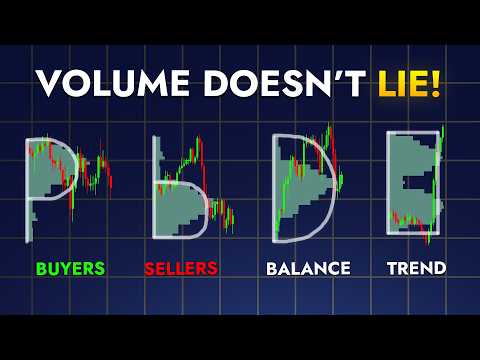
[0:00]foment. You can't create a yourself an impression that a stock's down. But you do it anyway because the SEC doesn't understand it, so it doesn't take much money. Uh, similarly, if uh or if I were long and I would want to make things a little bit rosy. I would go in and take a bunch of stocks and make sure that they are they're higher. I may be commit five million in capital to do it. You can move it up and then fade it. That's often creates a very negative feel. That's a strategy very worth doing. I would encourage anyone who's in the hedge fund game to do it because it's legal. Right. And it um, it is a very quick way to make money and very satisfying. Here's the brutal truth. Price can be manipulated. Big hedge funds and institutions can artificially drive the price up and artificially drive it back down. They do it every single day. But volume, volume is a lot harder to fake. That's why it changes everything. Price alone is a lie, or at the very least it's an incomplete sentence. Today, we are going to fix that. We're going to add the one layer of information that separates losing traders from the profitable ones. The one tool that shows you exactly where the real money is sitting in any market on any time frame. And stick around till the end, I'll share a bonus tip that most volume profile traders never even talk about. Let's get straight to it. Price tells you what happened. Did the market go up, down, sideways? Volume tells you how much conviction was behind that move. How many traders actually participated? How much money was injected into the market to make that price move happen? Now, you need to understand the three scenarios you'll see constantly. Open TradingView. If you don't have it yet, use the link in my description. Click on the indicators tab and write volume. Select this one. Scenario one, healthy move. Big candles, high volume underneath. Effort matches result. The move is real. It has backing. It likely continues. Scenario two, absorption. Small candle, massive volume. This is the dangerous one. Buyers are pushing hard. You can see it in the volume, but price barely moves. Why? Because there's an invisible wall. A large seller sitting there quietly absorbing every single buy order. The moment buyers exhaust themselves, price drops sharply. This is smart money disguising itself as a breakout. Scenario three, no supply. Price keeps moving on low volume, not because buyers are strong, but because sellers are completely absent. Nobody's blocking the road. Price floats upward with almost no resistance. Now, one thing to clear up immediately, green volume bar does not mean buying. Red volume bar does not mean selling. Every single trade requires a buyer and a seller. Always. If you bought 50 shares, someone sold you those 50 shares. Volume counts the number of transactions, not who's winning. The color of the bar just follows the color of the candle above it. That's it. What you actually care about, the size of the bar. When price makes new highs, but volume bars get progressively smaller, that's a warning. Think of a rocket burning through its fuel, the thrust weakens. Each new high has less participation behind it. The move is running out of believers. A reversal is forming, you just can't see it yet in the price. Same in reverse. Price falling on shrinking volume means sellers are getting exhausted. The selling is drying up. A bottom is likely forming. Volume divergence is your free early warning system. The market hasn't crashed yet, but it's getting tired. All right, so volume is powerful. But here's the problem with the standard volume histogram at the bottom of your chart. It tells you when volume happened. 9:00 a.m. had a lot, 10:00 a.m. had less. Great. So what? What if instead of asking when, you asked where? Not how much volume at 10:00 a.m., but how many people actually traded at that specific price? The answer to that question is where the real edge lives. That's exactly what the volume profile shows you. The volume profile is a histogram, a bar chart, rotated 90 degrees and placed directly on your price access. Instead of showing volume across time, it shows volume across price levels. Each horizontal bar answers one question. How many contracts were traded at this exact price? The wider the bar, the more people traded there. The narrower almost nobody was interested. Open TradingView. Hunt for anchored volume profile in your left side toolbar. You'll spot it positioned right above that brush icon. Open your volume profile settings. Make sure value area high, value area low, and point of control are all enabled. Go to inputs, change row layout to number of rows and set it to 400. The default setting gives you 24 rows, blurry and precise, useless. At 400 rows, the profile becomes sharp enough to actually trade from. Now that volume profile is on, three things become obvious immediately. One, the point of control POC. The price level with the most volume, the biggest bar. This is where the market spent the most effort, the center of gravity. Price tends to come back to it. Two, the value area. The range containing roughly 70% of all trading activity, one standard deviation. The zone where most players agreed on value. The market is balanced. This is where it lives and breathes. Three, low volume nodes. The thin spots. Price levels where almost nobody traded. These are the fast lanes of the market. Price rips through them like they don't exist because structurally, they don't. Nobody's there to slow it down. Here's the core idea. Tattoo this on your brain. High volume equals sticky prices. Low volume equals price rips. The market consolidates where people are. It flies where nobody is. Let's talk about why this works. Auction market theory. Fancy name, simple idea. Every financial market is a continuous auction. Buyers want to buy low, sellers want to sell high. They negotiate, and wherever they agree, volume accumulates. When buyers and sellers agree, the market chops sideways. Volume builds. That's your high volume zone, an area of fair value. When they disagree, one side dominates and price moves fast through thin air, searching for a new level where agreement can happen. That's your low volume zone, unfair value. The market doesn't stay there. And here's the kicker. Those high volume zones aren't just historical data points. They're loaded with trapped positions. Say the market ran up to this price, a high volume zone. Thousands of traders went long there. Then the market sold off. All those buyers trapped, red, uncomfortable. When price comes back to that price, every single one of them is making a decision. Some double down, some panic sell, some just finally breathe again. That reaction is guaranteed. There are too many people positioned there for the market to ignore it. That's your edge. And if you want to go deeper on exactly how to trade these zones in a real session, step-by-step, live on a chart, I put together a full dedicated video on that. Link is in the description. Go watch it after this one. Now, let's get practical. The volume profile takes four main shapes, and each one tells you the market's story before you even look at a single candle. The first one is the D-shape. It looks exactly like the letter D. Heavy volume in the middle, thin at the edges. This is a balanced market. Buyers and sellers are both content. Nobody has a strong opinion, nobody's really in control. When you see this, you don't look for a big directional move. You fade the extremes. Short from the top, long from the bottom, target the POC in the middle. Simple rotation, nothing fancy. The second shape is the P-shape. Heavy volume at the top, thin tail below. This is a bullish profile. Either the market's been in a strong uptrend or it just rejected lower prices hard and buyers stepped in with conviction. So, you wait for a pullback to the POC or that little low level bump in the tail and you go long. The market wants higher. One critical rule though, the day has to close above 50% of its range. If it doesn't, it's not a real P-shape. Don't trade it as one. The B-shape is just the mirror image. Heavy volume at the bottom, thin tail above, sellers are in charge. Same rules apply. The day needs to close below 50% of the range to be genuine. You'll look for bounces into the POC or that upper low volume bump and you go short. And then there's the thin profile, and this one's different. No heavy central zone, no clear area of balance. Just a thin column of volume spread across a wide range. This happens during explosive trending moves, usually news-driven. Price moves so fast there's simply no time for big players to build proper positions. So, what do you do? You don't fight it. Instead, you look for the small volume clusters within that thin profile. Because those are the exact spots where buyers or sellers were aggressively adding to their positions. In a bullish thin profile, those clusters become your support levels on any pullback. Okay, theory is done, let's look at a real trade. But first, I want to thank our amazing community. I'll be rewarding the most heartfelt comments because that kind of support is what keeps me going and motivates me to keep creating free content for you. This week's winner is this comment right here. Please reach out to my email to claim your free month of flux charts. Now, if you haven't heard about Flux charts yet, this is the platform I use every single day for my trades. It completely changed how I trade. Flux can run screeners on up to 15 tickers and time frames at once. So instead of flipping through charts, it tells me exactly where my setups are happening. They have back testing tools to build custom strategies and test them against years of market data in seconds. So you know if a strategy works before risking any money. Here's the best part. 90% of their indicators are completely free. Plus, you can use Flux charts even with the free version of TradingView, which is huge because you can use multiple indicators simultaneously, avoiding TradingView's two indicator limit. They also host daily live trading classes teaching strategies, risk management and trading mindset. Can't join live? They have a full library of recordings. Click the link in my description and use this code to discover the fantastic promotion I got for our community. All right, let's get back to the video. Open TradingView. As we said, hunt for anchored volume profile in the left side toolbar. You'll spot it positioned right above that brush icon. Volume profile is on. There's a massive high volume node sitting right here. Thousands of contracts traded in this range. This is where people are based, the center of gravity. Now, the market sells off, hard, macro event. Everyone's watching the news trying to figure out what's happening. And here's the question most traders get wrong. They ask, is this going to keep falling? The volume profile trader asks a better question. Where are the most people positioned and what will they do when price comes back? The answer is right there in the profile. That massive node is sitting below current price. Once price sweeps the low volume area underneath it and hits the edge of the high volume cluster, that's your trigger. Signal candle model. You wait for a relatively higher volume doji, hammer or shooting star at the edge. Higher volume than the previous candle, in the direction of your trade, and the candle must fully close, never front run it. The candle closes. Volume spike confirmed. You go long. Stop sits just below the node because if that gets taken out, the thesis is dead. Target the opposite edge of the profile, edge-to-edge. We let the trade run and boom, solid gain. That's not luck. That's auction logic. And here's the final tip I promised you at the beginning of the video. If price opens outside the previous session's value area and then re-enters it, the vast majority of the time, it will travel all the way across to the opposite extreme. Here's how it works in practice. You take yesterday's RTH session, the regular trading hours profile. That gives you your value area for the next session. Now watch where price opens. If it opens below the value area and then pushes back inside, that's your signal. The target is the opposite extreme of yesterday's value area. And it hits it. Every single time. Well, the vast majority of the time, which in trading is basically every single time. One detail you can't ignore though, price needs to show acceptance inside the value area. Not just a wick poking in for a split second. You need to see actual candles closing inside. If it just ticks in and immediately rejects, the rule doesn't apply. Simple, objective, repeatable every single session. Thanks for watching and see you guys next time.
NEVER Read Price Again – Volume Profile is 10x Better!
Trading Notes
13m 33s2,242 words~12 min read
Auto-Generated
Watch on YouTube
Share
MORE TRANSCRIPTS