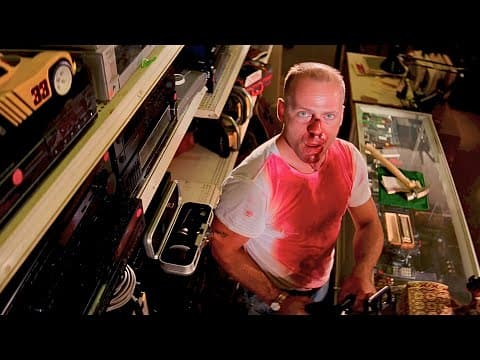
[0:00]The gimp scene in Pulp Fiction is undoubtedly the most disturbing moment in the entire film. It arrives near the end of Butch's story and it's dense with meaning, visual cues, character choices and earlier moments echo through it. And when the moment resolves, it doesn't just close a chapter, it completes Butch. Take this moment for example, Butch taking his time picking a weapon before heading back into the basement to save Marsella. Of all the weapons he chooses a katana and that's no accident. The katana is a weapon associated with the Samurai, warriors who place honor above all else. In this moment it aligns perfectly with Butch's moral stand and in turn the choice of the weapon becomes a symbolic one. But what's more is that we get one of the most striking shots in the entire scene, the camera positioned high looking down on Butch. It's almost as if the katana itself is looking down on him, bestowing the responsibility on him and recognizing the honor in his decision. It's a simple shot but it visually affirms his character's transformation at this point in the story. But to appreciate the totality of what this single scene has to offer, we've got to dive into the character of Butch and dissect everything his act in the film is offering up. And it all starts with what his story arc is called. The gold watch. A watch itself is a time piece and it's worth pointing out how much of Butch's journey revolves around time.
[1:36]It's time Butch. The exact time he's supposed to throw the fight for Marcellus. The exact time he and Fabienne need to leave town. Even on the phone with his friend, he directly mentions a shift in time. All right, Scotty. Next time I see you, it'll be on Tennessee time. Cool, brother. In fact, the entire phone booth scene where Butch talks with his friend mirrors the motion of a clock but with a twist. The camera isn't moving clockwise, it's rotating anti-clockwise as if the film is visually pushing back against the timeline Butch is supposed to follow. Watches, clocks, and timing appear again and again throughout his story and there's a reason Tarantino keeps returning to images of time. And I'll explain why once we dive in a little further. Now, this is Pulp Fiction, so I'm not going to break down basic context like I do in my other videos. You should have seen the movie by now, and if you haven't, pause this and go and watch it first. Butch is given the gold watch when he's a young boy by his father's war buddy, Captain Coons. We get our first clock as we're introduced to young Butch. Butch is center of the frame and the clock is hanging high frame right. One of many visual time motives to come. We learn the history of the gold watch and how it's been passed down through the generations of Butch's family, all of whom were war veterans. His father's story in particular, him and Captain Coons as prisoners of war, trapped together in a Hanoi pit of hell, foreshadows the situation Butch will later face in the basement with Marcellus. Something Tarantino does brilliantly during Captain Coons' story is cut to these extreme close-ups of the watch. Filmmakers usually reserve close-ups and extreme close-ups to emphasize importance or to guide the audience's attention and here, Tarantino uses them exactly for that reason. These tight shots build the watch's importance in our minds long before it becomes the driving force behind Butch's story. It's a long monologue by Christopher Walken, but it establishes the significance of the watch and the weight it carries in Butch's family line. The history sets up why the watch matters so much to him. And one could argue that the time Tarantino spends on Captain Coons explaining its history, 4 1/2 minutes to be exact, anchors the audience in how central the watch is to everything Butch does in his life.
[4:01]There are a few details from the story that surface later and they show how deeply the watch's history sits in Butch's mind, consciously and subconsciously. We're told the watch was first bought by his great grandfather during the First World War at a general store in Knoxville, Tennessee, before he shipped off to Paris, France to fight. It was bought in a little general store in Knoxville, Tennessee. Bought by private doughboy Ryan Coolidge on the day he set sail for Paris. These details echo through Butch's own life. His girlfriend Fabienne is in fact French, and after the fight he tells his friend on the phone that he and Fabienne plan to move to, of all places, Knoxville, Tennessee. No, me and Fabienne are going to leave in the morning. Yeah, it'll probably take us a couple days to get down to Knoxville. It's almost like his story is looping back to where the gold watch began. An idea that is punctuated in the shot of Butch standing at the pawn shop door, hesitating before he either walks out or goes back to save Marcellus. Of all the license plates on the wall, a Tennessee license plate sits center of frame with its slogan reading volunteer state. A nickname the state earned through its strong tradition of military service. The fact that it's sitting bang on center in frame highlights its importance. This moment reflects Butch's entire family line, his forefathers volunteered to fight for their country and now Butch is about to make a choice that carries that same honorable spirit. In order to complete the arc of his story and the gold watch, he too must volunteer like his forefathers and make an honorable choice. And he does so by returning back to the basement to save Marcellus. Now, before the gold watch story begins, we're actually introduced to Butch in the first act. He's at his lowest point, taking cash from Marcellus to throw a fight. There's one key moment in this exchange and it's this. Night of the fight, you may feel a slight sting. That's pride, f****** with you. The second Marcellus brings up pride, Tarantino cuts to a close-up of Butch. It's the only close-up in a scene that's comprised of three shots and it lands like a punch. Tarantino is emphasizing the exact nerve that's going to blow Butch's whole story line wide open. We're reminded of that pride comment again when Butch and Marcellus are brawling on the pawn shop floor. You feel that sting, big boy, huh? That's pride f****** with you. Butch throws it back at him and it lands with a different weight now. It's a clear signal of what all this means to Butch. We're reminded that it's still about pride for him, the same force that started this whole chain of events. Butch let his pride take over and he doesn't throw the fight. He in fact kills the other fighter and plans to leave town. But as most of you watching already know, Fabienne forgot to pack his father's gold watch. So Butch, with Marcellus hunting him across the city, must return to his apartment and retrieve the gold watch. He has a stroke of good luck, gets into his apartment, kills Vincent who was waiting for him, grabs the gold watch and hits the road. But unlike his forefathers who acted out of honor, Butch is still operating out of pride. And time finally catches up with him. Motherf*****. He and Marcellus cross paths. Everything erupts and the two of them end up as prisoners of war in their own pit of hell in the pawn shop. And the first thing that stands out in the pawn shop and even more so in the basement are the clocks. After Butch and Marcellus are captured, we fade into a two-shot of them tied and gagged. They're equals now and the framing makes that clear. The next cut strengthens this idea. A shot of Maynard from behind the pair. Both men sharing the frame equally with a common enemy between them. It immediately echoes what Captain Koons once told young Butch. We're in that Hanoi pit of hell together. Hopefully you'll never have to experience this yourself. Then we cut to a wide shot of the basement from above. The high angle looking down on them strips them of any power they had left. But the most ominous part of the image is the clock in the top left corner. It isn't working, it sits frozen in time. This is the first moment in Butch's story where time stops pushing him forward. And becomes the moment that forces him to confront who he really is. Zedd arrives and after bringing the GIMP out to play, we immediately understand the sick depravity he and Maynard revel in. Marcellus is chosen first and taken into the back where we later learn he's sodomized by Zedd. What I want to focus on though is the moment after Butch frees himself, slips upstairs and is right on the edge of escaping. This is the point his entire act has been building toward, and Tarantino elevates the visual language to make us feel the weight of the decision Butch is about to make. As I mentioned earlier, he stops at the pawn shop door, deciding whether to leave or go back for Marcellus. What I didn't point out before is how the license plates are displayed across two flags pinned to the wall. Side by side, we see a Confederate battle flag and a United States flag. It's no coincidence that the most defining choice of his story happens here. The Tennessee license plate echoes the legacy of his forefathers, and the two flags subtly suggest that it doesn't matter what side you're on. Sometimes you put your differences aside and choose the honorable path. We get a dolly forward into Butch's face, bringing us into a close-up that affirms the weight of his decision and visually emphasizes the internal shift taking place within him. This is new ground for Butch, and Tarantino shows this by immediately switching to a handheld camera as we follow him back inside. The only use of handheld camera work in the entire scene. The handheld doesn't just add to the unsafe, unpredictable nature of his decision. It mirrors the instability of stepping into a choice he's never made before. It's the visual language of a man walking into uncertainty, guided for the first time by something other than pride. As we follow him back inside, we see another clock that practically demands attention. The camera lingers on it long enough to make it obvious. A golden framed yellow clock with the word Dads printed in the center. It's a clear nod to his forefathers, each of whom received the gold watch from their own fathers. It's as if Tarantino is pointing straight at the lineage that shaped Butch, reminding us that the choice he's just made comes from the same place of honor that guided the men before him. Butch takes his time choosing a weapon, and as I mentioned earlier, when he finally finds the katana, it's as if the weapon itself chooses him. The shot looking down on Butch from the Katana's perspective almost feels like he's being knighted. But what's even stronger is what happens next. When we cut to the katana, we get a push-in, just like we did on Butch at the door when he made his honorable decision. These two Dolly forwards link the shots, visually affirming that Butch is stepping into a new version of himself. Someone guided by honor rather than pride. It might sound like a stretch, but considering these are the two Dolly forwards in the entire scene, and knowing how deliberate Tarantino is, it's not that hard to see the connection. And immediately after this, we cut to a low angle looking up at Butch, a stark contrast to the previous framing. It feels entirely deliberate. The shot signals a shift in power. In film, low angles often imply dominance, and with the katana now in Butch's hand, and with him being guided by honor rather than pride. It's clear the balance of power has swung in his favor. This low angle looking up at Butch continues as he slowly walks back down into the basement. But notice, we're no longer handheld, we're on a steady cam. There's now a stability to Butch's action. There are clocks lined all along the wall as he descends back into his own version of a pit of hell. The time motif appears again, and here it suggests that Butch is no longer running from time, but walking straight into it on his own terms. We then cut to a shot of the back room door. I love this moment because it's literally the final step Butch has to take to follow through on his honorable choice. And Tarantino makes sure it's the hand wearing the gold watch that pushes the door open. In a single frame, he brings the entire arc full circle. The watch that started all of this, is now the thing we see as Butch plans to end things. The door swings open and we see Marcellus being sodomized by Zedd. And as brutal as the moment is, it's my favorite use of irony in the entire film. And Marsellus Wallace don't like to be f***** by anybody except Mrs. Wallace. Butch enters and saves Marcellus by slashing and stabbing Maynard. But what's most interesting is how we toys with Zedd and how the framing links all the way back to the first time we ever see Butch on screen. In that early scene, the money Marcellus offers Butch sits in the foreground, looming over him as he quietly takes the deal that will shape his entire story. Now in the basement, the katana occupies the same foreground position, but this time Butch is the one holding the object. The visual rhyme feels deliberate. The first framing shows Butch being controlled by a choice rooted in pride. The second shows him taking control through a choice rooted in honor. This repeated composition shows just how far Butch has traveled between those two moments. And with that, Butch's entire character arc crystallizes in one honorable decision. Up until now, everything he's done has been driven by pride. The pride that made him reject Marcellus's deal and set these events into motion. And like his father, he was caught in his own pit of hell. And for the first time, Butch makes a choice not out of ego, but out of honor. It's the moment his story pivots from self-preservation to moral clarity. Marcellus more or less forgives Butch, but tells him to leave LA and never return. Tarantino seals Butch's transformation with one final visual queue. The Z keychain on Zedd's motorcycle keys. It's a nod to Zedd, yes, but it's also the last letter of the alphabet, symbolizing the end of Butch's journey. This is his finish line. He trades pride for grace as he literally rides off on a motorcycle called Grace. The gold watch story is, to me, one of the richest stories in Pulp Fiction. It isn't loud or flashy, but it carries a lot of weight, and most of it comes from something as simple as pride and how easily it can steer a person off course. Watching Butch shift from prideful to honorable, gives the whole act a relatable arc, and Tarantino's visual language across his story, makes that shift land in a very real way. Now, if you enjoyed this video, guys, consider checking out this video. My mate Donnie has started a new YouTube channel where he does deep dives, breaking down the psychology of movie and TV characters. They're actually really quite interesting videos. Check them out.


