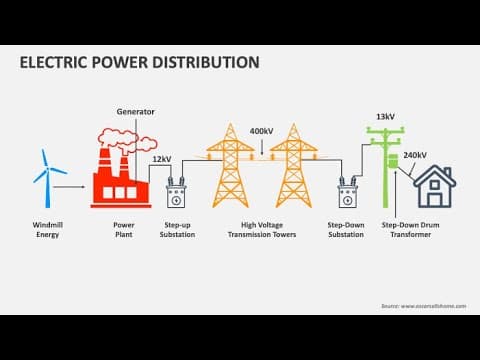
[0:00]What is an electric power system? An electric power system or electric grid is known as a large network of power generating plants, which connected to the consumer loads. Welcome back to Engineering YouTube, and if you're new to this channel, kindly subscribe and put on the notification button. The main objective of an electric power system is to obtain electrical energy and make it reachable safely to the load point, where it is being used in usable form. This is done in five stages, namely Generating Station, Primary transmission, Secondary transmission, Primary distribution, Secondary distribution. Generation means the conversion of a form of energy into electrical energy. Transmission implies the transport of this energy to very long distance with very high amount of voltage magnitude. Moreover, distribution is fulfilling the demand of the consumers at certified voltage level, and it is done in terms of feeders. Feeders are the small small chunks of load distributed at different places physically. Let's explain all of the above levels one by one. Generation or generating station. The place where electric power produced by the parallel connected three-phase alternators/ generators is called generating station, i.e. power plant. The ordinary power plant capacity and generating voltage may be 11 kV, 11.5 kV, 12 kV or 13 kV. But economically, it is good to step up the produced voltage from 11 kV, 11.5 kV or 12 kV to 132 kV, 220 kV or 500 kV or more. In some countries up to 1500 kV by step-up transformer, power transformer. Presently, the generating stations we employ mainly over the world are following. Thermal power plant, hydroelectric power plant, nuclear power plant, wind power plant, solar power plant, diesel power plant, gas power plant. We generate electric energy through these power plants at different voltage levels and at different locations, depending upon the type of the plant. In my next video, I'm going to explain how these generating stations generate electricity. So, kindly subscribe and put on the notification button so that you don't miss it. Let's continue. Primary transmission. The electric supply in 132 kV, 220 kV, 500 kV or greater is transmitted to load center by 3-phase 3-wire.
[3:11]3-phase 3-wires, also known as delta connection, overhead transmission system. For example, the generating station can be generating voltage at 11 kV, but the load center is 1000 km apart and at the level of 440 volt. Therefore, for the delivery of electrical energy at such a long distance, an arrangement must be there to make it possible. Hence, the transmission system is essential for the delivery of electrical energy. This is made possible by using the transmission lines of different length. These are overhead transmission lines in almost every cases. Some exceptions occur when it is needed to cross an ocean. Then there is a compulsion to use underground cables. Secondary Transmission Area far from the city, outskirts, which have connected with receiving stations, bylines, is called secondary transmission. At receiving station, the level of voltage reduced by step-down transformers up to 132 kV, 66 or 33 kV, and electric power is transferred by 3-phase 3-wire. 3-phase 3-wires overhead system to different substations. Primary Distribution Generally, electric supply is provided to those heavy load consumer, commercial power supply for industries, where the demand is 11 kV. From the lines which carries 11 kV in 3-phase 3-wire overhead system, and they make a separate substation to control and utilize the heavy power industries and factories. In other cases, for heavier load consumers at large scale, the demand is up to 132 kV or 33 kV. So, electric supply provided them directly by secondary transmission or primary distribution in 132 kV. Secondary Distribution Electric power is transferred by from primary distribution line, i.e 11 kV, to distribution substation is known as secondary distribution. This substation is located nearby domestic and consumers' areas where the level of voltage reduced to 440 volts by step-down transformers. These transformers, called distribution transformers, three-phase four-wire system, three-phase four-wires, also known as star connection. So there is 400 volts three-phase supply system between any two phases, and 230 volts single-phase supply between a neutral and phase live wires. Residential load, i.e. fans, lights, and TV, etc. may be connected between any one phase and neutral wires, while three-phase load may be connected directly to the three-phase lines. In short, secondary power distribution may be divided in three sections, such as feeders, distributors, and service-lines. In my next video, I'm going to explain how these generating stations generate electricity. So, kindly subscribe and put on the notification button so that you don't miss it.