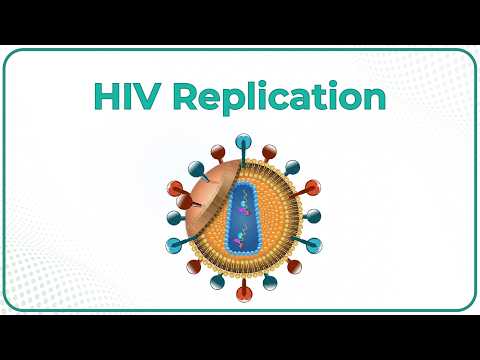
[0:03]AIDS is caused by the human immunodeficiency virus, HIV. This is an enveloped virus. The envelope is derived from the host cell membrane with viral glycoproteins such as GP120 and GP41, inserted into the membrane as the virus leaves the cell. The core is composed of P24 capsid protein, and the P17 matrix protein helps maintain viral structure. Inside the core are two identical copies of single stranded RNA viral genome and three enzymes: reverse transcriptase (RT), protease (PR), and integrase (IN). To establish infection, HIV must first attach to its host cell. Attachment occurs by interaction between GP120 on the surface of the virus and the CD4 antigen receptor on the surface of the host cell. In addition to the CD4 receptor, there must also be a co-receptor on the host cell. The co-receptor differs for different host cell types. In T lymphocytes, the co-receptor is called CXCR-4, whereas on macrophages, the co-receptor is called CCR-5. After attachment, the viral envelope and host cell membrane fuse, resulting in entry of the virus into the cell. Once the RNA is released into the cytoplasm of the host cell, reverse transcriptase makes a DNA copy of the viral RNA genome. As the DNA is being formed, reverse transcriptase degrades the RNA strand. A complementary DNA strand is then added by the reverse transcriptase, and the ends of the resulting double-stranded DNA segment are joined non-covalently. Treatment with nucleoside analogues or reverse transcriptase inhibitors interferes with these steps. The resulting circular DNA is then moved to the nucleus and inserted into the host cell chromosome by the viral integrase (IN) enzyme. The integrated viral DNA is now referred to as proviral DNA. Following integration, the proviral DNA may remain dormant or with host cell activation, RNA may be synthesized from the DNA, yielding messenger RNA and viral genome RNA. Viral messenger RNA is translated, yielding viral enzymes and structural proteins.
[2:38]Some of the functional proteins are formed by cleavage of a long polyprotein by the enzyme protease. Protease inhibitors interfere with this step. GP41 and GP120 are inserted into the host cell membrane, and the structural proteins surround the viral RNA to form the core. Finally, the virion is released by budding.


