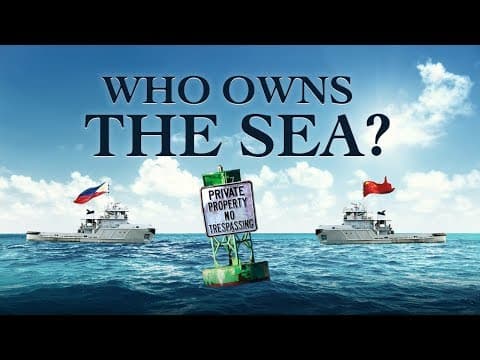
[0:14]This is one of many small commercial fish markets around Puerto Princesa in the Philippines. For the Philippines, as with many other nations in this part of the world, fishing is a major industry. Over 70% of the surface of the earth is covered by water. Now, most of that water is oceans and seas. For many hundreds of years, people have looked to the oceans and seas to better their lives, for trade, for food, and more recently, resources like oil and natural gas. However, the ocean itself has no landmarks. The water moves. The wealth below the surface moves as well. In a world of independent nations, large and small, how can something of such great value be shared? Who owns the sea? How would you divide up something like the oceans of the world? Would you divide it up by country? Would you base it on size of the country or perhaps population? What about landlocked countries? Does a nation need to have a coastline to be allowed access to the sea? The most widely accepted system in use today is called the United Nations Convention on the Law of the Sea. The way it works is by measuring out various areas very carefully from a defined baseline, which usually follows a country's coastline. Internal waters are all water and waterways on the landward side of the baseline, like bays, rivers, or lakes. The coastal state is free to set laws, regulate use, and use any resource. Foreign vessels have no right of passage within these waters. Territorial waters extend to 12 nautical miles. Within this area, a country is free to set laws, regulate use, and use any resource. Foreign vessels are allowed to pass through these waters, including military ships, so long as they conduct themselves peacefully and keep moving, no stopping to sightsee. Also, submarines must stay surfaced with a national flag flying. Fishing, polluting, weapons practice, and spying are not allowed. Exclusive economic zones, or EEZs, extend up to 200 nautical miles from the coast. In these waters, the nation has exclusive rights over all natural resources. That means everything from fishing to drilling for oil. The rest are international waters, which means everybody basically gets to do what they want. Even countries with no coastlines can fish here or cruise their navy around. These claim lines are straightforward enough when you're a nation like New Zealand or Australia, but things get complicated when you've got neighbors. Creative diplomatic solutions must be found to determine EEZs when the 200-mile limit of one country overlaps with another. Like the EEZs of the United States and Mexico, or Caribbean nations. Oftentimes, the boundaries between exclusive economic zones cannot be resolved, and conflicts can and do arise. Particularly, when the waters are valuable for trade, marine resources, and military strategy. So what happens when disagreements occur? Well, the UN has no direct role in enforcing the treaty regulations. They only provide a forum for different nations to meet and discuss their issues, and from time to time, attempt to pass judgment in the International Court of the Hague. Let's take a look at an area that has seen ongoing conflict over who owns what. This is the South China Sea. It's a large area, made up of hundreds of tiny, uninhabited islands, rich in natural resources, fisheries, and trade routes. There are overlapping claims on different parts of these waters by Vietnam, Malaysia, Brunei, the Philippines, and Taiwan. This is China's claim. China submitted this map to the UN, with their territory represented by a nine-dashed line. These dashes are meant to outline China's claimed exclusive economic zone.
[4:54]In the 30s, Chinese cartographers drew several maps, claiming the Parasols, the Pratas, some claimed the entire South China Sea. We can pass a law in the Philippines saying that California is part of Philippine territory, as long as we don't do anything about it, the Americans wouldn't even mind. I mean, if China draws a map saying that the world is part of China, nobody would care, provided they just keep it to themselves. So, when China drew up the map claiming the entire South China Sea, we just smiled because it's outrageous. However, China started to enforce it. They seized our submerged areas, Mischief Reef is a submerged area at high tide, they seized it from us in 1995. Every time we send our survey ships to the Reed Bank, Chinese Coast Guard vessels would harass them and shove them away. And in 1988, they seized Subi Reef from the Philippines. The men who fish the waters of the South China Sea are frontline witnesses to the conflicts of overlapping claims.
[6:09]The captain of this ship and the fishermen he transports are Filipino. Today, they will fish the waters around Subi Reef. It's a rich fishing ground which has long been considered Filipino territory. More recently, it became the site of a major Chinese military base. As for myself, I have no proof and have not experienced being attacked by the Chinese military. But I know people who were driven away by the Chinese by water cannons. We are saddened. They say that if the Philippines lose, China will get all the reefs. We can not go anywhere to fish. As their boat approaches Subi Reef, the captain and the crew grow nervous. They've been on the lookout for warning flares or small boats, signs that the Chinese wanted them to leave. Have you gone there? No, we can't go there. I mean near the edge of the reef. Are you scared? We are afraid already. Our fishermen are already afraid, but we try. Within two nautical miles of Subi Reef, the captain loses his nerve and turns back. So, should a country be allowed to build artificial land structures, like the newly built islands at Subi Reef, as a way to extend their claim on ocean resources and territory? In 2016, The Hague's permanent Court of Appeals ruled against China's claims to vast amounts of territory in the South China Sea. China's response was to dismiss it. If you look at the China's territorial disputes with this maritime neighbors, most of them came as a result of China's illegal fishing. 80% of their coastal waters are polluted, so they have to fish further out. They have to go to the exclusive economic zones of the Philippines, Vietnam, Malaysia, Brunei, and Indonesia. And China has the highest per capita consumption of fish in the world. They have to feed 1.4 billion people. So their demand for fish is very, very high. As the boat makes its way back to the Philippine mainland, a strange-looking ship approaches. It's a Chinese squid boat, and it is well within the Philippines exclusive economic zone. This Chinese fishing fleet, essentially, is China's militia. China's government has the power, authority to order its fishing fleet to off-limit a certain area. Is one of the few countries in the world can do that, and I think they're trying to provoke a conflict, whereby China's civilian fishing boat will be viewed as a victim of an armed patrol vessels of another country. Therefore, China would now justify its own armed vessels come in to protect its unarmed fishing vessels. So they're trying to gain moral ground. Now, fishing may seem like a minor issue to fight over, but food is a big deal. And it doesn't take much for a conflict over fishing to escalate into something larger. So what's to keep a stronger nation like China from ignoring the United Nations Convention on the Law of the Sea and making up its own claims? What's to keep a country from turning international waters, which other nations use for fishing and trade, into territorial waters? It is interesting to note that as of 2016, 167 countries have signed the UN Convention on the Law of the Sea. And the United States is not one of them. Well, the United States for many decades has been a key guarantor of peace and stability in the Asia-Pacific region. The US has been guaranteeing freedom of navigation for all countries, trying to create an environment in which countries that have territorial disputes see that it's in their interest to settle them peacefully through negotiations, rather than through the use of force. When examining the tonnage of the 10 largest navies in the world, the United States maintains a navy that is larger than all of them combined. Does having a large and capable navy mean the US bears responsibility for making sure the waterways of the world are kept open and free? How can freedom of navigation be enforced?
[11:48]Freedom of navigation operations are something that we have done for decades. You know, I've participated in many of them. Most of them are hugely boring. Uh, they will go through areas where, uh, a country has made a claim that we believe, uh, exceeds that allowed by international law. And so we will sail or fly through that area. And oftentimes, indeed, maybe even most times, no one is even out there. But in the case of, uh, you know, operations in the South China Sea that have been conducted recently, there have been some Chinese ships that have come out and will express their objection over a radio. They may follow you as long as you're in what they perceive to be their space, and then break off and and go away. While the lines that show what parts of the ocean belong to which nation are very visible on maps, out here, those lines are effectively imaginary. What do you think? Should a country like the United States enforce rules in the waterways around the world, or should regional powers sort things out themselves? Why is it important to maintain international waters as a global commons? It's difficult to answer the question of who owns the sea, and it begs the question, does anyone?