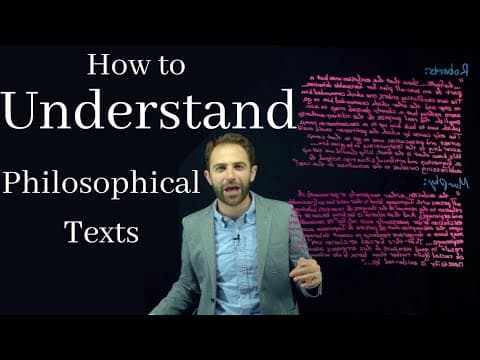
[0:00]Because this is a video that I'm posting on the internet, you're just going to have to believe me.
[0:13]This is a video about how to read the texts that are assigned in a college level philosophy course. I'm going to give you six pieces of advice for how to read philosophy, and I'm going to save the best, most effective piece of advice for the end, because that's how you create tension. The first piece of advice is, don't remember, or don't try to remember what's going on in the text. Instead, just try to understand what's going on in the text. You need to first just understand what's happening in the reading, and then the memory will just happen automatically. Here's sort of a cheesy illustration of this point. Try to remember this. One, two, three. Do you remember what I just wrote on the board, over here and over here? I bet you can remember what it said over here, but you can't remember what it said over here. The reason for that is that this was written in a language that probably you don't understand. And so even though you saw these symbols, in fact, you saw them for longer than you saw the symbols in English. You had six seconds to try to remember what this said, and you only had three seconds to try to remember this. It turns out, by the way, that these two sets of symbols mean exactly the same thing, they just mean it in different languages. Okay, that was a cheesy example, you get the point. The point is, if you understand what the author is trying to say, not just even at the sentence or word level, but you have a a grasp of what's going on in the reading, then it'll just stick in your head. You'll just remember it, but if you don't try to first understand what's going on, you just try to remember it, it's just not going to work. Okay, fine. Well, how do you understand these readings? That brings us to piece of advice number two. Figure out which claims in the reading support which other claims. I'll illustrate this with an example from René Descartes. who was a French philosopher. His most famous philosophical work is called the Meditations on First Philosophy. They were published in 1641. Here are two passages that appear in meditation number six. The body is by its very nature always divisible, while the mind is utterly indivisible. And then the next passage is, the mind is completely different from the body. So let's just say very quickly what's going on in these two passages. Right, so Descartes is talking about the human body, that is the brain and the skull and the fingers and the toes and the lungs, all that stuff. And he's also talking about the human mind or the soul or whatever. And in the first passage, he's saying that the body is always divisible, that is it can always be chopped up into parts, but the mind can never be divided or chopped up into parts, it's indivisible, it's a single unit that you can't split up. And in the second passage, he's just saying that the mind and the body are two different things. They're not the same thing. Okay, Mr. Professor guy, thank you very much for reading those two sentences by this dead French philosopher. What's the point? The point is that these aren't just two random sentences. One of them supports the other one. This is an argument. The first claim that the body is divisible, but the mind is indivisible. That claim is meant to demonstrate or prove or be an argument in favor of the second claim, which is that the mind and the body are different things. If one thing can be chopped up into parts, and another thing can't be chopped up, well then the first and the second thing can't be the same thing. We don't need to dwell on the details of this argument. We just need to realize that this is an argument. One of these claims is meant to support the other claim. And let's notice that the word support here is a metaphor. Right, like the walls of a house literally support the roof of the house, but these words over here don't literally support some other words. So, when you run into a metaphor when you're reading philosophy, you should try to figure out what the literal meaning is. Here's the literal meaning in this case. When one claim supports another claim, what that means is that the first claim, if it's plausible or even in the end, if it's true, then therefore the second claim is also plausible or in the end is also true. That's what it is to make an argument for something or to give reasons for something. It's to present one claim which seems to show that the other claim has to be true. This relationship, wherein one claim supports another claim, that's the crucial, the central relationship in philosophical text. And this relationship of supporting or demonstrating or being an argument for something, that's not the central relationship in like all forms of writing. Like in some works of literature, those works are all about symbolism. So like in The Great Gatsby by F. Scott Fitzgerald, I think there's like a billboard in the book and the billboard has the sky's eyes on it. It's like an advertisement for an eye doctor or something. I think his name was Dr. T. J. Eckleburg, and that might be the only thing I remember from the book. But the point is, those eyes on the billboard, they were supposed to symbolize something like, maybe they symbolized the emptiness of materialism and consumerism, or maybe they symbolized the eyes of God or whatever. I have no idea. The point is just that symbolism is not the main thing that you want to look out for when you're reading a philosophical text. What you want to look out for is some claims supporting or demonstrating or being reasons for other claims. The whole time you're reading a philosophical text, that's what you want to be on the hunt for. Piece of advice number three, don't skip the sign posts. To illustrate this, here's a passage by Barbara McKinnon. McKinnon is a very famous moral philosopher, she's still alive today. I think she's probably professor emeritus now at the University of San Francisco. Here's something that she says. A second reason to believe that what relativism holds is true is the great difficulty we often have in knowing what is the morally right thing to believe or do. Okay, what does that mean? Don't just try to figure it out all at once. Look for the sign posts. Right, sign posts are little signs or signals that get posted in. They get placed throughout the reading to point you to what's going on when. So the passage begins with, a second reason to believe that what relativism holds is true is the great difficulty we often have in knowing what is the morally right thing to believe or do. That's a signpost, a reason to believe. When you see that, she's telling you some reason or argument to believe something. What is this going to be a reason to believe? Well, it comes immediately next in the sentence, what relativism holds is true. Okay, so we're getting some argument for relativism. Relativism is a theory. In this case, it's a meta-ethical theory. And then there's that word second. She's numbering things. So if you come across the word second, then you need to figure out what was the first thing. That signposts, that word second that appeared in the text, that's your hint. Oh no, I gotta go back and figure out what the first thing was. Here's some other signposts, therefore, hence, as a result, consequently, thus. All of these are signposts that tell you when one idea or claim supports another idea or claim. If you see the word thus, then you know that what came before that word is meant to support whatever comes after that word. These signposts are a hint or a clue that's telling you about the most important thing that happens in philosophical readings. Here's some more, because, since. These are also signposts that clue you in to when one idea supports another idea, but they do it in the reverse order. If you see the word because, then you know that the thing that comes after the word is the thing that supports whatever came before that word. And the last very common, very important type of signpost that I'll mention here is something like this. One might object by saying, blah, blah, blah. What happens in philosophical texts all the time is that the author of the text will raise an objection to their own view, just so that they can knock down that objection. And when they're describing the objection, it may take them paragraphs or pages or even a whole chapter or something like that. And there may be only one or two little signals like this that tell you that what they're talking about is not their own view, but their opponent's view. It's tempting to skip over all of these signposts because they seem like they might be insignificant, but they're hugely important. If you skip over a signpost like this, then you might not realize that this whole paragraph is the opposite of the view that the author is arguing in favor. Right, like even that passage by McKinnon, she's just presenting some reasons to believe that relativism is true. Does that mean that she's a relativist, like a meta-ethical relativist, is that her theory? We don't know. What we need to do is look at the surrounding parts of the text and find the signposts to figure out whether she's advancing her own view at that part of the reading or whether she's laying out her opponent's view or whatever. Piece of advice number four, make abstractions concrete. To illustrate this one, here's a passage from Princess Elizabeth of Bohemia. Princess Elizabeth was a real princess, like her dad was a king or something, and she lived at the same time as Descartes, who we were talking about before. And they used to write letters to each other about philosophy, and in one letter or series of letters from the spring of 1643, she just like demolishes this whole central claim of Descartes in this one letter. And anyway, here's a portion of a sentence from one of those letters from 1643. The movement of something depends on the kind of impulse it gets from what sets it in motion, or again, on the nature and shape of this latter thing's surface. Okay, what? That's like very abstract. It's very hard to understand what's going on in that sentence. And so what we need to do, this is a tactic for understanding very abstract sentences, is you take some concrete example, some very real-world example, and you you put it in to all the places where the abstractions occur in the sentence, and then you reread the sentence and you say, oh, that's what it means. And then, of course, at the end, you take those concrete examples back out and reread the abstraction again. So let's do that. Okay, so the original quote is on the top, and I'm just going to read that. The movement of something, stop there. Something, what? Well, let's just pick a thing, like anything. So I've picked a rock, like a stone or whatever. And on the bottom, I just replaced the word something with a rock. So it reads, the movement of a rock. Okay, so we keep going with the original sentence on the top. The movement of something, let's say, a rock, depends on the kind of impulse it, well, what's it? It's the rock, right? Okay, so we replace it with the rock again on the bottom, and we keep going on the top. The movement of something depends on the kind of impulse it, the rock, gets from what sets it in motion. What sets it in motion? So there's something that sets the rock in motion, like there's something that moves the rock. So what's it going to be? Well, let's just say it's a hand. Like a human hand pushes the rock. Okay, that's the concrete example that we're replacing here. So now we just replace with what sets it in motion, with a hand that pushes the rock. Okay, and then it says, or again, on the nature and shape of this latter thing's surface. This latter. The latter thing is the second thing. Latter means the second thing. So, first we had the rock, then we had the hand. The hand is the second thing. So, the latter thing is the hand. So now we've got that whole sentence on the bottom. I'm going to read this whole sentence on the bottom, work through it with me. The movement of a rock depends on the kind of impulse the rock gets from a hand that pushes it. So like, the way that the hand pushes the rock, like whether it comes from the top or from the side or whatever, that determines how the rock is going to move. Okay, that's like actually a really simple idea when we fill in the concrete example. And then let's let's finish the quote with the concrete examples still filled in. Or again, on the nature and shape of the hand's surface. Right, so like the way that the rock moves depends not just on the kind of impulse that it's getting from the hand, like what angle it's coming from and how hard the hand is hitting it, but also on like the nature and shape of the hand. Right, so like if my hand is like this, then it'll then the rock will move differently than if my hand is like this or whatever. Okay, that's actually a really, really simple idea that Princess Elizabeth is saying there. She's just making it in a very abstract way. She's not making the point about rocks and hands. She's making that point about all objects. So then, once we figured out what this sentence means as applied to rocks and hands or whatever, these examples that we made up and we and we put into the to the abstract example, we we take them out again. We reread the sentence in its full abstract form. And it reads just like before. The movement of something depends on the kind of impulse it gets from what sets it in motion, or again, on the nature and shape of this latter thing's surface. Now we understand what that means. Or again, on the nature and shape of this latter thing's surface. Piece of advice number five, try to disprove what you're reading. To explain this, here's a passage from Tommy Shelby. Shelby is a very well-known, still living, professor at Harvard. Here's something that he says. The oppressed within a seriously unjust society can be fairly criticized when they fail to fulfill their basic moral duties to others, including their duty to contribute to reforming their society. What Shelby is saying is that being oppressed is not like a complete get out of morality free card. You still have moral obligations, and other people can still criticize you for not fulfilling your moral obligations. And Shelby has some argument for this or whatever, but we're not going to focus on that right now. The point is, when you come across a claim like this, you should try temporarily, for the sake of understanding the fullness of the text, you should try to argue against it yourself in your mind when you're reading it. How would you argue against the claim that people who've been oppressed continue to have their moral obligations? Well, maybe you'd come up with an example where someone is victimized or oppressed or something is bad bad happens to them, and then their a some duty of theirs goes away. They no longer have some duty or obligation that they previously had. And then you could say, well, the normal kind of moral duties that people have in society aren't different from the kind of duty that this person lost when something bad happened to them. That's just a sort of very broad, very generic outline of how one could argue against this claim that Shelby made. The only point is that when you're reading a philosophical text, you should try to do this along the way. You've made it this far. Now you get the sixth most important, most powerful, most efficient piece of advice for how to read text in a college level philosophy class. And that piece of advice is, read it more than once. When I say this at the beginning of the semester in all of the courses that I teach, most of the students just kind of don't believe me. They think, look, I read the thing, if I didn't understand it the first time, I'm not going to understand it the second time. And I know this sounds kind of crazy, but that's just wrong. If you read the text again, you will get more out of it. You will notice things that you didn't notice before. It really and truly does work. Of course, there are some diminishing returns. Like the tenth time that you read some paragraph, you don't learn nearly as much from it as you learned the second time. But philosophical texts are hard. And so, when I teach regular full courses, I do this sort of activity in the classroom, where I have the students read a passage, and then they take a little quiz on it. And then I make them read it again, and I don't explain anything to them in between the first time they read it and the second time they read it. And then I give them another harder quiz or whatever. And the result of this exercise is that at least some of them come to believe me that like, oh, yeah, if I just read it again, I just will understand more. Because this is a video that I'm posting on the internet, you're just going to have to believe me. I like can't make you go through that exercise right now. Just trust me when I tell you, this really works.


