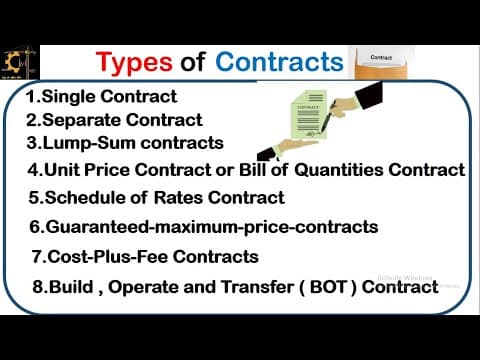
[0:05]Hello guys, I'm engineer Mohammad Adnan Khan and you are watching my YouTube channel Civilogy. In this video lecture, we are going to discuss the most important topic of the project management, that is contracts. What are the types of contracts? We will discuss eight different types of contracts that are in practice in the construction field. Being civil engineer, you must know about these types of contracts for the as you now, for example, if you are watching this video, being a site engineer or a construction engineer, in the upcoming days or in the upcoming years, you will be at the managerial post or at the management management post. So you must know about these types of contracts and what these contracts are about, what are the benefits and its advantages and disadvantages and what are these contracts about or what these contracts explains to you. We will discuss the first one is single contract, second one is separate contract, third one is lump sum contract, fourth one is unit price contract or bill of quantities contract. Fifth one is schedule of rates contract, sixth one is guaranteed-maximum-price-contracts, seventh one is Cost-Plus-Fee Contracts, eighth one is Build, Operate and Transfer (BOT) Contract. These are the eight major types of construction contracts which the engineer must know about these types of contracts. But before we start our today's topic, if you are new to my channel, you are requested to please subscribe it and press the bell icon to get more construction or civil engineering related video updates. So let's start our today's topic. The first one is single contract.
[2:04]Single contract, the owner contracts with the prime contractor. Now we as we can see here in construction, there are three major industries or you can say three major persons are involved in the construction industry, that is owner, which we can say it is also called as client, the contractor and the consultant. Okay, now in single contract, owner contracts with the prime contractor and prime contractor hires subcontractors and material suppliers.
[2:47]Subcontractors and suppliers are responsible towards the prime contractor. Prime contractor is responsible directly to the owner.
[3:07]You are getting my point, right? It's mean that prime contract and the owner are in contact with each other and subcontractor or material suppliers have nothing to do with the owner or client and the subcontractor is responsible to the prime contractor. Okay? The second one is separate contracts. Owner contracts separately for as the as it is obvious from the name, that separate contract means separate for each item or unit. For example, general construction, plumbing, heating, electrical or sewage disposal, specialties like elevators, lifts, air conditioning, etc.. It's mean that you have to contract with the subcontractors or the client or owner contract separately with the prime containers for the purpose of general construction or plumbing, heating, electrical for each unit separately. Third one is lump sum contract as the name tells us about that it is about lump sum. I mean, it's mean you can say that you have to pay single in a single amount or you have to pay in one go, the total amount of the construction of the project. The lump sum contract can sometimes be called 'Stipulated Sum' and is the most basic form of agreement where the contractor/supplier agrees a fixed lump sum price to undertake all the specified contract works and the employer (owner) agrees to pay this price upon completion of works. That in contract you already specify all the specifications, all the conditions, all the terms and conditions in the contract and the contractor agrees to carry out all the works or unit of works according to these specifications and terms and conditions and the owner and the owner agrees to pay the whole amount upon the completion of the work. The fourth one is unit price contract or bill of quantities contract. In a unit price contract, the work to be performed is broken into various parts, usually by construction trade, and a fixed price is established for each unit of work.
[5:44]For example, painting is typically done on a square foot basis. Unit price contracts are seldom used for an entire major construction project, but they are frequently used for agreements with sub-contractors. It's mean that the client will hand over the project to the prime contractor and the prime contractor will further make a contract or agreement with the sub contractor to carry out these units, unit of works on the unit price. The fifth one is schedule of rates contract. It contains inaccurate quantities of work. It's mean that it is the rough estimate or you can say the rough quantity of work, it is common for separate rates to be quoted for labor, materials, equipment, sub-contract work, temporary works. The contract price is derived by measuring the man hours, plant hours and quantities of materials actually consumed, and then pricing them at the tendered rates. The sixth one is guaranteed-maximum-price-contracts. The contractor agrees to undertake the project for a fixed price (A) and also gives a guarantee that a target price will not be exceeded unless the owner makes further additions to the work. Good management by the contractor is crucial for successful application of this type of contract. Now you can observe over here that this for for this type of contract, the contractor have to have good management skills or good management team, so that the amount or the target price should not exceed the the agreed sum. In some guaranteed maximum price contracts, a savings clause provide that if a project costs the owner less than the guaranteed maximum price the owner and the contractor are to split the difference between the cost and the maximum guaranteed price. The seventh one is Cost-Plus-Fee Contracts. The contractor undertakes the job, the owner pays for construction costs and adds a fee for management by the contractor. As you can see over here it is cost plus fee contracts. Okay, the cost, which is the actual cost of the whole project plus the fee contracts, which means that the owner pays for construction costs and adds a fee. Further fee is added for management by the contractor. It is necessary to have a reputable and efficient contractor who will undertake the detailed accounting for the contract. The eighth one is Built, Operate and Transfer contract. This type of contractor is sometimes, sorry, this type of contract is sometimes known as “Build, Own, Operate and Transfer (BOOT) contract”.
[9:08]The client will lay out a series of required end products with specification, terms and conditions; and the contractor has to finance, design, construct, maintain, manage and operate the finished work for an agreed period say 10 years, 20 years or so.
[10:33]These are the important terms. In this contract you can say built, operate and transfer contract, the contractor can own the project for a specified if he completed, completes the project. For example, let's say the completion period of the project is 10 years and he completes the project in 5 years, now then he have 5 years ownership. Okay, to get profit, to get profit from the users. For example, he build the construction, residential building and he rent the building to someone. The rent will be considered as the profit to the contractor and at the end of the 10 years or the agreed period, that is 10 years or 20 years, he will have to hand over the project to the client in specified conditions. That's all for today. In the end, you are again requested, if you are new to my channel, please subscribe the channel and press the bell icon to get more video updates.


