[0:00]Here's something most parents don't realize. Before your child turns five, their brain is growing faster than it ever will again, and you are the architect. Not toys, not tablets, not schools, you, your face, your voice, your attention, your interaction. And in the next few minutes, I'm going to show you exactly how everyday interactions in the early years literally shape your child's brain, their future confidence, their emotional strength, and even their success as adults. Most parents don't know this, but you will by the end of this video. Let's begin. The critical window, from birth to age 5, your child's brain is in what scientists call a supercharged growth phase. Over 1 million new neural connections form every single second. Yes, every second. And here is the part that shocks many parents. These connections do not form automatically. They form based on interaction, based on serve and return exchanges, the back and forth moments between parent and child. Every time your child babbles and you respond, every time your baby points and you look, every time your toddler asks why and you answer, you are building architecture inside their brain. You are wiring emotional intelligence, language, memory, attention, self-control, creativity and resilience. This is why what happens before age five is not baby stuff. It is brain building, and today I will teach you how to do it powerfully. Section one, the science why interaction builds the brain. One, the brain needs connection to grow. Children's brains develop through a system called neural sculpting. Every smile you share, every conversation, every cuddle tells the brain, build here, strengthen this pathway. When you don't interact, those pathways weaken or disappear. This is why studies show babies who experience responsive interaction have better language skills. Toddlers who receive consistent emotional attention develop stronger stress regulation. Children who experience loving connection early show higher IQ scores, better mental health and stronger social skills later. Two, the serve and return principle. This is simple but powerful. The child serves, you return. Child raises their hands to be carried. Parent picks the child up. Child looks at a toy. Parent talks about the toy. Child, mama. Yes, baby, I'm here. Every serve and return builds synapses, strengthens attachment and prepares the brain for learning, discipline and relationships. This is why children who feel connected are easier to teach and guide. Section two, practical, science backed ways to build your child's brain. One, talk more, but talk with your child. Talking to a child is instruction. Talking with a child is nutrition. Use what scientists call parentese, warm, exaggerated, melodic speech, not baby talk. Emotion rich communication, it boosts language, memory, emotional bonding, cognitive flexibility. Tip, describe everything you're doing. Narrate their world. It builds vocabulary faster than flashcards ever will. Two, touch and physical affection. Hug them, hold them, rock them, stroke their hair. Touch activates the vagus nerve, reduces stress hormones and increases oxytocin, the bonding hormone. Affection literally grows the emotional center of the brain. A child who feels safe learns better, sleeps better, behaves better, and listens better. Three, play, the brain's laboratory. Play is not a luxury. It is a biological necessity. Through play children learn problem solving, creativity, social intelligence, motor skills, focus. Let them explore, let them imagine, let them fail safely, let them try again. Studies show unstructured play builds the prefrontal cortex, the center for decision making and self-control. Four, eye contact and facial expressions, the social mirror. Your face teaches emotions, your eyes teach safety, your smile teaches confidence. When you look into your child's eyes while speaking, their brain releases chemicals that strengthen learning and connection. You are their emotional mirror. They read you to understand the world. Five, read to them every day. Reading is the most powerful brain building activity you can do. It strengthens imagination, language, attention, empathy. Even if they don't understand the words, your voice still wires the brain. A study found that reading to toddlers increases vocabulary by over 1 million words by kindergarten. Six, respond to emotions, not just behavior. When your child cries, shouts or becomes frustrated, their brain is overwhelmed. If you ignore them, the brain learns, my emotions are unsafe. If you respond gently, the brain learns, I can handle difficult feelings. This develops emotional intelligence, self-control, resilience, stress regulation. Your calm becomes their calm. Seven, limit screens. They block interaction. Screens talk at children, not with them. Screens don't smile back. Screens don't do serve and return. Screens don't build emotional intelligence. Under age five, screens should be limited because they can delay speech, attention, social skills. What screens remove is not time, it is connection. Use screens for communication only, not babysitting. Section three, the big secret parents never hear. You don't need to be a perfect parent. You don't need expensive toys. You don't need to be a scientist. You only need to be emotionally available. The secret is simple, mini moments repeated daily build massive brain development. A two minute cuddle, a five minute conversation, a bedtime story, a smile, a warm I love you. These small actions repeated before age five build confidence, intelligence, character, empathy, resilience, purpose, emotional strength. Your child is not waiting to be older before learning who they are. They are learning now from you. What you do now will shape who they become. So when you interact with your child today, remember this, you are not just raising a child, you are wiring a brain. You are planting seeds of identity. You are shaping emotional patterns that will last a lifetime. Every word you say, every hug you give, every playful moment is building something eternal inside them. If you take only one message from this video, let it be this, before age five, your presence is power. Your interaction is intelligence, your love is architecture, and your connection is your child's greatest chance at a strong, healthy and successful future. You are building a brain, and you are doing an amazing job.
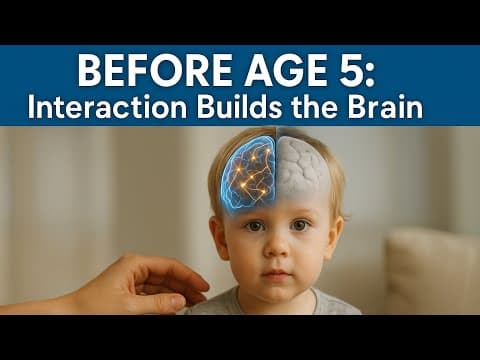
BEFORE AGE 5: Interaction Builds the Brain — Here’s How!
Parenting Hacks
6m 49s1,011 words~6 min read
YouTube auto captions
Transcript source
YouTube auto captions
This transcript was extracted from YouTube's auto-generated caption track. The transcript below is server-rendered so it can be read, searched, cited, and shared without opening the original YouTube player.
Pull quotes
[0:00]Before your child turns five, their brain is growing faster than it ever will again, and you are the architect.
[0:00]Not toys, not tablets, not schools, you, your face, your voice, your attention, your interaction.
[0:00]The critical window, from birth to age 5, your child's brain is in what scientists call a supercharged growth phase.
[0:00]They form based on interaction, based on serve and return exchanges, the back and forth moments between parent and child.
Use this transcript
Related transcript hubs
Watch on YouTube
Share
MORE TRANSCRIPTS


