[0:01]Hey Bob, do you have any plans this Friday? Yeah, I'm meeting Jane at 3:30 p.m. on Friday. I'm meeting Jane at 3:30 p.m. on Friday. Are we talking about the present or the future? We're talking about the future. Is it a fixed arrangement? Before you answer this question, let's define the word arrangement. An arrangement is a plan between two people or group for a future event. It's a plan that you have decided and organized with other people. So back to our question, is it a fixed arrangement? Yes.
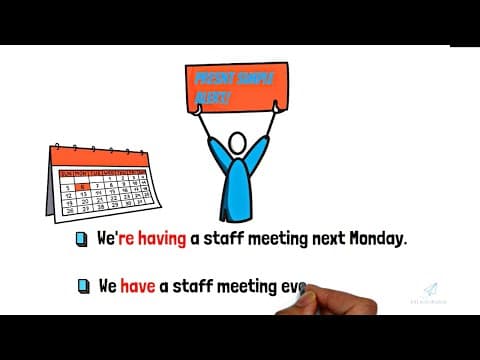
[0:43]The present continuous is used to talk about fixed arrangements when arrangements or plans have been made between people. We usually specify a future time on Friday, tomorrow, next weekend, unless it's already clear that we are referring to the future and not the present. For example, Bob could have just said, I'm meeting Jane, because it would be clear that he's referring to the future. Be careful, the simple present is used when a future event is a part of a program or a time table. Notice the difference between these two sentences. We're having a staff meeting next Monday. We have a staff meeting every Monday. In the first example, the meeting is just that once. Whereas in the second example, the meeting happens every week. It's part of the company's program. As we explained earlier, only people can make arrangements. Which means we use this tense only when people are responsible for the action. Look at these three examples and guess which one is the odd one out. As you may have probably guessed, the odd one out is example number three. Examples one and two are future plans made by people, in other words, arrangements. But example number three is a future event that doesn't involve people. It's a natural phenomenon, so it can't be considered an arrangement. Since it's not an arrangement, we don't use the present continuous, which means this sentence is not correct. So if you want to make this right, we use a different grammar structure to express this future event. We should say, it's going to rain tomorrow.
[2:40]That's it for now. See you in the next lesson when we will learn how to use going to to talk about the future.


