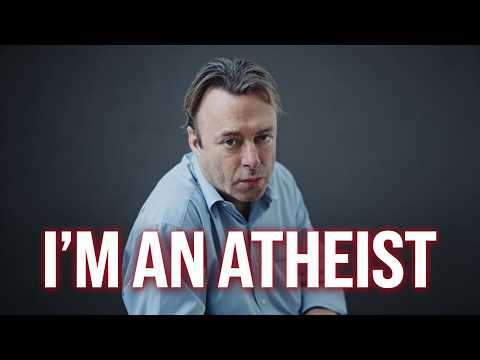
[0:08]Why I'm an atheist. You ask me why I'm an atheist, and I must say the question itself contains a rather fascinating assumption. That atheism requires explanation, justification, defense, as if the natural state of human consciousness were belief in the supernatural. And those of us who've declined this particular invitation need to account for our apostasy. But let me turn that assumption on its head if I may. The real question, the one that actually demands an answer is not why I'm an atheist. But why anyone would be anything else? Why given everything we know about the universe, about human psychology, about the origins of religious belief, about the transparently man-made nature of every holy text ever written, would anyone choose to organize their understanding of reality around the claims of Iron Age mythology? I'm an atheist for the same reason I don't believe in astrology, homeopathy or the idea that Elvis is still alive and working at a gas station in Memphis. I'm an atheist because I care about what's true, and religious claims about the nature of reality are demonstrably, provably, embarrassingly false. Not metaphorically false, not poetically false, but actually false in the same way that claiming the earth is flat is false. The universe was not created in six days by a deity who then needed a rest. Humans did not spring fully formed from the clay. The geological record is not evidence of a global flood. Prayer does not cure disease. The dead do not rise. Virgins do not give birth. These are not matters of interpretation or faith. These are factual claims about the physical world and they are wrong. But it goes deeper than mere factual error, doesn't it? I'm an atheist because even if I could somehow be convinced that a God exists, and I can't imagine what evidence would suffice, but let's grant it for the sake of argument, I would still refuse to worship such a being. The God described in the Bible, the Quran, the Torah, this is not a being worthy of admiration, let alone worship. This is a celestial dictator, a cosmic Kim Jong Ill, who demands absolute obedience, who punishes thought crime, who established a system whereby we're created sick and commanded to be well, then held responsible for our inevitable failures and threatened with infinite punishment for finite sins. What kind of moral monster creates beings capable of suffering, designs a world filled with disease and disaster and cruelty, then demands gratitude and praise for the occasional respite from the misery he himself ordained? I'm an atheist because the problem of evil is not a problem. It's a refutation. Every theologian who's ever tried to reconcile the existence of an all-powerful, all-knowing, all-loving God with the manifest reality of suffering in the world has failed, and failed for the same reason, the task is logically impossible. You can have a God who's all powerful but doesn't care about suffering. A God who cares but isn't powerful enough to prevent it, or no God at all. What you cannot have, what the evidence of your own eyes and the screams of tortured children will not permit, is a being who is simultaneously omnipotent, omniscient and omnibenevolent. The world we observe is precisely the world we would expect if there were no supernatural oversight whatsoever, if we were the product of blind evolutionary processes operating in an indifferent universe. That's not a tragedy. That's just reality. And I prefer reality to comforting delusions. I'm an atheist because I've read the holy books, and far from being impressed by their supposed wisdom and beauty, I've been appalled by their barbarism, their internal contradictions, their scientific and historical errors, their endorsement of slavery and genocide and misogyny. The Bible commands the execution of disobedient children, the stoning of adulteresses, the slaughter of neighboring tribes down to the last infant. It treats women as property, endorses human sacrifice, and presents a God who is by turns jealous, vengeful, capricious and genocidal. This is not sublime moral teaching. This is the moral reasoning of Bronze Age patriarchs, tribalists who knew nothing of modern ethics, modern science, modern anything. And yet we're supposed to treat this text as the inherent word of the Creator of the universe? It's laughable. It's obscene. And I refuse to pretend otherwise out of some misguided sense of respect for other people's beliefs. I'm an atheist because I understand where religious belief actually comes from, and it's not divine revelation. It's pattern recognition gone haywire, agency detection run amok, the tendency of the human mind to see intention and design where there is only chance and necessity. Our ancestors lived in a world they didn't understand, surrounded by forces they couldn't predict or control, storms, diseases, droughts, predators.
[5:03]So they invented stories to explain these phenomena, populated the world with spirits and demons and gods who could be appeased through ritual and sacrifice. This was the best they could do with the cognitive tools available to them. But we know better now. We have actual explanations for natural phenomena. Explanations that work, that make predictions, that cure diseases and put rovers on Mars. We don't need gods to explain lightning or earthquakes or the movement of the stars. And once you understand that religion is a human invention, a coping mechanism that evolved to help our ancestors deal with uncertainty and mortality. It loses whatever mystique it might once have possessed. I'm an atheist because religious moderation is intellectually dishonest. The moderates, the believers who've made their peace with modernity, who accept evolution and the Big Bang, and gay marriage and women's equality, these people have arrived at their positions not by reading their holy texts more carefully, But by ignoring the parts that contradict contemporary morality. They've decided quite sensibly that stoning adulteresses and keeping slaves and killing apostates are barbaric practices that should be abandoned. But on what basis? Not scripture, which explicitly endorses these things, not tradition, which practiced them for centuries. No, they've made these moral judgments using the same faculties of reason and empathy that atheists use, then retrofitted their religion to accommodate these conclusions. They're atheists who haven't yet admitted it themselves, cherry picking the bits of religion they find congenial while discarding the rest. And that's fine as far as it goes, but let's not pretend there's any principle at work here other than secular moral reasoning. I'm an atheist because I value intellectual honesty, and there is nothing honest about faith. Faith is the surrender of reason, the abdication of critical thinking, the willingness to believe things without evidence or even in the face of contrary evidence. Religious believers will say this is a virtue, this capacity to believe without proof. But why? In every other domain of human life, we recognize that believing things without evidence is a vice, a failure of reasoning, a path to error. We don't admire people who believe in conspiracy theories or pyramid schemes or fraudulent medical treatments. We recognize that they've been duped, that they've failed to apply appropriate skepticism. But somehow when the claims concern the supernatural, when they're embedded in ancient texts and backed by institutional authority, we're supposed to treat this same epistemological failure as noble, as a sign of spiritual depth. I reject that entirely. If your beliefs cannot withstand scrutiny, if they require the suspension of critical faculties, then they're not worth holding. I'm an atheist because the arguments for God's existence are unconvincing, every single one of them. The cosmological argument, everything that begins to exist must have a cause, therefore the universe must have a cause, therefore God, is special pleading. If everything needs a cause, then so does God. If God doesn't need a cause, then neither does the universe. The teleological argument, the appearance of design in nature points to a designer, is undermined by our understanding of evolution by natural selection, which explains apparent design through entirely natural processes. The ontological argument, God is that than which nothing greater can be conceived, existence is greater than non-existence, therefore God exists, is word games, an attempt to define something into existence. The moral argument, objective morality requires God, gets things exactly backward. Morality based on divine command is the opposite of objective, it's the most subjective thing imaginable, the mere opinion of a being who happens to be powerful. And the argument from religious experience, people feel the presence of God, therefore God exists, proves far too much. People also feel the presence of aliens, the Virgin Mary, their dead relatives, and any number of things that we have good reason to think aren't actually there. I'm an atheist because religion is not a force for good in the world, whatever its apologists might claim. Yes, religious people do good things, they also do terrible things, often in the name of their faith. But the good things they do, feeding the hungry, clothing the naked, caring for the sick, these don't require religious motivation. Secular charity has accomplished the same ends without the theological baggage. The terrible things, on the other hand, the persecution of heretics, the oppression of women, the demonization of homosexuals, the obstruction of scientific progress, the instigation of sectarian violence, these flow directly from religious doctrine.
[10:04]You can't fly airplanes into buildings for secular reasons. You can't stone adulterers in the name of humanism. You can't wage holy war on behalf of atheism. These atrocities require the absolute certainty that comes from believing you're acting on divine authority, that you're serving a higher purpose that transcends mere human morality. Religion doesn't make people better. At best, it's irrelevant to their behavior. At worst, it provides justification and motivation for unspeakable cruelty. I'm an atheist because the idea of an afterlife is wishful thinking, a refusal to accept our mortality, a childish demand that the universe should conform to our desires rather than accepting it as it is. We're going to die. Consciousness will cease. There will be no reunion with loved ones, no heavenly reward, no continuation of the self in any form. And this is not a tragedy, it's simply the way things are. The universe owes us nothing, certainly not eternal life. And frankly, eternal life would be a curse, not a blessing. Imagine existing forever for billions and trillions of years, long after the heat death of the universe, with nothing to do, nowhere to go, no way to end the tedium. It's a nightmare masquerading as paradise. No, I'm content with the finite span we're given. It makes life more precious, not less. It concentrates the mind wonderfully on how we spend our time, on treating others well while we can, on making the most of our brief flicker of consciousness in an ancient and indifferent cosmos. I'm an atheist because morality does not require God. This is perhaps the most pernicious lie religion tells. That without divine authority, morality collapses. That atheists have no reason to be good, that ethics requires supernatural grounding. But think about what this actually means. If you're only good because you fear divine punishment, or hope for divine reward, then you're not actually good at all. You're just prudent, you're just calculating self-interest over an infinite time horizon. True morality is doing what's right because it's right, not because you expect to be paid for it. And we know what's right through empathy, through reason, through recognizing that other conscious beings can suffer and flourish just as we can. And that their suffering and flourishing matters. We don't need a God to tell us that causing unnecessary suffering is wrong. We don't need ancient texts to inform us that kindness is preferable to cruelty. These are conclusions we can reach through careful thinking about the world we want to live in and the kind of people we want to be. I'm an atheist because the diversity of religious belief undermines the claims of any single religion. If Christianity were true, if Islam were true, if Hinduism were true, we'd expect everyone who examined the evidence fairly to reach the same conclusion. But instead we find that religious belief is overwhelmingly determined by accidents of birth. If you're born in Saudi Arabia, you'll almost certainly be Muslim. If you're born in India, you'll likely be Hindu. I You're born in Mississippi, you'll probably be Christian. Does God reveal himself only to people in certain geographic regions? Does truth change based on your latitude? Of course not. The obvious explanation is that people adopt the religion of their culture, their family, their community and then convince themselves that they've discovered universal truth. They can't all be right, they can be and I would argue are all wrong. I'm an atheist because science works and religion doesn't. By which I mean that science produces results, makes predictions, builds technologies, cures diseases, sends spacecraft to other planets. It does this through a rigorous methodology of observation, hypothesis, experiment and revision. It's self correcting. When scientists get things wrong, the process of science eventually identifies and corrects those errors. Religion, by contrast, produces nothing but assertions backed by authority and tradition. It makes no predictions. It enables no technologies. Its claims about the world have been repeatedly contradicted by actual investigation. And when religion gets things wrong, which is often, it doesn't correct itself. It either ignores the contrary evidence, or reinterprets its doctrines to accommodate it, then pretends this was what it meant all along. That's not a path to truth, that's a path to nowhere. I'm an atheist because religious claims are unfalsifiable, and unfalsifiable claims are worthless. If I tell you that there's an invisible, undetectable dragon living in my garage, and you reasonably ask for evidence, and I respond that the dragon is invisible to all forms of observation, leaves no physical traces, and cannot be detected by any instrument, then what exactly am I claiming? I'm not making a factual assertion about reality, I'm just playing word games. And this is precisely what religion does. God is immaterial, outside of space and time, beyond human comprehension, working in mysterious ways. Every potential piece of counter evidence is explained away. Prayers that go unanswered, God's will. Natural disasters that kill thousands, God's plan. The complete absence of any empirical evidence for divine intervention, God doesn't reveal himself in ways that would convince skeptics. It's intellectually bankrupt. If a claim can't possibly be proven false, then it can't possibly be proven true either. It's simply meaningless. I'm an atheist because I respect myself too much to believe I'm inherently sinful, fallen, in need of salvation from a cosmic crime I didn't commit. The doctrine of original sin is psychological abuse. It tells you that you're broken from birth, that your natural desires are shameful, that your very existence is an offense to the divine. It creates an artificial problem, you're sinful, then offers its own solution, except Jesus or Muhammad or whatever savior your particular religion provides. It's a protection racket. It's like smashing someone's windows, then offering to sell them say, security services. I reject it utterly. I'm not perfect, I make mistakes, I have flaws, but I'm not fundamentally corrupted. I'm a human being, the product of millions of years of evolution, doing my best to navigate a complex world with the tools I've inherited. That's not something to be ashamed of. That's something to work with, to improve, to understand. And I can do that without prostrating myself before invisible authorities. I'm an atheist because prayer is talking to yourself. Every study that's tried to measure the efficacy of intercessory prayer has come up empty. When you control for variables, when you do proper double blind testing, prayer has no effect on outcomes, none. It doesn't heal the sick, it doesn't prevent disasters, it doesn't change anything except possibly the psychological state of the person praying. And meditation or self-reflection would accomplish the same thing without requiring belief in the supernatural. People pray because it makes them feel better, because it gives them the illusion of control, because it's a coping mechanism. Fine, but let's not pretend there's anyone listening. Let's not act as if the Creator of the universe is standing by waiting for your request, ready to intervene in the laws of physics on your behalf, if only you phrase your petition correctly and believe with sufficient intensity. I'm an atheist because the concept of hell is morally obscene. Infinite punishment for finite sins is not justice, it's sadism. No crime, no matter how terrible, deserves eternal torture. Hitler doesn't deserve eternal torture. Stalin doesn't deserve eternal torture. The worst human being whoever lived doesn't deserve infinite suffering, it's disproportionate, which means it's unjust. And the Christian version is even worse, because it's not even about the severity of your sins. It's about whether you believe the right things. You can be the most moral person imaginable, devoting your life to helping others, and if you don't accept Jesus as your savior, you're damned. Meanwhile a serial killer who repents on his deathbed gets paradise. This is not a moral system, this is not divine justice, this is Bronze Age tribalism, the kind of thinking that says our group is saved, everyone else is damned, dressed up in theological language. I'm an atheist because free will and omniscience are incompatible. If God knows everything that will happen, if he knew before creating the universe every choice every person would make, then those choices aren't truly free. The future is fixed. You couldn't have chosen otherwise because God already knew what you would choose. And if you couldn't have chosen otherwise, how can you be held responsible? How can you be punished or rewarded for actions you were always going to perform? The theological gymnastics required to get around this problem are impressive in their way, but ultimately unconvincing. Either we have free will, in which case God doesn't know what we'll choose, or God is omniscient, in which case our choices are predetermined. You can't have it both ways, and both options create serious problems for traditional theology. I'm an atheist because consciousness is what the brain does, and when the brain stops so does consciousness. Every piece of evidence we have points to the mind being the product of physical processes in the brain. Damage the brain and you damage the mind in predictable ways. Alter brain chemistry and you alter consciousness. There's no evidence whatsoever for a soul that exists independently of the body, no reason to think that consciousness could survive the death of the brain. The idea of a soul is a relic of a time when people didn't understand neuroscience, when they couldn't imagine how mere matter could give rise to thought and feeling. But we understand it now, or at least we're beginning to. Consciousness is an emergent property of sufficiently complex information processing systems. It's remarkable, it's mysterious in some ways, but it's not supernatural, and it ends when the physical processes that give rise to it end. I'm an atheist because I've seen the mechanisms by which religions spread, and they're not divine revelation. There's social pressure, indoctrination of children, exploitation of fear and hope, and sometimes outright coercion. No one is born believing in Jesus, Muhammad or Vishnu. These beliefs are taught, usually to young children before they've developed critical thinking skills, reinforced through repetition and community pressure, and defended through threats of social ostracism, or worse for those who question them. This is not how truth spreads. Truth doesn't require you to catch children before they can think for themselves. Truth doesn't threaten you with hellfire for doubt. Truth doesn't need to insulate itself from criticism. The fact that religions go to such lengths to protect themselves from scrutiny, to prevent their adherents from being exposed to alternative viewpoints, tells you everything you need to know about the confidence their leaders have in their actual truth claims. I'm an atheist because theodicy fails. Every attempt to justify God's ways to man, to explain why a benevolent deity would permit suffering, collapses under examination. Suffering builds character. Tell that to the child dying of bone cancer. It's a test. An omniscient being doesn't need to test people. He already knows how they'll respond. It's the result of human free will. Most suffering isn't caused by human choices. It's caused by disease, natural disasters, genetic defects. We can't understand God's plan. Then on what basis do you claim it's benevolent? The problem of evil isn't just an intellectual puzzle for theologians, it's a decisive refutation of the existence of an all-powerful, all-knowing, all-loving God. The only honest response is to acknowledge that such a being doesn't exist, that the universe is indifferent to our suffering, and that if we want to reduce misery in the world, we'll have to do it ourselves. I'm an atheist because miracles don't happen. Every supposed miracle that's been seriously investigated has turned out to be either a misinterpretation, a fraud or explicable through natural causes. The sun didn't actually dance at Fatima. It was a combination of mass psychology and looking at the sun until you damage your retinas. Weeping statues aren't supernatural phenomena. They're condensation or deliberate trickery. Faith healings don't cure disease, they're placebo effects or misdiagnoses combined with regression to the mean. And this is exactly what we'd expect if naturalism were true and supernaturalism were false. In a universe without gods, we wouldn't see violations of natural law. We'd see exactly what we do see, a consistent, predictable physical reality that operates according to discoverable rules. The absence of genuine miracles is not something religion can explain. It's precisely what atheism predicts. I'm an atheist because the fine tuning argument is backward. Yes, the fundamental constants of the universe appear to be calibrated in such a way that life is possible. Change any of them significantly and we wouldn't be here. But this doesn't suggest design, it suggests selection bias. We find ourselves in a universe compatible with our existence because we couldn't exist in any other kind. If the constants were different, we wouldn't be here to observe them. Moreover, we have no idea what other kinds of life might be possible under different physical laws. And we're potentially living in a multiverse where all possible configurations exist, in which case it's inevitable that some universes would be life permitting. But even if we grant for the sake of argument that the universe was fine tuned, this doesn't get you to God. It gets you to some kind of tuner whose nature, purposes and characteristics remain completely unknown. Maybe it's a programmer and we're living in a simulation. Maybe it's a committee of lesser gods. Maybe it's something we can't even conceive of. The leap from the universe shows signs of fine tuning to therefore the God of Abraham exists and cares whether you eat shellfish is unjustified. I'm an atheist because religious experience proves nothing. People have profound experiences they interpret as encounters with the divine. And I don't doubt the sincerity or intensity of these experiences. But people have similarly intense experiences they interpret as alien abductions, past life memories, communications with the dead and any number of other things we have good reason to doubt.
[25:03]The human brain is capable of generating powerful feelings of transcendence, connection, presence. We can induce these feelings through meditation, drugs, sleep deprivation, sensory deprivation, electrical stimulation of certain brain regions. Their real experiences, but they're products of neurochemistry, not evidence of supernatural realms. And the fact that people interpret these experiences through the lens of their particular religious tradition. Christians see Jesus, Muslims see Muhammad, Hindus see their preferred deities, strongly suggests that interpretation is cultural rather than veridical. I'm an atheist because I find meaning and purpose without God. This is perhaps what troubles believers most. The idea that life without religion is somehow empty, meaningless, nihilistic. But why? I find meaning in relationships. In work I find valuable, in understanding the universe, in creating things, in helping others, in experiencing beauty and love and laughter. None of this requires belief in the supernatural. None of it is diminished by accepting that we're finite beings in an uncaring universe. If anything, it's enhanced. My relationships matter more because they're temporary. My work matters more because this is the only life I have to make a difference. Beauty is more precious because it's fleeting. I don't need cosmic significance to justify my existence. I exist, I'm conscious. I can experience and create value and that's enough. It has to be enough because it's all there is. I'm an atheist because I refuse to believe things just because they're comforting. Yes, it would be nice if there were a benevolent God watching over us, if death weren't the end, if justice would ultimately prevail. If the universe cared about our welfare, it would be nice. But nice if true is not evidence of truth. The universe is under no obligation to arrange itself according to our preferences. Reality is what it is, regardless of what we'd like it to be. And I'd rather face reality as it is, however harsh or indifferent, then retreat into comforting fantasies. There's a dignity in that, a maturity, an honesty. We're adults, we can handle the truth. We don't need fairy tales about loving sky fathers and eternal life. We can face our mortality, accept our insignificance in cosmic terms and still live meaningful, ethical, fulfilling lives. I'm an atheist because the burden of proof lies with those making the positive claim. I'm not claiming that I can prove God doesn't exist, anymore than I can prove there are no invisible unicorns, or that I'm not a brain in a vat. You can't prove a negative. What I'm saying is that there's no good reason to believe a God exists. That the evidence is absent, that the arguments fail, and that therefore the reasonable position is non-belief. If you claim there's a God, you need to provide evidence proportionate to the extraordinary nature of that claim. And look at the trees doesn't cut it. I feel it in my heart doesn't cut it. The ancient book says so doesn't cut it. Extraordinary claims require extraordinary evidence. And the claim that an invisible, immaterial, omnipotent, omniscient being created the universe and cares about human behavior is about as extraordinary as claims get. I'm an atheist because hypocrisy is the rule, not the exception among believers. I've watched evangelical Christians support the most transparently immoral politicians as long as those politicians advance their agenda. I've seen Catholics condemn abortion while protecting pedophile priests. I've observed Muslims who claim to follow a religion of peace justifying terrorism. I've witnessed believers of all stripes pick and choose which commandments to follow, which inconvenient doctrines to ignore, which barbaric practices to excuse as products of their time. And I've concluded that religious belief doesn't actually doesn't guide behavior in the way believers claim. People do what they want to do, then find religious justification for it afterward. Religion doesn't constrain human impulses, it provides cover for them. The good people would be good without it, the bad people use it as an excuse. I'm an atheist because I understand that morality has evolved. And religious morality has evolved right along with it despite claims of eternal, unchanging divine law. Christians no longer keep slaves, though the Bible explicitly permits slavery. They don't execute people for working on the Sabbath, though Mosaic law demands it. They do in practice polygamy, though the patriarchs did. They allow divorce, though Jesus forbade it. They've accepted the equality of women, the wrongness of racism, the rights of children, none of which are supported by scripture. How? By using the same moral reasoning that atheists use, the same empathy and rational consideration of harm and flourishing, then retrofitting their religion to accommodate these advances. This proves that secular morality is doing the heavy lifting, that we don't need religion to make moral progress, and in fact that religion actively impedes such progress until social pressure becomes overwhelming enough to force reinterpretation. I'm an atheist, finally, because it's the only intellectually honest position available to someone who values truth over comfort, evidence over authority, reason over revelation. I didn't choose to be an atheist in the sense of deciding that atheism would be a fun lifestyle or a useful identity. I simply followed the evidence where it led, asked hard questions and demanded good answers, refused to accept special pleading for religious claims, and concluded that there's no good reason to believe in any gods. This isn't a faith position. It's not a religion itself, despite what some apologists claim. It's simply the absence of belief in claims that haven't met their burden of proof. And until someone presents compelling evidence for the existence of a God, evidence that couldn't be better explained through natural causes. That makes specific predictions that are confirmed through observation, that survives rigorous skeptical scrutiny. I'll remain an atheist, not because I'm closed minded, but because I'm open-minded enough to change my views when presented with sufficient evidence. The problem is that such evidence has never been forthcoming, and after thousands of years of religious claims and theological arguments, I'm not holding my breath waiting for it to appear. So that's why I'm an atheist. Not because I'm angry at God. You can't be angry at something you don't believe exists. Not because I want to sin without guilt. I have a perfectly functional conscience without divine oversight. Not because I haven't heard the gospel. I've read the Bible more carefully than most Christians. Not because I'm arrogant. Humility is accepting that you're one species among millions on one planet among billions in a universe that's been around for billions of years and doesn't care about you. I'm an atheist because it's the only rational response to the available evidence. The only honest conclusion to draw from careful examination of religious claims. And the only position consistent with intellectual integrity and respect for truth. And I'm perfectly comfortable with that. I sleep well at night. I live a meaningful life. I treat others ethically. I face the future without fear of divine judgment or hope of heavenly reward. I accept my mortality and make the most of the time I have. And I do all of this without believing in any gods, which proves if nothing else, that such belief is unnecessary for living well. That might not be why you're an atheist, but it's why I am, and I see no reason whatsoever to change my mind.


