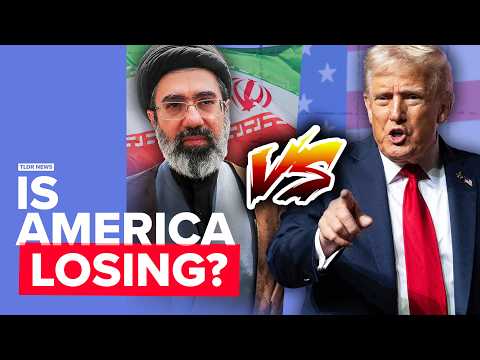
[0:00]At this point, it's become pretty clear that America's war in Iran isn't going to plan. Ayatollah has been replaced by his son, a reclusive hardliner. Negotiations have collapsed, and Iran is continuing to strike targets across the region with the furious consequences for the global economy. The US already looks like it's searching for an exit. On Monday, Trump himself claimed, somewhat implausibly, that the US has already won, and that the war, which Trump is now calling an excursion, could be over, quote, very soon. So in this video, we're going to explain why it looks like America is headed for what we might call a strategic defeat, and whether Trump can really just pull out at this point.
[0:48]Sam Altman was ranked seventh on our list of the world's most influential people. So in the latest issue of our magazine, we discuss how he surged up the list and why he could very plausibly tumble back into irrelevance all too quickly. That's just one of the 72 pages in the magazine, because as always, there's more to too long than you'd expect. Purchase your copy by clicking the link in the description. So, before we get into it, a few quick caveats. First, we should stress that strategic defeat is not the same as a military defeat. Militarily, Iran is probably losing. It's suffered more losses and more damage than either Israel or the US. However, the point we're trying to make is that despite his apparent military supremacy, the US seems unlikely to achieve its overarching strategic aims. Secondly, a strategic defeat for the US does not necessarily imply a strategic victory for Iran. If Iran were to collapse into a regionally destabilizing civil war, for instance, this would plausibly be a strategic defeat for both the regime and the US, given its likely impact on America's regional allies and the global economy. Third, evaluating whether the US has suffered a strategic defeat in Iran is made difficult by the fact it's not entirely clear what the US actually wants to achieve in Iran. Nonetheless, reading between the lines, we can see at least three overlapping strategic objectives. First, Trump wanted to achieve some sort of Venezuela style regime change, outing Ayatollah Ali Khamenei and replacing him with some more pliant regime insider. Trump made this pretty clear last week when he told the New York Times, quote, What we did in Venezuela, I think, is the perfect, the perfect scenario. Much like in Venezuela, where Trump snubbed official opposition leader Corina Machado and instead let Maduro be succeeded by his vice president Delcy Rodriguez, Trump also made it clear that he'd prefer Khamenei be succeeded by another regime insider. For instance, during a bilateral meeting with German Chancellor Friedrich Merz last week, Trump was asked about the prospect of installing Reza Pahlavi, the son of the last Shah and probably the best-known opposition figure in Iran, and responded by saying he preferred quote somebody from within. Anyway, the administration's second objective seems to have been to force an unfavorable deal on the regime. For context, before the war kicked off, the two sides were engaged in negotiation centered around Iran's nuclear program. Although the US was reportedly trying to expand negotiations to include Iran's ballistic missile program and its proxy network. Only hours before the first strikes, Oman, who were mediating the negotiations and who are usually pretty tight-lipped about this sort of thing, publicly signalled that the Iranians have made unprecedented concessions during negotiations. With their foreign minister telling CBS, the peace deal is within reach. Nonetheless, this apparently wasn't enough for Trump, and Trump seems to have been hoping that by exercising American military might and perhaps replacing Khamenei with someone more amenable, he would be able to force further concessions. Finally, the administration's third objective seems to have been Iran's effective demilitarization. This objective only really emerged later in the war, once it had become clear that a political solution wasn't immediately available. This is a fact sheet that the White House put out last Tuesday, for instance, claiming that Operation Epic Fury had four clear objectives. Destroying Iran's missile industry, navy, proxy network, and nuclear program. These are pretty maximalist objectives and would functionally require Iran's demilitarization. Unfortunately for Trump, the reason that it now looks like the US is headed for a strategic defeat is it currently looks unlikely to achieve any of these objectives. The odds of a Venezuela style outcome are basically zero, given that early this week, Khamenei has already been succeeded by his son Mojtaba, who's closely aligned with the Iran Revolutionary Guard Corps and apparently even more hardline than his father. Nor does the deal seem forthcoming. A number of senior Iranian officials have signaled that they no longer have interest in further negotiations, and it's hard to imagine Mojtaba going for it, given his reputation as a hardliner, and the fact that in the past week or so, America and Israel have killed his father, mother, wife, and son. And finally, demilitarization also looks unlikely. While the rate of fire has apparently decreased, Iran continues to launch missiles and drones at Israel and its Arab neighbors, which suggests that its missile industry is still up and running. Moreover, complete demilitarization, including a dismantling of Iran's nuclear program, would probably require some sort of ground invasion, with all the attendant risks. To make matters worse, not only does the US look unlikely to achieve its strategic objectives, it's also suffered a number of additional costs during the war. The closure of the Strait of Hormuz, as a consequence of Iranian drone strikes on passing tankers, has pushed up global oil prices, stoking inflation, and straining the global economy. In an attempt to bring them back down, the US has decided to withdraw some of its sanctions on Russia, thus making peace in Ukraine, another of Trump's stated strategic objectives, even less likely. There's also a lot of evidence that the war has put further strain on America's relations with its Gulf allies, who were apparently counseling Trump against military action in the lead up to the war, and are now additionally irritated by the fact that the US can't provide them with enough anti-air systems or interceptors to defend against Iran's attacks. There have also been a number of credible reports that to add to their exasperation, the Gulf states believe that Israel is trying to disingenuously drag them into the war by misattributing strikes against Iran to Gulf countries. The Economist, for instance, published a piece a couple of days ago claiming that officials from the UAE and Qatar were angry at Israel for manufacturing reports that they'd launched drones against Iran in an attempt to drag them into direct war. You get the idea. The war is taking an economic and diplomatic toll on America, and the administration looks unlikely to achieve its headline strategic objectives. This might be why the administration is apparently looking to extricate itself. Secretary of State Marco Rubio articulated a conspicuously watered down set of objectives earlier this week, which, unlike the previous White House readout, didn't mention anything about Iran's nuclear program or proxy network. And Trump claimed on Monday that the war would end, quote, very soon, and that, quote, we've already won in many ways, but we haven't won enough. Nonetheless, whether Trump can just walk away and claim victory with any degree of plausibility, is very much an open question, especially if the war with Iran and Israel continues afterwards. Now, if you're one to binge watch our videos, or in fact, any news recently, it's very understandable that you might feel as though the world isn't super safe right now. You're probably doing all you can to at least feel in control of your online security. You're adding an extra one or capital letter to your passwords. But is that always enough? Well, luckily our sponsor this week, NordVPN takes your safety seriously. And expertly works to protect all of your data online. It's an unfortunate reality that online scams and fishing attacks are on the rise right now. With us getting bombarded with emails from our banks, social media accounts, and constant newsletters we forgot we even signed up to. It's easier than ever to click the wrong thing. But with NordVPN's certified anti-fishing tool, you don't need to worry about your online safety being compromised. As their threat protection pro feature detects at least 85% of fishing websites, blocking millions of scams every single month. Even if one slipped through and you did reach a suspicious website, NordVPN's data encryption tools will protect against a number of other attacks, like malicious man in the middle data breaches and intense DDoS attacks. And don't worry, if you're concerned about past sensitive information being compromised, NordVPN's dark web monitoring is always scanning for your details and passwords and can actively notify you before you even notice. Their super handy Nordpass feature will even upgrade those old passwords for you and keep them all organized and safe in one place. NordVPN isn't just the fastest VPN on the planet, it's a much-needed shield to protect you from all the threats that exist online. So if cybersecurity is as important to you as it is to us, sign up to NordVPN today. Simply click the link in the description or go to nordvpn.com/tldr, and not only will you get a massive discount, but you'll also get four extra months totally free. There's no better time to protect yourself, so once again, that's nordvpn.com/tldr and it's completely risk-free with their 30-day money back guarantee.


