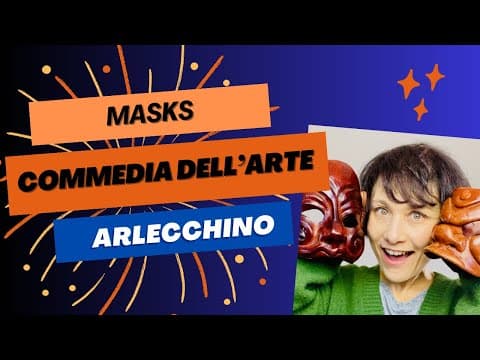
[0:07]And here we go with the second servant. I want to introduce you to Arlechino or Harlequin, Harlequin in in English. is part of the big family of the Zanni, but we will see, he has quite very different physical features compared to the Zanni we saw before. Uh there are also other masks to the servants that I'm not going to introduce in in this specific course. But for now, we're going to look at this one. This mask was developed a bit later on by an actor who worked at the French court and probably. The reason why all the servants, all these different masks of commedia are so unique and then the develop with from the initial small family or so many masks developed, is because they were the invention of the actors. And the act, the actors at the time, like today, had to respond to the taste of the specific time, the taste of the specific audience in order to make a living. They had to be admired, they had to please the the their audiences. And that's why all the masks developed out of the abilities and the and the quality of of each actor. In this specific case, you will see this Arlecchino have few animalistic features, and at the same time is almost balletic. Who knows, perhaps the French court, a an environment with with ballet might have uh uh might have an influence in that. In the sense that the actors that were working at the French court recognized that maybe that would have pleased uh their audiences. There are few uh features of Arlecchino in common with all the family of Zanni. Well, first of all is that he's uh he's a servant and lower uh classes, the lower classes, and still we have a lower center of gravity. First of all, we reconnect with this idea of the lower center of gravity like at the Zanni before. Because he's a servant and also with a strong connection with the ground. Here, heels are even more important than before. He's a bit of a stubborn character, so that's why we will see how active his heels are. In terms of, before we get specifically in the detail of the mask, I wanted again for you to connect with something that you know, animals. Here we have to another pair of animals. The first animal I wanted to connect is the monkey. When the Zanni we have the chimpanzee, here we have a monkey, more agile, more jumping, very electric and energetic. So connect with the lower center of gravity. It's more the feature, the quality. I don't want you to get necessarily to get into to do the best monkey that you you can do. It's more like about thinking about how agile and playful and maybe a bit mischievous, they might be. This is a very mischievous character. And once you got this, this little jumpiness, the lower center of gravity, playfulness, maybe an imaginary tail, then I wanted to think about a cat. Yes. So, think about the again, the mischievousness and also the lightness and the quick movement that a cat can have. So maybe in doing that, why don't we think about moving a bit your limbs as you were moving slowly and maybe faster. And your head. So, with this idea of a cat and monkey combined, and with this idea of a little naughty, little tail, we kept that tail, but we imagine it's still there. Let's try to move from from that and activate the center of your body. This character is led by the basic instinct of your of your belly. But rather than pushing forward your pelvis, I wanted to rotate in the opposite direction. Here. Remember, your tail. And big, wide open chest. Here we go. So, we have your little cat monkey in position. Why I wanted to connect more with your chest with this character? Because this is the place of the heart and often Arlecchino ended up being in love in the scenarios, traditional scenarios of commedia. Let's reconnect with the idea of the clocking, Il colpo di maschera. You look, eyes on the tip of your nose, and then, wow, the body aligned. And again, eyes on the tip of your nose, clock, in this case, you, my audience, and then the body. And left, there's something really interesting over there. And the body, and back. And then, once you have your cat, your monkey, we're going to do something on the spot. All right. So, lower center of gravity, tail, heart. And from here, let's just do this little step. Here, here, free your arms, here, here, here, here. Tack, tack, tack, tack. Stop. And again, one, two, three, four, stop. One, two, three, four. Tack. Okay, now, as we did for the Zanni, I wanted to show you something. If you move normally, you swing your arms. And exactly as we did before, you keep swinging your arms, also when you walk uh as Arlecchino. As Arlecchino walks like us, a bit differently, but with the same principles. So, let's go to a process of Arlecchinification. So, here we go. I'm working up and down. Then I find my lower center of gravity. Then I find my monkey tail, my proud open chest. And the arms keep swinging up to my leg and one, two, one, two, one, two. Tack. And one, two, one, two. Pam. Now on the spot, try to do this for me. So, step and step and step and step. And you warm up, classic move, heels, legs, heels, legs. You might have noticed one thing that I want to say with this character, that lower part of the body is extremely active, like a constant engine. Well, the upper part of the body is quite uh quite still. You have your chest wide open, but it's quite still. There isn't so much happening while you're running around. So, another thing that I might you might want to add in order to find the sharpness, the clean, sharp movement of this mask of Arlecchino. Is perhaps connect also with the quality of wood. If you start to think about staccato movement even more than the wood with other masks, that can help you. Particularly at the beginning, this is something that I say when you start at the very beginning to approach these masks, you might start with techniques that are something quite extreme, and then you can obviously bring your own take. You're obviously very personal to each individual person and actor with your body, with your tempo rhythm, with your experience, with your culture, with anything else that you bring in. You make it your own. Exactly as the actors of the commedia de l'arte they did. They looked around, they created new characters based on the physicality they had, on the quality and experiences that they had in order to please their audiences. And you probably want to do the same. This is just a starting point. It's not the the point of arrival. This is just a starting point for you to discover something much more interesting. Okay, so step and step and step and step. And now, let's do something as they said, it's more agile, it's a bit more demanding from a physical perspective. Let's start to play with level with Arlecchino. So, and down. Up and down and tack and tack. You remember the exercise? And tack and tack. Up and down. And step and step and step. And now, on the spot, a little bit of excitement. Arlecchino gets a bit excited. He just saw perhaps, ah, Servetta, he just saw Colombina passing by, his love. And ooh. Oh yes. Oh yes. And step. This will just change the position of the leg. Again, we maintain the integrity of the mask, chest, hips. Position, and then we step to the left and we put the right leg on the front. And when we step to the right, we place the left leg on the front. But we do it a bit faster. Ready? Do it a few double step. One and two, and one, and two. And one. And two. And one. And two. And then, bow. He's a he's a servant. And bow. Now, as we did with the Zanni, let's see few of his walk. We can add a little step here. We can have the kick. So I must I have to do it on the side. So you see what I mean. Step, kick, step, kick, step, kick, step, kick, step, kick, step, kick, step, kick, step, kick. And from the front, we can look at something like that. Step, kick, step, kick. And Arlecchino. Mm, mm, mm, mm.
[11:49]Step, kick, step, kick. And now we come to another classic walk of Arlecchino. Well, it allows you, it will allow you to cross the stage very fast. And this it's easier to learn by um just do it a lot, lot, lot of time and it based on a certain rhythm more than anything else. If I break it down in small steps, this fast walk, that we saw the fast walk Arlecchino, running, running, running. Now we see the fast walk of Arlecchino, a sort of version of of run, of running. And this it was in in different steps. So, you step, you slightly move your weight. Let's say to the right first. And then in reality your weight doesn't shift. You stay on the on your left leg, and you kick in the air with the right and then the left. You move to the left and then you kick with the left and with the right. Looks something like that. Right, right left. Left, left right. Let's see how it looks in space. One, two, three and one. Two, three and one. Two, three and one. Two, three and one, two, three. One, two, three. One, two, three. Obviously, more space you got, if you have a big stage is much more much more space to cover. But this is the idea. You can go as fast as you want. Tack, tack, tack, tack, tack, tack, tack, tack, tack. Very fast. Okay, so, these were the different steps.
[14:14]And then you can bring some of the if you look at the the video on on warm up, advanced warm up. With this character you can really afford to bring loads of different variation with hand standing, head standing. All standing.
[14:40]This mask is more a cat like Arlecchino. You can see the round, the smooth, almost like more feminine, more sweet feature. Here, this is quite strong and this, in fact, is called the mask maker, and mask maker, a very famous practitioner called Antonio Fava, made this mask and called it Arlecchino Shini, that it means monkey. Arlecchino monkey, monkey Arlecchino in in Italian. Let's have a go with the mask. Ah. Oh. Arlecchino's back. Very, very more agile, Arlecchino. Very, very loud, tutti quanti. Ah. Oh. Guarda capa. Oh. aspetta un poco. Guarda la mia Colombina. Io vengo, vengo, vengo. Vado dall'altra parte. Oh, Arlecchino! Forse che Arlecchino adesso si, dai. Colpo di, uh. Aspetta un po'. Oh, no, che non mi do la voglia di lavorare. No, no, no, no. Mi no. I don't want to work. Na. Non se la vuoi fare, na. Na. no, no.


