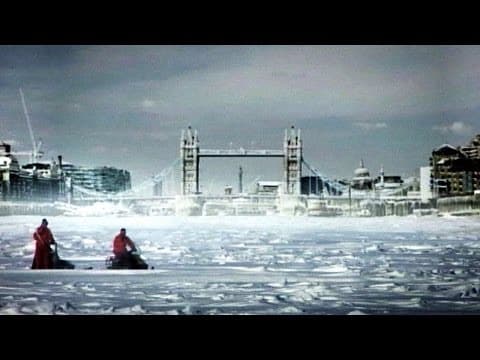
[0:04]London, its people, the people who built it. In fact, all life on Earth are only here by chance. 99% of all the species that ever lived have been wiped out in a series of catastrophes, disasters that changed the course of evolution. 650 million years ago, the earth froze. It pushed life to the verge of extinction, but if it hadn't, then life today would be little more than microscopic slime. This is the story of Snowball Earth.
[0:53]When we think about how we evolved from being single cells to what we are today, we tends to see it as a pretty calm process, don't we, with animals slowly transforming into other animals. But that's only part of the story, the reality is much more brutal and violent with creatures hanging on for dear life while disaster after disaster threatens them with extinction.
[1:20]It's almost impossible to comprehend the immense timescale of our planet's lifetime. So, imagine the whole of Earth's history compressed into a single day. Each minute represents around 3 million years. At midnight on our clock, 4 and a half billion years ago, the planet was born. Two minutes later, the first catastrophe struck.
[1:50]A proto-planet Thea smashed into the infant Earth. And in its wake, the first life appeared. By 8 a.m., there were shallow seas full of simple bacteria. Gradually, over the next 2 billion years, the planet stabilized. Though life remained as single-celled organisms. Until 12 and a half hours later, at 8:27 p.m., 650 million years ago, disaster struck again.
[2:37]The planet froze.
[2:44]Temperatures plummeted. Ice spread down from the poles. It encased the planet in a layer thousands of meters thick, a snowball Earth. Life had only just got started, now it seemed doomed. There are no traces of these ancient ice sheets left. They're long gone. But there are still clues that can tell us about this dramatic ancient ice age. The evidence is hidden away in some of the world's most remote places.
[3:28]These are the Flinders ranges in the Australian Outback. Today, it's one of the hottest and driest places on Earth. But geologist Jim Gehing knows that the rocks here provide direct evidence of our planet's frozen past.
[3:51]The area's so vast, the best way to investigate is from the air. There's a disaster story written in these layers of rock. You just have to know how to read it. It's really like looking at a, a book made of rock. Every single layer has a secret on it. We look at these rocks as though they're a history book. With the help of aerial photographer Tim Byer, they spot an unusual rock formation in a dried up creek.
[4:25]It's the evidence Gehing's been looking for. A 650 million-year-old rock called a dropstone. A dropstone is a, an exotic piece of rock. They shouldn't be mixed in with mud and sand, they should be together in boulder beds or gravel beds, but there they sit. The rock may look insignificant, but it's a major clue to the powerful forces that created the frozen world of Snowball Earth. This rock shouldn't be here. It's sitting in a rock composed of mud, silt, sand, and gravel. And normally, that's impossible. The whole lot now is one big rock. There's only one force that can carry rocks like this around the globe, and that is ice.
[5:30]There's not a lot of ice in Australia today. So, to investigate how ice could have moved rocks around the world in the ancient past, glaciologist Chad O'Neal scales the sheer walls of the Matanuska Glacier in Alaska.
[5:51]It's the closest we can get to our distant icy past. We're taking a look at the rocks that are being transported down the valley by the glacier. And to do that, we need to go down there.
[6:10]Glaciers are nature's bulldozers. They smash everything in their path.
[6:23]They gouge stones and rocks from high up in the mountains and carry them down the valley. Rocks as big as buses can be transported for miles across the landscape by a glacier. The longest glaciers are hundreds, if not thousands of kilometers long, so you can move, move rocks over long distances. When the ice melts, it deposits debris at the base of the glacier. This glacier is only a few hundred meters thick, but it can still carry thousands of tons of rock. The glacier brought all this stuff down from the mountains, and when the glacier melts away, it, it ends up looking like a, a building site that's been bulldozed.
[7:10]The Matanuska Glacier transports rocks for over 24 miles. It's the same process that carried the ancient dropstones in the Flinders Ranges. But the glaciers of 650 million years ago carried them for thousands of miles. Here's a great example of a rock that was picked up by the glacier, carried down, down valley, and then deposited, very similar to what you'd find in, in Australia where glaciers used to be in the past. So, the Australian Outback was once covered in ice. But that doesn't prove the whole world was frozen over.
[7:54]The problem is that the Earth's surface is in constant very slow motion, pushing the continents to different places. So, it's possible that 650 million years ago, when the dropstones were deposited, Australia could have been much closer to the cold South Pole. Meaning the dropstones were carried by normal polar glaciers. The solution to this conundrum can be found in another desert.
[8:33]Death Valley in the American Southwest. The term Snowball Earth was coined by geologist Joe Kirschvink, who's been gathering evidence on the theory for the past two decades. Death Valley has a series of rocks that are extremely important for understanding Earth's history. It's a treasure chest.
[8:59]Like the Flinders Ranges, it's not the kind of place you'd expect to find evidence of ice. But geologists have found dozens of glacial dropstones here. Every time I come here, I see new things. There are those big boulders and I see one at the bottom, and they're all dropstones. You can see that they're coming in from the top. This is one of the best places in the world to see this type of geology. The dropstones Kirschvink has discovered here date back to the same period as those found in the Outback. So, this desert too was covered in ice. But the big advantage is that we know where Death Valley was 650 million years ago.
[9:51]Every rock has a unique magnetic signature. This allows scientists to determine the point on the globe where the rock was formed.
[10:04]To study this signal, Kirschvink drills cores from the rocks containing the dropstones and measures their magnetic field.
[10:16]The Earth's magnetic field is formed by electric currents flowing in the middle of the planet. The pattern of that field allows us to measure the latitude that a rock forms at. When a glacier dumped these dropstones here, Death Valley was inside the tropics. The results at the Flinders Ranges were even more dramatic. A group started studying the magnetism in the Flinders Ranges, and they thought they had a very stable magnetization that, I said, 'Well, wait a minute, something might be relevant there.' The rock's magnetic signal revealed that 650 million years ago, Australia was in a completely different place than today.
[11:03]When the whole continent was in the grip of a big freeze, Australia was near the equator. Here was proof the scientists were looking for.
[11:17]It, it was wonderful. It was the first time anywhere that we had proven that the glaciers were on the Equator.
[11:37]If you have ice at the Equator, then the whole of the globe must have been covered by ice. And so you have to envisage a completely white planet.
[11:49]Scientists believe it was the greatest ice age in the history of the Earth. The entire Earth would have looked like Antarctica looks today. Even areas as desolate like this in Death Valley with nothing on it would be under several hundred meters of ice. The whole planet, indeed, would be a snowball.
[12:23]This was the greatest ice age that this planet has ever known. You have to manage in a planet whose oceans were not only capped by ice near the poles, but that ice had grown across the entire planet and all but shut down its living systems. 650 million years ago, life on Earth seemed destined for total extinction. Somehow, something had plunged the whole planet into a catastrophic deep freeze. The question was, what?
[13:04]8:27 p.m. on our clock of the Earth's history, 650 million years ago. The planet faced climate disaster, a global deep freeze. But what made it happen? Snowball Earth wasn't the first time the Earth had frozen, and it wouldn't be the last. Our planet goes through an ice age about once every 100,000 years. Most of them are caused by changes in our orbit. The further away from the Sun we go, the colder it gets. At the height of the last ice age, ice sheets covered around a third of the planet, and all of this would have been buried under hundreds of feet of ice. But factors like orbit and rotation aren't enough to explain ice stretching right down to the Equator. That must have taken something far more dramatic.
[14:12]The smoking gun turned out to be our atmosphere, specifically greenhouse gases like carbon dioxide.
[14:24]A greenhouse gas is any kind of gas which has the capacity to convert the Sun's rays into heat, making this planet the warm planet that it is today.
[19:37]Carbon dioxide, it's one of the very dominant species of gas that is coming out of volcanoes. There have been times when we've had certainly, you know, thousands of tons per day coming out of this volcano.
[38:35]The torrents of hot gases and ash blew a giant hole in the glacier.
[38:43]It melted ice at a furious rate, flash floods carrying 45,000 tons of water a second, raged for hours. But on a global scale, that's nothing. When the whole world was frozen, a few little holes wouldn't have made much difference.


