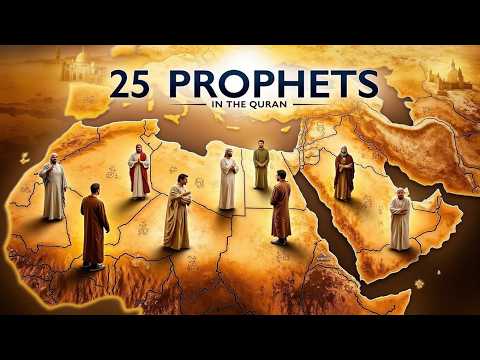
[0:00]Even though the hadiths mentioned that 124,000 prophets were sent, only 25 of them are named in the Quran. We have some knowledge about these prophets from the Quran, from hadiths, and even from earlier books like the Torah and the Bible. However, many people don't know about the nations they were sent to, the regions they lived in, and where those places are today. In this video, we will take a short but educational journey through who these 25 prophets mentioned in the Quran were, where they were sent, and where those lands are now in today's world. They were human beings just like us. They had families, they had desires, but they dedicated their lives to their mission. Allah mentioned their names in the Quran, peace be upon them all. Before we start, please subscribe to our channel and like the video so we can reach more people. Adam Alayhissalam. Adam Alayhissalam, the first human and the first prophet, was created by the command of Allah from different types of soil. The angels mixed this soil with water and shaped it. After waiting for 40 years, the clay hardened and became like dry mud, salsal. On the 10th day of Muharram, which was a Friday, Allah gave him a soul and taught him the knowledge of everything. By Allah's command, the angels prostrated to Adam, but Iblis became arrogant and refused. He was then cast out of Paradise. Adam married Hawa, who was created in Paradise, and they lived there together for a while. However, because they ate from the forbidden tree, they were sent down to Earth. Adam realized his mistake and sincerely repented. Allah accepted his repentance, see Surah Al Baqara 2:37. Allah appointed Adam as a Khalifa, representative on Earth. After being separated from Hawa for many years, they met again in Arafat and built the Kaaba. Adam (AS) was chosen as a prophet, he was given a small book with 10 pages. He taught people about faith, worship, and knowledge. They lived in towns and worked with crafts and skills. A tragic event happened between Adam's sons, Habil and Kabil. Kabil, driven by jealousy, killed his brother Habil. This was the first murder in human history. Humanity continued through the children of both brothers. According to some narrations, Adam (AS) lived a long life, about 960 years, even though worship and divine teachings continued among his children and grandchildren after his death, over time, some people began to go astray. This would later lead to the coming of new prophets. It is said that his grave is in either Jerusalem, Mina, or Arafat. Hadiths mentioned that his height was between 30 and 40 meters. Idris (AS). Idris Alayhissalam is one of the prophets mentioned in the Quran. According to narrations, he had many special qualities. He was the fifth generation descendant of Adam (AS). Allah gave him 30 suhuf small scriptures and taught him many sciences. Before him, people wore animal skins or leaves. He taught people how to sew clothes and build cities. He knew 72 languages and invited every community to the true religion in their own tongue. Idris was the first person to write, to use a pen, and to teach knowledge. He also studied the stars and the movements of the sky. Because of this, he is known as the prophet of both knowledge and art. He migrated from Babylon to Egypt and lived there for many years, calling people to the true religion. In Surah al Anbiya verse 85, he is mentioned as one of the patient, righteous, and truthful people. The Quran says, we raised him to a high place. Many Islamic scholars believe that he was taken to the heavens without dying. Some narrations say he is in the fourth level of the sky. Nuh (AS). Nuh Alayhissalam was sent as a prophet after Idris (AS). Islamic historians say he was sent to the region of Mosul in Iraq. His people were idol worshipers from Mesopotamia. At that time, people started worshipping idols, and sins like injustice and immorality became common. Nuh (AS) was given prophethood at the age of 50. He invited his people to believe in Allah and to leave idol worship for 950 years. But only a small number of people believed in him. Most of his people rejected him, mocked him, and treated him badly. When he realized that they would never believe, he prayed to Allah. Then Allah informed him of a great flood that was coming. By Allah's command, he built a large ship. He took on board the believers and a pair of every animal. Then the great flood began. Heavy rain poured from the sky. Water gushed from the Earth, and all those who disbelieved drowned. The flood lasted for six months, and the ship finally came to rest on Mount Judi. One of Noah's own sons did not board the ship and drowned in the water. Noah (AS) had three sons: Sam, Ham, and Yafeth, who became the ancestors of all people. According to Islamic historians, Sam's descendants include Arabs, Jews, Assyrians, Babylonians, Persians, Syriacs, and Arameans. Ham's descendants include African peoples, Egyptians, and Ethiopians. Japheth's descendants include Turks, Greeks, Russians, Mongols, Chinese, Indians, and Europeans. These lineages are described in the works of scholars like Ibn Kathir, Tabari, Ibn Khaldun, and other classical Islamic historians and commentators. For this reason, Nuh (AS) is known as the Second Adam. He lived a long life and died at the age of 1,000. The Quran mentions him in many verses and describes him as a very grateful servant of Allah.
[7:05]Hud (AS). Hud (AS) was from the descendants of Sam, the son of Nuh (AS). He was sent to the people of Ad in Yemen. The people of Ad earned their living through trade. Over time, they became wealthy and powerful. They built tall buildings, but they also became corrupt and started worshipping idols. They committed injustice, behaved arrogantly, and cheated in trade just for more wealth. Hud (AS) called them to believe in Allah, but they denied him. Allah warned them first with drought and famine. Then he sent a strong burning wind that destroyed them. Only Hud (AS) and those who believed in him were saved. Hud (AS) later settled in Makka and passed away there. This story is told in many parts of the Quran. Salih (AS). Salih (AS) was sent as a prophet to the people of Thamud. The people of Thamud were idol worshipers. They were advanced in technology and architecture, carving homes inside mountains and building strong cities. See Surah al Araaf verse 74. They lived in a region known today as Madain Salih in Saudi Arabia. Salih invited them to believe in Allah. They said to him, if you bring out a pregnant she-camel from this rock in front of our eyes, we will believe you. Saleh prayed to Allah, and as a miracle, a large she-camel came out of the rock in front of everyone. This camel was a clear sign from Allah. Its milk was so abundant that the entire people could drink without shortage. But the leaders of the tribe said, if this camel stays, Salih's influence will grow and people will no longer listen to us. They made a secret plan and killed the camel during the night. This was not just killing an animal, it was destroying a sign from Allah. After that, they were given three days of warning. During this time, Salih and the believers left the city. On the third day, a loud sound and a violent shaking from the Earth destroyed the people of Thamud. Only a small group of true believers survived. The destruction of Thamud is mentioned in the Quran as a lesson. Ibrahim (AS). Ibrahim Alayhissalam is one of the five great prophets in Islam. He was sent to the people of the Chaldeans (Caldani), who were idol worshipers. He defended the belief in Tawhid, oneness of Allah. While his people were away celebrating a festival, Ibrahim (AS) broke the idols, except the biggest one, and he hung the axe around its neck. When they returned, they questioned him. Ibrahim said, maybe the big one did it, ask him if he can speak. He defeated them with wisdom. They had no answer, but still they lit a huge fire and threw him into it. By the will of Allah, the fire did not burn him, and he came out safely. After this, his people rejected him. By Allah's command, he migrated. He traveled with his wife Sarah to Egypt and then to Palestine. In Egypt, he married Hajar as his second wife. After many years without children, Ibrahim had a son, Ismail, from Hajar, and later another son, Ishak, from Sarah. Ismail became the ancestor of the Arabs and Prophet Muhammad (Sallallahu Alayhi Wasallam). Ishak became the ancestor of the Jews and the prophets from Bani Israel. So in reality, Jews and Arabs are brothers, but the Jews saw the Arabs as stepbrothers and excluded them, leading to a power struggle. Ibrahim and his son Ismail built the Kaaba by Allah's command. The Kaaba became the center of worship. They also performed Hajj and taught it to the people. Allah showed Ibrahim a dream to sacrifice his son Ismail. Ismail said, father, do as you are commanded. When he placed the knife on his son's neck, Allah stopped him and said, oh Ibrahim, you fulfilled your dream. We have completed this clear test. Then Allah sent a large animal to be sacrificed instead. As Muslims, we continue this tradition by celebrating Eid al Adha as ordered in the Quran. Ibrahim (AS) passed away in Jerusalem at the age of 175. He is known as the close friend (Khalil) of Allah. Lut (AS). Lut (AS) was the nephew of Ibrahim (AS). After they migrated together from Babylon to Sham (Greater Syria), Lut was sent as a prophet to the people of Sodom. This region is around present-day Jordan and the Dead Sea. The events happened a few centuries after the flood of Nuh (AS), around 2000 BCE, during the rise of Mesopotamian civilizations. As a miracle, Lut made rain fall from a clear sky and spoke with stones. These miracles proved to his people that he was a prophet. But the people of Sodom worshipped idols and committed a type of relationship the world had never seen before: homosexual acts. However, these acts were not just private sins, they were forced upon others. They would assault young boys and enslave them. Wealthy men would treat young males as property. They even blocked roads and kidnapped male travelers to abuse them. This was not just individual sin. It had become a system of organized oppression.
[13:17]The Quran describes their behavior like this: you approach men, block the roads, and commit shameful acts in your gatherings.
[13:28]Sura al Ankabut 29. Lut (AS) invited them to the Right Path, but they refused and became even more aggressive. They even threatened to expel Lut and his family from the city. One day, three strangers came from the sky. They appeared as handsome young men and stayed at Lut's house as guests. The people of the city gathered and demanded to take these guests by force. They wanted to assault them. Lut was afraid, but the guests revealed they were angels. They told Lut to leave the city during the night with the believers. That night, Lut and a few believers escaped. By morning, the city was turned upside down. Stones rained from the sky, and the corrupted people were completely destroyed. According to Islam, they were not destroyed just for practicing homosexual acts. They were punished because they forced this lifestyle on society, kidnapped the weak, and normalized group assaults. The story of the three handsome young men is told in the Quran to show this exact reason. Ismail (AS). Ismail (AS) was the eldest son of Ibrahim (AS) and one of the great-grandfathers of Prophet Muhammad (Sallallahu Alayhi Wasallam). His mother was Hajar. Ibrahim (AS) left Hajar and Ismail in Mecca and returned. While Hajar ran between the hills of Safa and Marwa in search of water, the water of Zamzam miraculously burst from the ground. As Ismail grew older, he was sent as a prophet to the tribe of Jurhum. He taught them the religion of Allah, called people to worship, and showed them how to pray and give zakah. He was also known for his skills in archery and horse riding. It is mentioned in hadith books that Ismail (AS) revived and established the Arabic language. His miracles included making fruits grow on thorny trees and causing sheep to give milk. He passed away in Makkah and was buried beside the Kaaba in the area known as Hijr. Ishak (AS). Ishak (AS) was the second son of Ibrahim (AS), and his mother was Sarah. He was sent as a prophet to the people of Canaan, the land of today's Palestine. He visited Makkah with his brother Ismail and later spread the religion of his father. The Quran describes Ishak as a good servant, righteous, truthful, and devoted to Allah. He was also the father of Yakub (Jacob), who was a prophet too. His miracles included animals testifying to his prophethood, a mountain moving through his prayer, and bringing dead animals back to life. He passed away at the age of 120 in Palestine. His grave is in the city of Hebron, where his father Ibrahim (AS) was also buried. Yakub (AS). Yakub (AS) was the grandson of Ibrahim (AS) and the son of Ishak (AS).
[16:49]His title is Israel, which is why his descendants are called Bani Israel (the Children of Israel). He had 12 sons, and from them came the tribes of the Israelites. He was sent as a prophet to the land of Canaan and invited people to believe in Allah. Because of his deep love for his son Yusuf, his other sons became jealous, a test that Yakub had to endure. The Quran introduces Yakub as one of the most patient prophets. When he lost his son, he did not complain, but said, I only express my sorrow and sadness to Allah. Surah Yusuf 86. On his deathbed, he asked his sons, who will you worship after me? They replied, we will worship your God and the God of your fathers, Ibrahim, Ismail, and Ishak, the one true God. Yakub (AS) died in Egypt, but according to his will, he was taken to Palestine and buried next to his father Ishak. Yusuf (AS). Yusuf (AS) was the son of Yakub (AS) and was sent as a prophet to the people of Egypt. He lost his mother at a young age and was raised with great love by his father. As a child, he saw a dream and told his father, my dear father, I saw in my dream 11 stars, the sun and the moon, all prostrating to me.
[18:22]Surah Yusuf 4. This dream was a sign that he would one day become a prophet and be given a high rank. Yusuf's good character and his father's deep love for him made his brothers jealous. Out of envy, they threw him into a well. A passing caravan found him and sold him as a slave in Egypt. The chief minister (Aziz) of Egypt bought him and raised him in his home. Everyone admired Yusuf for his beauty, honesty, and purity. When Yusuf grew older, the minister's wife Zuleika tried to tempt him, but Yusuf protected his honor and ran away. Even though the truth became known, he was still imprisoned unfairly for a time. Even in prison, Yusuf preached Tawhid (the oneness of Allah). He taught morals and reflection to the prisoners. He interpreted the dreams of two inmates. One of them later went to serve the king. Years passed, and the king had a strange dream that no one could interpret. Then they remembered Yusuf, who explained it. There will be seven years of abundance, followed by seven years of famine. Surah Yusuf 47. Because of his correct interpretation, Egypt prepared for the famine, and Yusuf was placed in charge of the country's treasures. Due to the famine, his brothers came to Egypt. Yusuf recognized them and kept his brother Binyamin with him through a clever plan. Later he revealed his true identity, brought his whole family to Egypt, and healed his father's blindness. Yusuf forgave his brothers, even though they had wronged him. He told them, there is no blame on you today. May Allah forgive you. Surah Yusuf 92. This is one of the most powerful examples of forgiveness in the Quran. After reuniting with his family and reaching the highest position in Egypt, Yusuf still longed to return to Allah. This shows how elevated his spiritual rank was. His heartfelt prayer is recorded in the Quran. My Lord, you have given me power and taught me the interpretation of events. Creator of the heavens and the Earth, you are my protector in this world and the hereafter. Let me die as a Muslim and join me with the righteous. This is the peak of true servitude and detachment from the world. After his death, he was buried near Jerusalem. Shu'ayb (AS). Shu'ayb (AS) was sent as a prophet to the people of Midian and the people of Aika. Midian was located between today's Jordan and northwest Saudi Arabia. Because of his sweet and effective speech, he was known as the orator of the prophets. His people worshipped idols and were involved in trade, but most of them were busy with sins like cheating in measurements, unfair weighing, charging interest, and fraud. He called them to Tawhid, belief in the oneness of Allah and justice. He said, give full measure and weight with justice, and do not reduce people's belongings. Do not spread corruption on the Earth. Surah Al Araf 85. But his people mocked him and said, o Shu'aib, do you tell us to leave the religion of our ancestors or not to do what we want with our wealth? Surah Hud 87. Shu'aib (AS) warned them that Allah's punishment would come within three days. Then an earthquake seized them, and they were found dead in their homes, fallen on their knees. Surah Hud 1194. The people of Ika were also traders and showed the same corrupt behavior as the people of Midian. However, their punishment was different. Days of extreme heat followed. Then the sky darkened, and it looked like cool shade was coming. But from that shade came a painful punishment. A burning fire came from the sky, and they were all destroyed. Shu'aib (AS) later returned to Midian with the believers. He also met Musa (AS), who married one of his daughters. According to narrations, Shu'aib (AS) lived for 242 years. Today, there is a shrine in Jordan in a place called Wadi Shu'aib. Ayyub (AS). Ayyub (AS) was sent as a prophet to Bani Israel (the Children of Israel). He was very wealthy, generous, righteous, and thankful to Allah. Allah tested him with both blessings and great trials. He first lost his wealth, then his children, and finally his health. His body was full of painful sores. Only his wife stayed with him and cared for him with patience despite the whispers of Shaitan. He trusted Allah completely. He never complained. He only shared his pain with Allah and showed patience. When Allah saw his strong patience, he accepted his prayer. After seven years of illness, Allah told him to strike his foot on the ground. A spring of water appeared. He drank and washed with it and was cured. Allah gave him back his wealth and children. Strong narrations say that Ayub (AS) lived in the region near today's Shanliurfa in Turkey. In the Quran, his patience is praised. After his test, he lived many more years in health. His story teaches us to never lose hope in Allah and to continue worshipping with patience and trust, even in the hardest times. Dhul-Kifl (AS). Dhul-Kifl (AS) was one of the prophets sent to Bani Israel (the Children of Israel).
[24:33]He was the cousin of Ilyasa (AS), and after his death, Dul Qifl continued to convey the religion of Musa (AS) to the people. He was known for his patience in worship, his calmness in judgment, and his fairness, which is why he was given the title Dul Qifl (the one with responsibility). Despite Shaitan's tricks and tests, he never failed in his duty. Allah granted him prophethood, and he taught people the laws of the Taurat (Torah). He passed away in the region of Sham (Greater Syria). Dul Qifl (AS) is mentioned in the Quran in Surah al Anbiya and Surah Saad. Musa (AS). Musa (AS) was one of the greatest prophets, one of the Ulul Azm prophets, sent to Bani Israel. He was born during a time when Bani Israel were enslaved in Egypt. The pharaoh of that time was warned that a child from Bani Israel would one day threaten his throne. So he ordered all newborn boys from that community to be killed. Allah inspired the mother of Musa, "Breastfeed him, and when you fear for him, place him into the river. Do not fear or grieve, we will return him to you and make him one of the prophets." Surah Al Qasas 28:7. The baby was placed in the Nile and found by Pharaoh's wife Asia, who took him into the palace. Later, his real mother was brought to the palace as his nurse, just as Allah had promised. Musa (AS) grew up in Pharaoh's palace. After accidentally killing an Egyptian man, he escaped to Midian, where he married the daughter of Prophet Shu'ayb. Allah gave Musa prophethood on Mount Tur. He was commanded to go to Pharaoh and demand that he release Bani Israel and believe in Allah. As miracles, his staff would turn into a snake, and when he placed his hand in his chest, it would come out bright and shining. With these signs, he went to Pharaoh. Pharaoh rejected the message and challenged Musa, calling himself a god. He accused Musa of magic and gathered all his magicians to defeat him publicly. But when Musa threw his staff, and it became a giant snake that swallowed all their fake tricks, the magicians were shocked. They believed in Allah immediately, but Pharaoh had them killed. Allah then commanded Musa to take Bani Israel out of Egypt. Pharaoh chased them with a great army. When they reached the sea, Musa said, my Lord is with me. He will guide me. Surah ash Shuara 62. Allah told him to strike the sea with his staff. The sea split in two. The Israelites crossed safely, and when Pharaoh's army followed, the sea closed, and they drowned. Allah said, today, we will preserve your body so you may be a sign for those who come after you. Surah Yunus 92. Musa was later called to Mount Tur again, where he received revelation. Allah gave him the Torah, but while he was gone, his people led by Samiri, made a golden calf from their jewelry and started worshipping it.
[29:38]Although Harun warned them, he couldn't stop them completely. He stayed with his people in the desert of tea for many years and passed away before Musa. It is said that he was buried on a mountain known as Jabal Harun. Dawud (AS). Dawud (AS) was a prophet and king sent to Bani Israel. He was from the family of Yakub (AS) and the father of Sulaiman (AS). He was born, lived, and passed away in Jerusalem. He was given the book Zabur and had a very beautiful and powerful voice. He fought in the army of Talut and killed Jalut (Goliath), which led him to become king. He ruled with justice, made Jerusalem the capital, and conquered many lands. One of his miracles was shaping iron without fire. He used to fast during the day and worship at night. He is mentioned in many parts of the Quran. Sulaiman (AS). Sulaiman (AS) was the son of Dawud (AS) and was both a prophet and a king. Allah gave him great knowledge, unique power, and a vast kingdom. The Quran describes him as a just ruler and a prophet who could command the winds and communicate with animals and jinn. He was born near Jerusalem. The wind and animals were under his command. He ruled with wisdom, completed Masjid al Aqsa, and supported knowledge and art. The jinn worked for him, building palaces, castles, and statues, diving in the sea to bring pearls and serving in his kingdom. The hoopoe bird (Hudhud) informed him that the people of Saba, including Queen Balqis, were worshipping the sun. Sulaiman invited her to Islam. When Balqis came to his palace, he had her throne brought instantly. After seeing the wonders in his palace, she said, my Lord, I have wronged myself. Now I submit with Sulaiman to Allah, Lord of the Worlds. Surah Anamul 44. Sulaiman traveled with the wind, understood the languages of animals, and had both animals and jinn in his army. At the end of his life, he died while leaning on his staff, and no one knew until the staff broke and he fell. This showed the jinn that they did not know the unseen. According to narrations, he died near Bait al Maqdis in Jerusalem. His grave is believed to be in that area. Ilyas (AS). Ilyas (AS) was sent to Bani Israel in the region of present-day Lebanon. According to some narrations, he was from the family line of Harun (AS).
[32:36]The Israelites at that time were worshipping a false god called Baal. Ilyas invited them to worship Allah alone, but they rejected him. As a result, famine and disasters began. Later, when the people repented and believed, Ilyas (AS) prayed to Allah. Rain came down, and blessings returned. But after some time, the people went astray again. They returned to shirk, immorality, and worship of Baal. Ilyas warned them again, but this time their denial was even stronger. During this period, Ilyas (AS) miraculously healed a sick boy in a village named Al Yasa (Alyasa). Alyasa believed in him and later became a prophet after him. According to narrations, when the people became more rebellious, Ilyas (AS) neared the end of his life. After him, Alyasa (AS) was chosen as the next prophet. Alyasa (AS) is mentioned twice in the Quran.
[33:43]In the Torah, he is known as Elijah. He continued the mission of Elias (AS), calling his people to believe in Allah and worship him. But the people stayed misguided for a while. Alyasa was patient and firm in his efforts. He became known as a just leader and a strong prophet. Eventually, for a time, his people returned to the path of truth. He was given miracles such as healing the sick and making food and water abundant during times of famine by praying to Allah. When Bani Israel became disobedient again, Allah sent the Assyrians to punish them. Although Elijah helped his people with his miracles, before he passed away, he appointed Dul Qifl (AS) as his successor by Allah's command. According to narrations, Alyasa lived a long life and passed away peacefully. His grave is said to be in the region of Sham or near Aleppo, though the exact location is not confirmed. Yunus (AS). Yunus (AS) was sent as a prophet to the city of Nineveh, the capital of the Assyrian Empire. The people of Nineveh worshipped idols. Yunus (AS) preached Tawhid for years, but they called him a liar and rejected his message. He warned them of Allah's punishment, and Allah gave them time. Thinking the punishment was near, Yunus left the city believing it was the right decision, but it was a mistake in judgment, as he had not received permission from Allah. He boarded a ship during a violent storm. Lots were drawn, and his name was chosen three times. He was considered the cause of the trouble and was thrown into the sea. A great fish swallowed him. Inside the darkness of the fish, the sea and the night, he made this sincere prayer: La ilaha illa anta Subhanaka Inni Kuntum Minaz Zalimin. Surah Al Anbiya 87. His sincere repentance was accepted. The fish brought him to the shore, safe and alive. He quickly returned to Ninawa. Meanwhile, the people felt the coming punishment after Yunus left. They repented altogether and turned to Allah. When Yunus returned, they welcomed him joyfully and renewed their faith. They became the only community in the Quran that was saved as a whole after mass repentance. Surah Yunus 98. Yunus (AS) taught Allah's commands and passed away at the age of 83. His story is told in various parts of the Quran. The Quran does not mention his burial place, but narrations suggest locations like Mosul, Lebanon, and Palestine. When the Prophet (Sallallahu Alayhi Wasallam) returned from Ta'if, feeling sorrowful, he remembered Yunus and found comfort in his story. Lessons from his story: never lose hope. Despair is forbidden. Allah opens a path to salvation whenever he wills. A nation that repents together can be saved, like Adam (AS), Yunus (AS). Yunus (AS) is remembered as a prophet whose repentance was accepted.
[37:07]Zakaria (AS). Zakaria (AS) was a prophet sent to Bani Israel. He worked as a carpenter and served in Bait al Maqdis (Jerusalem).
[37:20]He took care of Maryam and raised her with good character and worship. When he saw miraculous provisions coming to her in her prayer place, he was amazed and made a heartfelt prayer.
[37:39]Though he was old, Allah blessed him with a son, Yahya (AS). Later, when the Israelites rejected the miraculous birth of Isa (AS), they began slandering and trying to kill those who supported him. Zakaria fled, but was eventually martyred when the Jews cut down the tree where he had hidden. His shrine is believed to be in Aleppo. His life and miracles are described in different chapters of the Quran. Yahya (AS). Yahya (AS) was the son of Zakariya (AS) and a prophet sent to Bani Israel.
[38:20]He preached in Palestine (Jerusalem), Damascus, and nearby areas, under Roman rule at the time. He was granted as an answer to Zachariah's prayer in old age. Yahya learned the Tawrat at a young age and delivered Allah's message to the people. He was pure, righteous, and deeply devoted to Allah. When Isa (AS) became a prophet, Yahya also called people to follow the teachings of the Injil. Due to the request of a queen, Yahya was imprisoned. He was later martyred because he did not approve of King Herod's unlawful marriage. This story is mentioned in both Jewish and Islamic sources. He died at the age of 34. His miracles included a rock speaking and stars being seen in daylight. He is mentioned in Suras Ali Imran, Mariam, and Al Anbiya.
[39:22]Isa (AS). Isa (AS) was one of the Ulul Azim prophets sent to Bani Israel. He was born without a father. His mother was Mariam, a righteous and pure woman. The Quran says, Allah breathed into Mariam from His spirit. He made her and her son a sign for all worlds. Surah Mariam 21. Jibril (AS) came to Mariam in the form of a man and gave her the good news of a child from Allah. When she was shocked, it was said to her, "This is easy for your Lord. We will make him a sign for the people and a mercy from us." Surah Mariam 21. Mariam went to a quiet place and gave birth to Isa under a palm tree. While still in the cradle, Isa defended his mother against the people's accusations, saying, "I am a servant of Allah." He has given me the book and made me a prophet. Surah Mariam 30. Allah gave Isa the Injil (Gospel). He was sent to confirm the Torah and to correct the corrupt beliefs of his people. He had 12 disciples (Hawariyun) who supported him closely.
[41:28]Most of Bani Israel still rejected him. They tried to kill him and informed Roman soldiers, but Allah did not allow them to succeed. Instead, He raised Isa up to the heavens, and will return one day to fight the Dajjal and unite people under Islam.
[42:16]This return will lead many Christians in the West to accept Islam.
[42:24]Muhammad (Sallallahu Alayhi Wasallam). Muhammad (Sallallahu Alayhi Wasallam) is the final prophet sent by Allah as a mercy to all people and all worlds. He was born in the year 570 in Makkah. His father was Abdullah, and his mother was Amina. He came from the noble tribe of Quraysh, specifically from the family of Hashim, tracing back to Ismail (AS), the son of Ibrahim (AS). He lost his father before birth and his mother at the age of six. He was raised by his grandfather, then by his uncle Abu Talib. In Makkah, he was known as Al Amin (the trustworthy). He never worshipped idols and never committed any sin. At the age of 25, he married Khadija (Radi Allahu Anha), who admired his honesty. At 40, while in the cave of Hira, he received the first revelation from Jibril (AS): "Read." Surah al Alaq 1. This marked the beginning of his prophethood. The first believers were Khadija, Abu Bakar, Ali, and Zaid ibn Haritha. The idol-worshipping people of Makkah rejected his call to worship only one God. They accused him of being insane, a poet, or a magician. The believers were tortured. He was boycotted, stoned, insulted, and even threatened with death. His hardest year was the year of sorrow, when both Khadija and his uncle Abu Talib passed away. Then came the miracle of Isra and Miraj. In one night, he traveled from Makka to Jerusalem, then ascended to the seven heavens. At the age of 53, he migrated to Madina with Allah's permission. This migration marks the beginning of the Islamic calendar, Hijri. In Madina, he established the first Islamic state and made treaties with Jewish tribes. Allah says, indeed, Allah has greatly favored the believers by sending a messenger from among themselves, reciting His verses, purifying them, and teaching them the Book and wisdom. Surah Ali Imran 164. Today, I have perfected your religion for you. Surah Al Maidah 3.
[45:30]In 632, he passed away in the room of Aisha (Radi Allahu Anha), resting his head in her lap. His noble grave is inside the Prophet's Mosque (Masjid an Nabawi) in Madina, known as Raudah al Mutaharah. Muhammad (Sallallahu Alayhi Wasallam) taught people Tawhid, worship of one God, good character, justice, and mercy. Though he was an orphan, he left the greatest legacy, the Quran and Sunnah. He said, there will be a group of my Ummah who will believe in me without seeing me. They are my brothers. Hadith. His greatest miracle is the Quran, the book sent from Allah. It is the highest example of Arabic language, unmatched in meaning, wisdom, and depth.
[46:20]To those who claim it was not from Allah, the Quran itself gives a challenge: "Bring a chapter like it." But no one has ever succeeded, not even one Surah. This challenge still stands today. Muhammad (Sallallahu Alayhi Wasallam) was Ummi. He could not read or write. Yet he brought a book so deep, so perfect, and so free from contradiction that it continues to guide all of humanity. The message he brought changed hearts and entire societies, and even today, it continues to shine with the same divine light.