[0:00]Ever wondered how cats apologize to humans? Most people think they don't, but the truth is they do. They just do it in ways that look nothing like what you'd expect. And that's the problem. Because if you miss those moments or worse, punish them for it, you could be rejecting the only way your cat knows how to say sorry. Let's start with the one signal hiding in plain sight. They stare at you and blink really slowly. Have you ever caught your cat staring at you after doing something wrong and then slowly closing their eyes? Most people know that slow blinking means trust, but what almost nobody talks about is what happens inside your cat's brain in the seconds before that blink. When your cat senses tension in the room, maybe you raised your voice, maybe your body language shifted, their amygdala fires a stress response. Their instinct is to flee or freeze, but instead of running, they choose to stay, look at you and deliberately shut their eyes. Think about what that actually means. A predator is choosing to go blind in front of a threat. That is not casual. That is a calculated emotional risk. A 2020 study from the University of Sussex confirmed that cats use slow blinking intentionally as a social signal. But what the study also revealed is that cats who receive slow blinks back showed measurably lower cortisol levels, which means your response literally changes their body chemistry. When you blink back, their stress drops. When you ignore it or stay frustrated, their brain registers it as a failed attempt at repair. And here's the part that should hit you. If your cat keeps offering slow blinks after conflict and never gets one back, over time they stop trying. They don't escalate, they just go quiet. And that silence is not peace. That is a cat who gave up on apologizing to you. And later in this video, I'll get to one apology signal that looks almost human. And it's the one most owners accidentally punish their cat for. Stay with me on that one. They headbutt you out of nowhere. Have you ever been sitting on the couch, maybe still a little annoyed at your cat, and out of nowhere, they walk up and press their head right into your face or your hand? Most people laugh it off or think their cat just wants attention, but what if that headbutt is actually your cat trying to fix what just broke between you two? Cats have scent glands concentrated around their forehead, cheeks, and chin. When they press their head against you, they're depositing pheromones onto your skin. It's called bunting. And in a calm, everyday moment, yes, it's affection. But when it happens right after conflict, the meaning changes completely. See, when tension fills a room, your cat can literally smell the shift. Stress hormones change your scent. And to a cat who relies on scent the way we rely on facial expressions, that change feels like the bond is breaking. So what do they do? They walk up and remark you. They're not just being sweet. They're overwriting the tension with their own scent, restoring the chemical signature that tells their brain, this person is still mine, and I'm still theirs. What makes this even more powerful is that while cats can bunt casually, even with strangers, the timing is what matters. When your cat headbutts you specifically after tension, after you've scolded them or raised your voice, that's not random affection. That's intentional. They're telling you, in the most primal way they can, that they refuse to let the bond dissolve. And hey, if your cat has ever done something like this, and you're only now realizing what it meant, hit like and subscribe. Let's make sure more cat owners stop missing these moments. They drop their favorite toy at your feet. Have you ever been upset with your cat and then randomly found a toy sitting right next to you, maybe on the couch, maybe by your feet, maybe right on your lap? Most owners just toss it aside or think their cat wants to play. But what if your cat just handed you the most valuable thing they own, and you threw it away? Cats are not like dogs. They don't fetch to please you. When a cat brings you something, there's always a reason. And while hunting instinct plays a role in some situations, behaviorists have observed something fascinating. When a cat drops an object near their owner after a period of tension, the behavior mirrors what's called a reconciliation offering in animal social dynamics. They're not asking you to play. They're offering something of value to restore the relationship. Think about it from their perspective. Your cat has a favorite toy. The one they carry around, the one they guard, the one they sleep next to. And in the middle of an emotional disconnect between you two, they pick it up, walk over, and place it at your feet. That is not random. That is sacrifice. They're giving you the one thing that brings them comfort because they're hoping it brings you comfort too. So next time you find a random toy next to you after a rough moment, don't ignore it. Pick it up. Acknowledge your cat because that little gesture might be the bravest apology they've ever made. They start licking your hands or face. Have you ever noticed your cat suddenly grooming you right after a tense moment? Maybe they hop on your lap and start licking your fingers, your chin, even your nose. Most people think it's just a quirky cat thing, but there's a reason this behavior shows up specifically after conflict, and it's more meaningful than you think. In cat colonies, mutual grooming, called allogrooming, is one of the most important social behaviors. But here's what most people don't know: cats don't allogroom every cat in the group. Studies on feral colonies have shown that grooming is highly selective. Cats only do it with individuals they have a strong social bond with. It's not about hygiene, it's a tool for maintaining relationships and reducing tension within the group. And here's a detail that makes it even deeper. When cats groom each other to resolve tension, researchers have observed that it actually lowers heart rate in both cats involved. Which means when your cat licks your hand after conflict, their own body is calming down through the act of repairing the bond with you. It's not just emotional, it's physiological. Apologizing to you is literally how they self-regulate. They roll over and expose their belly. Have you ever scolded your cat and watched them immediately flop over and show you their stomach? Most owners think their cat is being playful, or worse, that they don't care about what just happened. But that belly exposed might be the most misunderstood apology in the entire cat world. A cat's belly houses their most vital organs. In the wild, no cat would ever willingly expose that area unless they felt completely safe, or unless they were deliberately making themselves vulnerable to de-escalate a threat. And when your cat rolls over right after tension, that's exactly what they're doing. They're not playing. They're surrendering. It's the cat equivalent of putting both hands up and saying, I'm not a threat. Please don't be upset with me. This is where it gets important. Most owners see the belly and instinctively reach down to rub it. And what happens? The cat swipes, scratches or bites. Now the owner thinks the cat was being manipulative or aggressive. But the truth is, the cat was never asking to be touched. They were asking to be forgiven. Rubbing the belly in that moment violates the very vulnerability they just offered you, and to the cat, it feels like a betrayal of the trust they were trying to rebuild. So what should you do instead? Simply stay calm, lower your voice, maybe offer a slow blink back. Let your cat know that you receive the message without turning their apology into a reason to grab at their most protected area. That small shift in how you respond can completely change how safe your cat feels repairing things with you. They follow you everywhere without a sound. Have you noticed that after something tense happens, your cat just starts appearing wherever you go? Not meowing, not rubbing against you, not asking for food, just quietly sitting in the same room as you, watching from a distance. Most people don't even register it, but this is the apology signal I told you about earlier, the one that looks almost human, and it's the one most owners completely miss. Cats are solitary by nature. When they want space, they disappear. They have no problem walking away from any situation, any person, any room. So when a cat chooses to do the opposite, when they follow you from the kitchen to the bedroom to the bathroom, without making a single sound. That is not clingy behavior. That is a deliberate decision to stay close to you during emotional discomfort. Behavioral researchers describe this as proximity maintenance. It's a strategy also seen in bonded primates after conflict. Instead of vocalizing or making physical contact, the individual simply reduces distance and waits. They're saying, I'm not going to force this, but I'm not leaving either. I'll be here until things feel right again. And if you really think about it, we do the same thing. After a fight with someone we love, sometimes we don't say anything. We just sit in the same room. We make coffee, we exist nearby. No words, no grand gesture, just presence. Your cat is doing the exact same thing. And the fact that an animal who could easily walk away and be perfectly fine alone, is choosing to stay near you in silence, should tell you everything about what you mean to them.
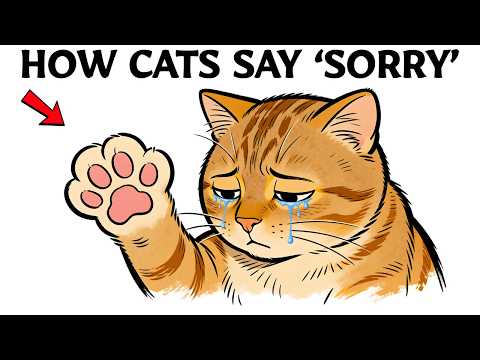
How Do Cats Apologize To Humans?
Felune
9m 12s1,674 words~9 min read
YouTube auto captions
Transcript source
YouTube auto captions
This transcript was extracted from YouTube's auto-generated caption track. The transcript below is server-rendered so it can be read, searched, cited, and shared without opening the original YouTube player.
Pull quotes
[0:00]Because if you miss those moments or worse, punish them for it, you could be rejecting the only way your cat knows how to say sorry.
[0:00]Have you ever caught your cat staring at you after doing something wrong and then slowly closing their eyes?
[0:00]Most people know that slow blinking means trust, but what almost nobody talks about is what happens inside your cat's brain in the seconds before that blink.
[0:00]When your cat senses tension in the room, maybe you raised your voice, maybe your body language shifted, their amygdala fires a stress response.
Use this transcript
Related transcript hubs
Watch on YouTube
Share
MORE TRANSCRIPTS


