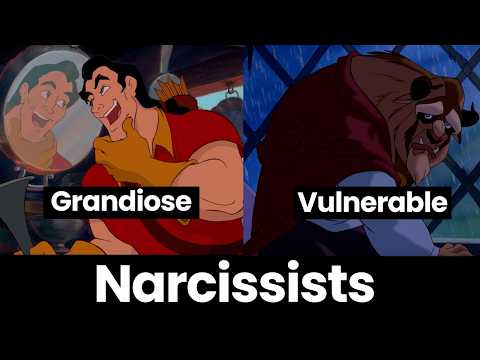
[0:00]If you want to truly understand narcissism, not just the symptoms, but the pain, the patterns, and the path to healing, look no further than our old childhood story of the Beauty and the Beast. This one movie shows us a lot about narcissism. First off, it showcases the two main types of narcissism, grandiose and vulnerable. It also shows us eerily what it's like to actually be in a relationship with a narcissist. It shows us what creates narcissism to begin with, and most importantly, it shows us how to heal from narcissism. This is more than just a fairy tale. It's a mirror of our lives, and it's a guide to healing. So let's break it down. The two types of narcissism. The entire movie of Beauty and the Beast is showcasing the two main types of narcissism: grandiose and vulnerable. Vulnerable is also known as covert or introverted narcissism. But let's start with grandiose. It's easy to see that Gaston is our grandiose narcissist. This is also known as an extroverted narcissist. This is what comes to mind when we generally think of a narcissist. And in case you're wondering, I was a grandiose narcissist. Delusions of grandeur, building giant businesses, going public on the New York Stock Exchange, thinking that I was the coolest thing all the time, that was me. I'm not too proud of it, but it's the truth. It's obvious that Gaston was a grandiose narcissist. The man is completely obsessed with himself and unaware of everyone else around him. He doesn't choose Belle because he knows her or loves her, he chooses her because she's the most beautiful and the most admired. And I've got my sight set on that one. The inventor's daughter. She's the one. The lucky girl I'm going to marry. The most beautiful girl in town. I know. That makes her the best, and don't I deserve the best? To him, Belle is a prize, not a person. Not once in the movie does Gaston ask Belle about her dreams, her thoughts, or her heart. Every conversation is about him or what she can give to him. Gaston is also delusional. He's convinced that Belle will marry him because in his mind, how could anyone say no to him? Gaston is charming, but it's very clear that his charm is used for manipulation, because when he is rejected, his charm turns to rage. Her rejection of him hurts so much more because it's threatening his fantasy. It threatens the idea that he is not the best. This really interesting phenomenon explains why a narcissist can so deeply want somebody and at the same time be so incredibly aggressive toward this person. We're actually going to understand this a lot better later on in the video, but for now, let's jump into the beast. He's the other side of the coin, the vulnerable narcissist. This is also known as an introverted or covert narcissist. The Beast is a typical vulnerable narcissist. Unlike Gaston, the Beast is outwardly ashamed. He appears anxious, he hides away, and he's full of self-loathing. The Beast shows a lot of narcissistic traits: he uses anger instead of vulnerability, he uses control because he doesn't trust, and he lacks empathy. Please, let him out. Can't you see he's sick? And he shouldn't have trespassed here. The Beast isolates himself not because of his looks, but because deep down, he believes he's unworthy of love. His wounds are raw, he's reactive, explosive. It's not confidence driving him, it's pain. And that's what's so powerful about the Beauty and the Beast is it shows us that narcissism doesn't always look the same. One type looks charming and powerful, while the other appears anxious, depressed, and full of self-loathing. On the surface, these look like completely opposite conditions, but the truth is, they're exactly the same. They're just showing you different sides of the coin. Just like a coin can only show one side at a time, but it still has the other side as a part of it, you just can't see it. An extroverted narcissist or a grandiose narcissist puts forth that grandiosity, they think they're the best. But what they hide both from you and from themselves is they have a deep-seated sense of being unlovable, of shame. When you see a vulnerable narcissist, it's the opposite. They are putting forth this more anxious, self-loathing version, but what's behind that is actually this feeling of, I am better than everyone else. The world just doesn't quite understand my genius, and if they did, they'd get it. These are key aspects in narcissism and explains all the symptoms. And what's interesting is that both of these came from the exact same wound. Which we'll actually explore deeper later on in the video, but first let's see what this movie teaches us about what relationship dynamics look like with a narcissist. Gaston shows us what it's like to be pursued by a narcissist and what happens when that pursuit gets rejected. The Beast shows us what it's like to be in a relationship with a narcissist and what happens when you try to get too close to their vulnerabilities. Let's start with Gaston. Gaston just doesn't want to marry Belle, he wants to win her. She's the prize that he needs in order to prove his worth. In his mind, if the most admired woman in town chooses him, that must mean that he's the best man alive. He is not loving her, he is objectifying her. She's the trophy that validates his imagined greatness. But when Belle rejects him, it's like the trophy slips off the pedestal and shatters. And with it, so does the illusion of his superiority. And when the narcissistic ego is threatened, we basically have one of two choices. One, we can either accept the wound and think, well, maybe I'm not as great as I thought I was. But this is essentially narcissistic collapse. It's like an identity earthquake. It's incredibly painful. I've gone through it myself. And so subconsciously, our mind chooses option number two, which is to devalue and destroy. And that's what we see in Gaston. He doesn't just take the loss, he smears Belle. He turns the whole town against her. He paints her as the problem because the more he can make her wrong, subconsciously, the more he can avoid the collapse and avoid feeling unworthy. Now let's see what the Beast teaches us about what it's like being in a relationship with a narcissist. When it comes to insecure moments, the Beast always uses anger instead of vulnerability. Good evening. Well, where is she? Who? I thought I told you to come down to dinner. I'm not hungry. This is what many partners experience: outbursts that come out of nowhere, emotional punishment for expressing needs or setting boundaries. The other thing the Beast does is opts for control instead of love. He locks her in the castle, he forbids her to go into the west wing. He's constantly controlling her because trust is extremely hard and scary for a narcissist. invited her to dinner. You will join me for dinner. That's not a request. The Beast and Gaston both use anger and control, instead of love and vulnerability, because deep down, we narcissists are incredibly insecure. Most narcissists in childhood learned that it wasn't safe to trust, and that vulnerability was dangerous. You see, it's way more uncomfortable to get rejected when you're being vulnerable about your true feelings than it is to act like it wasn't going to hurt your feelings in the first place. Especially when it comes to areas where we carry shame. Now, I'm not trying to defend any narcissist in your life or any narcissist in the world. I personally know that every single time that I chose anger and control over vulnerability and connection, I was wrong. I know that I hurt people, and I can speak for myself, but I can also speak for all the narcissists that I've worked with and ever met that before when they were asleep in their narcissism, they were completely unaware of what they were doing. Like they knew they were mad, but they didn't realize that they were actually just protecting a vulnerability. The truth is, we truly feel justified in those moments that we're angry. Our mind tricks us into thinking that it's okay for us to be angry in that moment. Now, this all makes more sense when you understand what actually creates narcissism to begin with, and crazy enough, this movie shows us that as well. What creates narcissism? In the very beginning of the movie, it explains the root cause of narcissism. The prince tried to apologize, but it was too late, for she had seen that there was no love in his heart, and as punishment, she transformed him into a hideous beast and placed a powerful spell on the castle. And all who lived there, ashamed of his monstrous form, the Beast concealed himself inside his castle. This part was insane when I saw it because I've been on my own healing journey and studying narcissism for a really long time now. And what we know about narcissism is that 90% of the time, from research shows us that narcissists in childhood experienced extreme neglect and abuse. And neglect is just another way of saying lack of love. And abuse is really hard for a young child because they internalize everything. They don't just hear you made a mistake, they hear you are a mistake. This is called internalized shame, and it creates a lens of which they see the world of thinking that something's inherently wrong with them. For many grandiose narcissists, this is happening on the subconscious level, and on a vulnerable narcissist, this is happening on the conscious and forward-facing level. Like everything else, narcissism is a pattern that could be found in our genes that gets turned on by our environment. Dr. Craig Malkin in his book, Rethinking Narcissism, said it best when he said, "Genetics set the stage, but the environment holds the trump card." Meaning, many of us, yes, have this genetic pattern, but it's our environment that turns on that pattern as a way to cope from the intense feelings of neglect or internalized shame. Growing up, I subconsciously came to believe that I was unlovable. My dad wasn't home, and my mom had horrible chronic pain, so much so that she had to use opioids every day just to get by. On top of that, I was an extremely ADHD kid that was hard to manage. I was number six of seven kids in a very, very poor family. My parents didn't have the ability to give me the help that I needed. And my brain, instead of wanting to sit with all this pain of thinking I was the problem, it did the opposite. It said, I'm the best, I'm fantastic. And luckily, I was a pretty talented kid, so I was able to shine in a lot of ways. And this all allowed me to hide behind this idea so that I didn't have to feel my deep-seated feelings of unlovability. When my ex-wife would get too close to my vulnerabilities or my shame or my insecurities, I would automatically just lash out. And at the time, I felt completely justified. But now looking back, I can see I was just trying to avoid those deep-seated feelings of unlovability. Having to feel that feeling, honestly, feels like hell. But the truth is that narcissists don't have to sit in anger trying to protect their unlovability. They can heal. And what's absolutely wild is that this movie even showcases how a narcissist heals. I think it's the most captivating part of the movie. How to heal from narcissism is the main conflict of this movie. It's set right at the beginning with the curse that's put on the beast. If he could learn to love another and earn her love in return by the time the last petal fell, then the spell would be broken. If not, he would be doomed to remain a beast for all time. Is it really that simple that the answer to healing narcissism is just love? Let's see what the movie says. As time goes on, the Beast makes changes in how he's showing up. He starts to choose trust and vulnerability and starts to feel okay looking silly in front of Belle. The Beast also starts to practice kindness with Belle. He develops empathy and wants to make her happy. This is shown when he restores the library for her. The library is actually a really key detail. It's the moment that he steps away from looking at himself to focusing on her, and thinking to himself, what does she want? He's trying to understand her. His love for her builds, and when he realizes that her father is in trouble, the Beast chooses her happiness over removing the curse for himself. Later, he even risks his life for her. Belle loves him back, and the curse is broken. The climax of this movie is actually paramount in understanding how to heal narcissism. And the truth is, it's not actually Belle's love that healed the Beast. It was the love that the Beast had been practicing all along that had healed him. Being willing to be vulnerable, being able to trust another person allows narcissist to stop focusing on themselves, to get out of this childhood pattern that they've been stuck in for so long on autopilot. When Belle kisses him, that's not actually what healed him. That was just there for dramatic effect. Healing my own narcissism was wretched, to say the least. It was absolute hell at times to face the deep-seated insecurities and the pain that I'd been hiding under there all along. But I will say that at the very end of the day, love was core to my healing. And for every narcissist that I've worked with and helped, love has been core to their healing. Now, if you are in a relationship with a narcissist and you're hoping that they'll change, full disclaimer, this is where the fairy tale stops. I want to tell you something that's very, very important. You cannot love your narcissist into healing. They have to love themselves. They have to do the actual soul-crushing work of accepting parts of them that they've been hiding for so long. You can't do it for them. So if you don't want to waste your time being in a relationship for 10, 20, 30 years with somebody who is never going to heal, then I've got a video after this that hopefully will give you more clarity on your situation and how to navigate this. And I hope it's helpful. If you're someone who's trying to heal from narcissistic tendencies, it's not just that you have to learn love. You have to remove all of the barriers that are in between you and feeling that love. That is soul-crushing work, and I actually have a video for you right after this that I hope will be helpful as well. Now, I want to wrap this up by pointing out one of the most amazing truths that was hiding right in plain sight. Tale as old as time, song as old as rhyme, beauty and the beast. Tale as old as time, song as old as rhyme, suggest that the dynamic between "beauty" and the "beast" is universal and timeless. It's a mythic pattern, a dance between our higher self, which is the beauty, and our wounded, guarded, primal self, which is the beast. It speaks to the eternal truth that love has the power to transform darkness into light, fear into intimacy, and shame into acceptance. This iconic line in the song keeps getting told because it's a story that's always true. It's not just a fairy tale, it's a spiritual truth. Real love asks us to face the beast inside of ourselves, inside of our partners, and when we do so with grace and with courage, our life becomes a true love story. Thanks for listening. Tale as old as time, song as old as rhyme, beauty and the beast.
Beauty & the Beast is a Story of Two Narcissists— But Only One Healed
Recovering Narcissist
14m 28s2,739 words~14 min read
Auto-Generated
Watch on YouTube
Share
MORE TRANSCRIPTS