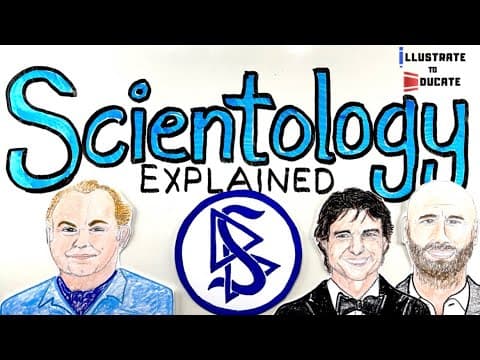
[0:04]You might have heard of Scientology, but where did it start and what exactly do they believe in? Hey, it's Dan Zimmerman and welcome back to Illustrate to Educate. In this short video, we'll dive into a detailed explanation of the basics of Scientology, covering its origins, beliefs, texts, practices, and so much more. And if you find this video to be helpful, be sure to like, comment, share and subscribe. Scientology is a modern religious movement founded by L. Ron Hubbard in the early 1950s. It presents itself as a religion that offers a precise path to self-improvement and spiritual enlightenment, using a structured system of counseling and self-discovery. While some view it as a genuine faith, others criticize it as a commercial enterprise or a cult. Scientology was founded by L. Ron Hubbard, an American science fiction writer and former naval officer. Before establishing Scientology, Hubbard wrote extensively in the science fiction and fantasy genres. In 1950, he published Dianetics, The Modern Science of Mental Health, which introduced his theory of the reactive mind, claiming that past traumatic experiences, called engrams, stored in the subconscious negatively affect present behavior. The book became a best-seller and sparked the Dianetics movement, which aimed to help individuals rid themselves of engrams through a process called auditing. After the initial Dianetics movement lost momentum due to financial and organizational struggles, Hubbard refined his ideas and formally founded the Church of Scientology in 1954 in Los Angeles, California. He positioned it as a religion, rather than a self-help movement, granting it tax-exempt status and expanding its spiritual claims. Throughout the 1950s and 1960s, Scientology expanded globally, establishing churches and recruiting members. Hubbard developed new teachings, including the Operating Thetan Levels, which claimed to unlock extraordinary spiritual abilities. The organization became highly secretive and controlled, leading to conflicts with governments and ex-members. In the 1970s, Scientology faced legal battles, including Operation Snow White, a covert program where church members infiltrated US government agencies to remove unfavorable information about Scientology.
[2:27]This led to multiple arrests, including the imprisonment of Hubbard's wife, Mary Sue Hubbard. After Hubbard's death in 1986, David Miscavige took over as the church's leader. Under his leadership, Scientology aggressively expanded its influence, fought legal battles to regain tax-exempt status, which it achieved in the US in 1993, and sought to gain celebrity endorsements. Now, let's look at some of the core beliefs of Scientology. Scientology does not adhere to a traditional concept of God. Instead, it teaches that individuals are spiritual beings called Thetans, who possess God-like potential but have forgotten their true nature. While the church acknowledges the existence of a supreme being or infinite, it does not define this entity nor require followers to believe in a specific deity. Scientology does not consider Jesus Christ a divine figure. While Hubbard acknowledges Jesus as a historical person, he dismissed Christian teachings as part of implanted false memories that were used to control people in past lives. Some Scientology texts even suggest that Jesus was an inferior spiritual figure compared to Hubbard's insights. Scientology teaches that humans are immortal spiritual beings called Thetans, who have lived through countless past lives, even on other planets. Thetans are trapped in MEST, matter, energy, space, and time, and must undergo spiritual awakening to reclaim their power. The church's goal is to help Thetans free themselves from their limitations through auditing and spiritual advancement. Next, let's look at sacred texts and teachings. Scientology's key teachings come from the writings and lectures of L. Ron Hubbard, which include number one, Dianetics, the modern science of mental health, the foundational book explaining the reactive mind and how auditing can remove engrams. Two, Scientology, a history of man, which describes past life experiences and concepts of Thetans. Three, the creation of human ability, which details auditing techniques. Four, advanced operating Thetan materials, secret writings only available to high-level Scientologists. One of the most infamous teachings is the Xenu story, where Hubbard claimed that 75 million years ago, a galactic ruler named Xenu sent billions of beings to Earth, then called Teegeeach. He killed them with hydrogen bombs and trapped their spirits. These spirits, called body Thetans, now attached to humans and cause mental and emotional problems. Most of these teachings are only revealed to members after they pay for years of expensive courses. Next, let's look at some of the main practices of Scientology. Auditing is the central practice of Scientology, similar to counseling, but structured as a question and answer session. A trained Scientologist, known as an auditor, helps a participant recall past traumas using an e-meter or an electropsychometer, a device that allegedly measures electrical responses in the body. The goal is to remove negative engrams and achieve a state called Clear, where a person is free from subconscious limitations. Scientologists advance through a structured spiritual progression, known as the Bridge to Total Freedom, which includes levels such as level one, pre-clear, a beginner who undergoes auditing. Level two, Clear, a person free of engrams. And level three, Operating Thetan levels. Advanced levels where a Scientologist supposedly gains extraordinary abilities, such as telepathy and mind over matter control. Each level requires expensive coursework with costs reportedly reaching hundreds of thousands of dollars for completion. Scientology enforces a strict disconnection policy, meaning members must cut ties with critics, former members, or family members who are deemed suppressive persons. This has led to widespread accusations of family separation and social isolation. Scientology also heavily recruits celebrities through the Celebrity Centre, offering them privileged status within the church. Some of the most famous Scientologists have included Tom Cruise, John Travolta, and Elisabeth Moss. Scientology uses these figures to promote its public image while suppressing criticism. Lastly, let's look at some of the controversies and criticisms that surround Scientology. Critics argue that Scientology operates more like a business than a religion, requiring members to pay large sums of money for courses, auditing, and spiritual progress. Some ex-members have described it as a pay-to-play system that pressures people into financial hardship. Scientology has a history of aggressive litigation and intimidation tactics against former members, journalists, and government officials. The Fair Game policy, created by Hubbard, once permitted Scientologists to attack or ruin critics by any means necessary. Although the church claims this policy is no longer in effect, many ex-Scientologists report continued harassment. Numerous former members have accused the church of abusive practices, including forced labor in the Sea Organization, a religious order within Scientology where members signed billion-year contracts and work under extreme conditions. Did you find this video about Scientology to be helpful? If so, don't forget to like, comment, and subscribe to Illustrate to Educate, to support more simple and objective videos on topics that matter.