[0:00]Mr. Caman, great pleasure to meet you and thank you for doing this. I appreciate it. Oh, thank you. It's nice talking to you. I think that what's so interesting as I kind of look through this exhibit, uh to me, the backstory of how you became so interested in deep sea exploration. In particular, the fact that you went to the ROM at 14, you saw this exhibit involving Dr. McKinnis and you thought, unlike so many others of us who went to the ROM at 14, I'm going to write him. I'm going to tell him that I want to build something like this and then that he wrote you back. Do you think you would have achieved what you have in this area if he had not written you back? That's a really interesting question, and I'm going to go, I'm going to go with the idea that he empowered me at that age. I was 14. Um, you know, a kid in high school. I used to love to go to the ROM and and just draw whatever it was, anything a bust of Nefertiti or something like that, you know? And uh, and there was this thing sitting outside there, and I, I sketch it up and then I thought, I've got to build one of these. I'm going to build one of these and get in it. You know. And so I wrote down the name of of the guy and I sent him a letter. Now, what was going through his mind, you know, as as probably Canada's most esteemed oceanographer at the time, you know, kind of the Canadian Jacques Cousteau, to write a 14-year-old kid back and tell me how to build a submersible habitat? Um, but you, you know, I think that that was such an empowering event in my young mind. I thought, well, I guess I can. He says I can, I must be able to. Yeah, that's what I was so interested in because, like I said, I was 14. I went to the ROM many times too. I'm not sure if I ever would have thought at that age I had the capacity to do what you ended up doing. I think it's I think it's not only age, but it's place. I was in rural Canada, you know, life was of a certain scale. I never imagined I would do anything big anywhere, you know what I mean? But that that that feeling of empowerment from somebody saying, well, of course you could do it, kid, you know, he even sent me, he sent me the address for the, for the people that make the plexiglass because I asked him how do you make the windows? And so I wrote them and I said, hey, Dr. Joe McKinnis says that, you know, you make the plexiglass for the, made the plexiglass for the windows on his habitat, and they sent me a sheet of plexiglass. At that point, I had the window. I was halfway there, you know, and just had to build the rest of it. So speaking of the rest of it, we get to now see what the rest of it looked like. In particular, the vessel you went down in in 2012, the the big famous, I mean, there's been many of them, but the one that that we're focused on in this exhibit. Yes. I think there is uh among the public a higher level of interest right now on what that, given, you know, unfortunate events, but in in general, what that felt like. If you were to describe to people what it felt like to go down in that as deep as you did, how would you describe it? Well, just put it in perspective, it was it was a vehicle that was designed to go three times deeper than Titanic. And that's where I took it, and, and as I was diving it on that dive, the deepest one, I'd already been down five miles a couple of times in another trench system. And we'd done test dives, you know, sort of going deeper and deeper, but at that point, I was going to a target depth that was almost seven miles down, 10,098 meters, I think, something like that. Almost 11,000 meters. And um, so, you know, what's going through my mind? Excitement. Excitement. I'm going to get to see something no human being has ever seen before. And it's the culmination of a seven-year project. And everybody that worked on the sub is up there on the ship, up above me, and they're waiting to hear from me that I'm seeing the bottom and that I'm landing, or that I have landed. I actually landed so I didn't want to plop in and make a big mess, you know, I wanted to be able to look around and see everything and just just be there. But then when I called them, I could picture them just going crazy up in the control room on the on the ship, seven miles above my head, kind of like at JPL when they when they get a Mars lander on the surface and they get the signal back and everybody goes nuts. You know, and that's the that's the culmination of of seven years of of work. So I approached it as an engineering problem. Um, I think about the risks a lot. There are obviously always risks in exploration. Um, I think that's the nature of exploration. kind of definitionally, you're going beyond, you're going, you're going beyond where people have gone before, you're going deeper, you're going farther, farther out in the space. Whatever it is, and it's our technology that allows us to project ourselves physically into these places. That's very exciting to me. Was the risk and the degree to which it played a role in your mind as you did make that descent mitigated by the work that you had done in advance? Like was it the technology and the engineering that mitigated or was that a part, was it all excitement or was there a bit of fear? No, I don't get, I don't get excited by the risk. This is not like bungee jumping or, you know, jumping out of a perfectly good airplane with a parachute on your back. Um, no, it's it's this is about knowing the vehicle intimately, being involved in every single step of the testing, looking at every single computer simulation, every bit of finite element analysis, understanding the stress fields, understanding the safety margins. I knew that vehicle intimately because I was the co- co-designer with a an Australian engineer named Ron Allum, and he and I designed it for us both to get in and and dive. And it wasn't a passenger vehicle, it was experimental, uh, in the sense that there it was a prototype, so it wasn't a production model. I know that, um, as far as the risk goes, and especially with the most recent events, you you've been asked and and you've given interviews about, uh, your own reflections on the tragedy and what went wrong. I'm not, I'm not going to ask you the same questions. I'm I'm more curious from the perspective of the advocacy you've done over the years for deep sea exploration and its benefits. If you worry that the way in which this whole thing was consumed by the public, the drama of it, the way it unfolded, if it might have a chilling effect, A on people's desire to actually go down, but B on the bodies that need to fund that kind of exploration, be it private sector or in the government. Well, first of all, I don't think you can you can stifle true science and true exploration. People are always going to go. Uh because they believe in it, you know, you're talking about a, you're talking about a very small segment of the population that are passionate about that kind of work, about seeing with their own eyes or through robotic eyes, new things, expanding the circle of our knowledge, expanding science. You're not going to be able to stop that. Um, I do think it it may, I think it's important for people to remember that we've done deep submergence exploration all the way down to the deepest places in the ocean. the trenches, the the abyssal planes, the hydrothermal vents, all over the world for 50 years without incident. And it was a company that was transporting people on the cheap on what they thought of as a bus ride to a relatively safe place. Only one-third of the depth that I went to in in my sub, where they got, they got caught. They got caught by by poor engineering. It was a poor design, and I think we could see it was a poor design, but, but it was unfortunately a very graphic demonstration. And and equally unfortunately, you know, one of my friends was in the sub, P.H. Nargeolet, who was a legendary submersible pilot. But he wasn't an engineer, he didn't build the sub. He believed what they, what they told him, I guess, and it wasn't right. Do you think there's inherently an issue with the idea of taking tourists on those kind of expeditions? Well, here's another interesting fact. So there are tourist subs that range anything from, from like 20 seat subs that'll go down a few hundred feet to uh five to seven person subs that'll go down much deeper than that. to subs that'll go down to 1,000 meters to 1500 meters to 2,000 meters, and it's got a perfect record. It's got a perfect record if the subs are classed, if they're certified. So I work with a company called Triton. They have about 20 vehicles all over the world now. Uh there's another another commercial company called Atlantis. They have 20 seat subs. You're talking about literally millions of human hours spent in tourist subs all over the world, all kinds of different environments, done 100% safely. No fatalities, no incidents because there's a classing system, there's a system of certification. You can't put passengers into a sub without it fit fitting certif fitting the certification rules, and they're quite stringent, as they should be. Now, these guys were circumventing that by calling them mission specialists and having them sort of carry a bucket and help turn a wrench or something so that it looked like they were doing something on the expedition, but it was a transparent workaround. I have just a few minutes left. Your time is limited. So I do want to ask you a movie making question if you don't mind. And that is around actually artificial intelligence. You created a movie a few decades ago that at the time seemed Terminator seemed like a fantasy. Now most people who are the so-called godfathers of AI say it's not so much a fantasy that that in fact there could be a risk to the extinction of humanity. Do you share their concern about that risk? Oh, absolutely. I absolutely share their concern of of, you know, I warned you guys in 1984. You didn't listen. Uh sure, look, I mean, you've got you've got to follow the money, who's building these things, right? They're either building it to to dominate market share, so what are you teaching it greed? Or you're building it for defensive purposes, so you're teaching it paranoia. Uh, I think the weaponization of AI is the biggest danger. I think that we will get into the equivalent of a nuclear arms race with AI. And if we don't build it, the other guys are for sure going to build it. And uh so then it'll just, it'll escalate and and, you know, you could imagine an an AI in a combat theater, the whole thing just being fought by the computers at a speed that humans can no longer intercede, you have no ability to deescalate. And when you're dealing with the potential of it escalating to nuclear warfare, deescalation is the name of the game, and having that pause, that timeout, but will they do that? the AIs will not. On a more granular less existential level. Would you ever create a movie that's written all by AI or acted only with actors created by AI? Well, I think there's a misunderstanding about what we do on the Avatar films. We we're not using AI to create our characters. They're created by actors, right? And we use computer graphics techniques to put those performances into computer generated bodies, but there's no AI involved whatsoever. And I certainly wouldn't be interested in having an AI write a script for me, unless they were really good. You know? But you're open to the possibility. Well, you know, let's wait 20 years if an AI wins a Oscar for best screenplay, I think we got to take them seriously. I guess I asked just because it's a central issue in these two strikes. I heard you say you didn't want to comment on that in the in the scrum that just took place, but I, you know, you're you're the biggest filmmaker out there, and I'm wondering, would you accept a script that wasn't written by a human? I don't think it's a matter of of who wrote it. It's never an issue of who wrote it. It's a question of is it a good story? And I just don't I personally don't believe sitting here that a disembodied mind that's just regurgitating what other embodied minds have said about the life that they've had, about love, about longing, about fear, about mortality, what they've said, and just put it all together into a word salad and then regurgitate it, you know, like what they call a stochastic parrot. I don't believe that's ever going to have something that's going to move an audience. I think you have to be human to write that. And I think any I don't even know anybody that's even thinking about having, you know, an AI write a screenplay. But I certainly don't know everybody in Hollywood, and Hollywood people do some crazy ass stuff. And on that note, I'll leave it there, Mr. Cameron. Thank you very much. I appreciate your time today. Thanks. Yeah, good questions. Thanks very much.
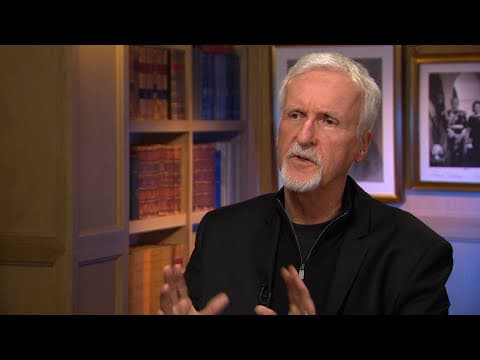
EXCLUSIVE: One-on-one interview with filmmaker James Cameron
CTV News
11m 58s2,426 words~13 min read
YouTube auto captions
Transcript source
YouTube auto captions
This transcript was extracted from YouTube's auto-generated caption track. The transcript below is server-rendered so it can be read, searched, cited, and shared without opening the original YouTube player.
Pull quotes
[0:00]I think that what's so interesting as I kind of look through this exhibit, uh to me, the backstory of how you became so interested in deep sea exploration.
[0:00]In particular, the fact that you went to the ROM at 14, you saw this exhibit involving Dr.
[0:00]McKinnis and you thought, unlike so many others of us who went to the ROM at 14, I'm going to write him.
[0:00]I'm going to tell him that I want to build something like this and then that he wrote you back.
Use this transcript
Related transcript hubs
Watch on YouTube
Share
MORE TRANSCRIPTS


