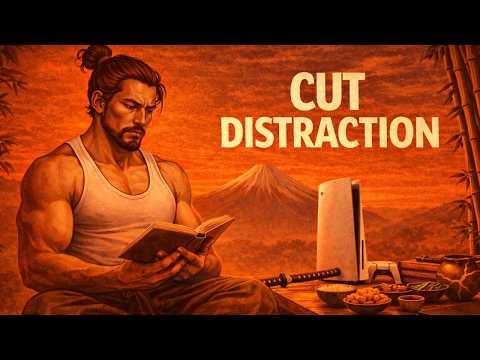
[0:00]There's a lie that most people believe about themselves. A lie that makes you feel guilty, ashamed, inferior, a lie that makes you wake up in the morning already indebted to yourself. This lie has a name, and that name is laziness. Have you ever looked in the mirror and thought, "I'm lazy"? Have you ever given up on starting something important because you thought you didn't have enough willpower? That you were too weak, not disciplined enough, that other people simply had something you didn't? That's right, and that's the, because studies in the field of cognitive neuroscience show that most people who self-identify as lazy don't suffer from a lack of motivation. In fact, they suffer from something completely different, excessive distraction combined with a lack of mental clarity. The difference matters a lot, because if your problem is laziness, the solution is willpower. But willpower is a limited resource, willpower runs out, it fails, it abandons you precisely when you need it most. But if your problem is distraction, the solution is something completely different. It's a skill that can be trained, a skill that the Japanese developed centuries ago in a philosophy that passed through samurai, Zen monks, and that today, through life's twists and turns, has reached a 19-year-old named Isaiah in a city in Ohio on a Saturday afternoon when he should have been studying programming, but it wasn't. Before I tell you Isaiah's story, I want to ask you something simple. If you're watching this video right now, it's because something in the title or thumbnail caught your attention. And if it did, it's because this topic resonates with you in some way. So do one thing. Subscribe to the channel, like this video, and comment below with a word that represents the biggest enemy of your concentration. It could be your cell phone, YouTube itself, social media in general, your thoughts, it could be anything, just one comment. Thank you very much. Now back to the story. Chapter 1 The Eternal Beginning. Isaiah was 19 years old, lived with his mother in a small house in Columbus, Ohio, and had a dream that he took seriously, at least in theory. He wanted to be a programmer. It wasn't a vague dream, one of those that people have and forget. Isaiah thought about it all the time, he watched developer videos on YouTube, he followed startup profiles on Instagram, he read Twitter threads from founders telling their stories. He knew exactly what he wanted, to create an app, to work on a large project, maybe one day to found his own company. The problem was that Isaiah never got off the starting line, perhaps you know exactly what that feeling is like. Every week he would schedule it, Monday it's going to start, this time it will, he would sign up for a course, open his laptop, put a bottle of water on the table. But that's where the cycle began. Before studying, he would think, "Wait, let me tidy the table first." He would tidy it, then, "Let me take out the trash because I can't concentrate with a full trash can." He would take it out. "Before I start, let me put out the dog's food, because they'll be staring at me and I won't be able to focus." He would put it out. 30, 40 minutes passed, the table was set, the trash was out, the dogs were eating, and Isaiah still hadn't clicked in the first lesson. When he finally sat down, his mind was already tired, not from studying, from the effort of avoiding studying. Then the first distraction came easily. He opened the course, saw the index, and the index had 50 lessons. 50 lessons, where to begin? Go in order, go straight to the language, do the theory first, but which theory? Python or JavaScript, back end or front end, what if he starts the wrong way and wastes time? Doubt was paralyzing, and when doubt paralyzed, YouTube appeared. I'm just going to watch a quick video to help me decide where to start. The video featured a programmer explaining the best programming languages for beginners. It made sense to watch, right? It was about programming, it was technical, it was productive, but in reality, that wasn't productive. At that moment it was an escape disguised as productivity. Isaiah would watch that video for 40 minutes. Then I'd watch the next one, then another, and suddenly it was 2 in the afternoon. He hadn't written a single line of code, but he felt busy, he felt like he'd been studying because he was consuming content on the subject. This trap has a name. Psychologists call it active procrastination, or sometimes productive procrastination. The person thinks they are learning, researching, preparing, but in practice, they are just avoiding the real task. They are stuck in the eternal beginning, that comfortable place where you are always about to start but never actually begin. And the worst part, Isaiah thought he was lazy because of it. Every night before going to sleep, he would take stock. Another day wasted, I'm lazy, I have no discipline, others can do it, I can't, maybe this dream isn't for me. This thought grew stronger. Week after week, month after month. The dream became smaller in his mind, the guilt grew stronger, until one Saturday afternoon something different happened. Chapter 2 the video that changed everything. It was Saturday, Isaiah had promised himself that this weekend would be different. He had left his cell phone in the bedroom, put his laptop on the kitchen table and opened the Python course. 20 minutes later it was on YouTube. It wasn't a conscious decision, it was automatic. His hand went to his phone, his thumb opened the app, the algorithm showed him a video. He clicked before he realized he had clicked. But this time the video was different. The thumbnail showed a Japanese man with glasses and a serious expression, and the title said something about how most people who think they're lazy are wrong. Isaiah wasn't the type of person who usually stopped to watch philosophical videos, but something about the title resonated strongly with him. Because it was exactly what he thought of himself, he clicked. The man's name was Fabio Akita, a programmer for over 20 years with a long career in the world of technology. And Akita wasn't talking about programming languages. He was talking about the mind. Akita said something that Isaiah had never heard so clearly before. He said there's a huge difference between not wanting to do something and not being able to do it. Laziness is not wanting to, but most people who consider themselves lazy actually want to. These people really want to, their problem isn't motivation, it's that their minds don't have enough to sustain an action long enough to produce results. And then Akita spoke a word that Isaiah had never heard before. Fudoshin. Chapter 3 The mind that does not move, Fudoshin. The meaning of this word would be something like a mind that doesn't move. It is not a rigid mind, it is not a cold or unemotional mind, it is a mind that is not swayed. The concept originates from Japanese martial arts, especially kendo and bushido, the samurai code. A warrior with Fudoshin could be in the midst of combat, with the enemy shouting, the environment chaotic, the danger real, and his mind would remain stable. Make no mistake, a warrior feels fear like any other human being, but fear does not dictate his actions. Akita explained that in the modern world, the enemy doesn't use swords. The enemy uses notifications, they use autoplay, they use that video that appears in the corner of the screen when you're trying to work. And most people don't have fudoshin. Their minds are moved by anything, a noise, a notification, a random thought, a suggested video, and their attention goes without resistance, without even realizing it. Isaiah was watching this and feeling something strange, it was recognition. It was the feeling of finally having a name for something he was experiencing but didn't know how to describe, because his problem was never laziness. It was never a lack of willpower. The problem was that his mind was too easily moved, anything would move him, doubt about where to begin would move him. The discomfort of not understanding immediately would move him, the suggestion of a video would move him. He had no anchor, he had no Fudoshin. Akita continued, and he said something that stuck in Isaiah's memory like fire in dry wood. Distraction doesn't kidnap you, you surrender to it, there's a difference, and that difference is everything. What Akita described in that video finds direct support in contemporary neuroscience. Neuroscientist and Oxford University professor Daniel Levitin, who has dedicated years studying how the brain functions under pressure, describes in his work that the human brain was not designed for multitasking. When we jump from one activity to another, what happens is not that we do two things at the same time. What happens is that we do each thing halfway, leaving a trail of incomplete attention in each of them. He calls this trail attention residue. In practical terms, when Isaiah stopped studying to watch a video, his brain didn't switch off from studying. Part of it remained processing, trying to solve the problem, and when he returned to studying, part of it was still on the video. He was never fully present anywhere. This explains the fatigue he felt. It wasn't the tiredness from studying too much, it was the tiredness from being constantly torn between things. Psychologist Mihaly, creator of the concept of flow, the state of flow, goes in the same direction. Flow, that state of deep concentration in which time seems to disappear and productivity explodes, only happens when there is total attention, a single task, a single direction, a mind that is not moved. Fudoshin in modern terminology is the neurological condition for the state of flow. You don't get into a state of flow with a YouTube tab open, you don't get into a state of flow with your phone on the table, you don't get into a state of flow with your mind divided between, "Am I doing this right?" And, "Should I be watching that other lesson?" Isaiah didn't know Mihaly's name. I hadn't read Levitin, but I was understanding all of this from a Japanese programmer's video on a Saturday afternoon, and for the first time in months, something inside him shifted. Chapter 4 The first real day. The following Monday, Isaiah did something different. He didn't make a huge list of goals, he didn't promise to study eight hours a day, he didn't download a new course, didn't research which was the best programming language, didn't reorganize his computer desktop. He only did one thing, he chose Python, Lesson 1, from the beginning, without questioning, perhaps it wasn't the perfect choice. But the paralysis of choosing was destroying more time than any wrong choice could have. Fudoshin isn't about being certain. Fudoshin is about not being paralyzed by uncertainty. He put his cell phone in the room, he closed all the browser tabs except the one for the course, he set a 25-minute timer on the screen, and it began. The first five minutes are always difficult, your mind tries to sabotage you, there was a moment when he thought about opening YouTube just to check something quickly, but he kept. 25 minutes later, the timer beeped, he had attended an entire class, he had written his first lines of code. I had understood variables in Python. It was a small start, but Isaiah managed to make progress. He didn't have the feeling of having consumed content, he had the feeling of having done something. This difference for those who have never felt it is difficult to describe, but for those who lived through months in the eternal beginning, this difference is the difference between being alive and merely existing. Isaiah stared at those lines of code on the screen, simple four lines, but they were his, written by him, working. He completed another 25-minute cycle. In total that Monday he studied for 50 minutes of real study. He didn't study all day, 50 minutes with his mind present, and that was more than he had studied on any day of the previous month. Chapter 5 What Fudoshin really demands. In the following months, Isaiah continued, understand one thing, progress isn't linear, there will be days when your phone will win for a few minutes, days when you'll fall into YouTube and only realize it an hour later. Days when doubt might return and you might get stuck in front of the computer for a few minutes. This happened to Isaiah, but there was a difference now, he knew what was happening. Before when distraction won, he thought, "I'm lazy." Now he thought, "My mind wandered, I need to bring it back." He no longer treated it as defeat, but as information. This is fundamental to understanding Fudoshin. The unmoved mind is not the mind that is never tempted, it is the mind that when moved knows how to return. Samurai didn't practice fudoshin because they were naturally calm, they practiced it because they had trained the skill of returning to the center. The wind blows, the flame sways, but it returns to its position, the wind doesn't extinguish the flame, it only tests its root. Isaiah was building that root.
[13:56]He developed a simple ritual. Before studying, he would take three deep breaths. He wasn't doing an elaborate meditation, it was just a 10-second pause to tell his brain, "Now it's time for one thing only." He would put his cell phone in a drawer, not on the table, not in his pocket, in the drawer, because he knew that if the cell phone was on the table, his mind knew it was there, and part of his attention would be focused on monitoring it. Small rituals, big effects. Six months after the Saturday he watched Akita's video, Isaiah had completed the Python course, he had built three small projects, one of them a tool that automatically organized his computer files, simple, functional, made by him. After a while, he decided to send his first resume. Chapter 6 The company. Isaiah joined a mid-size tech company in Columbus at age 19 as a junior developer. The salary was modest, the work was demanding, but Isaiah had something that most of his colleagues in the same position didn't. He knew how to work with a present mind. While other junior developers got lost in side conversations on Slack, in unnecessary meetings, in cycles of procrastination disguised as research, Isaiah worked with focus. Not because he was smarter, but because he had trained the skill of being where he was. In a corporate environment, fudoshin isn't about the absence of interruptions, it's about the ability to refocus after an interruption, because interruptions will happen, emails will arrive, colleagues will call, meetings will take place in the middle of your best moment of concentration. The point isn't to eliminate all of that, it's about not being defined by it. Isaiah grew quickly. In three years, he went from junior to senior. He learned about data security out of necessity for the job. He discovered a problem that no one was solving well, digital identity verification, the process companies use to confirm who the person on the other side of the screen is in an online transaction. It was a complex, regulated market, full of technical friction. He began studying it in his spare time, this study wasn't a requirement of his job, but he was intrigued by the subject. That's the difference between learning through distraction and learning through guided curiosity. Distraction takes you where the algorithm wants you to go, guided curiosity takes you where you need to go. At 22 years old, Isaiah had saved enough money and had sufficient clarity about the problem he wanted to solve. He spoke with two colleagues he knew well, they put together a plan. At 25, Isaiah left the company and founded his own startup. But here's something most success stories don't tell you. Isaiah's startup didn't explode overnight. It didn't have that cinematic moment where the product is launched and the world stops to applaud. The first six months were tough, clients who promised to sign contracts and then disappeared, bugs that appeared at the worst possible time. Money going out faster than it came in. And do you know what was the greatest fudoshin test of Isaiah's life? It wasn't any of the external problems, it was the inner whispering, the whisper that said, "Maybe you made a mistake. Maybe you should go back to the safety of your job, maybe you're not the type of person who can do this." That whisper appears to every founder, to every artist, to every athlete in the midst of their toughest training. It's the moment when the mind wants to move away from the discomfort, and that's exactly where Fudoshin shows his true worth. Because fudoshin is not unwavering confidence or absolute certainty. It is the ability to feel fear, to feel doubt, to feel weariness, and not be swayed by these things. It is the difference between observing thought and being thought. Isaiah watched, he did not obey. Chapter 7 What he built. Today Isaiah is 27 years old, his company, focused on cybersecurity and identity verification, serves dozens of corporate clients, their technology helps companies confirm who their users are in real time, reducing fraud and simplifying processes that previously took days. But what matters most in this story is not the size of the company. That's what Isaiah did with what he earned. His mother no longer works, Isaiah takes care of her, his cousin, who was on the wrong path, without direction or prospects, joined Isaiah's company as an intern, he's learning, he's growing. Other young people in the neighborhood where Isaiah grew up saw that it was possible. Fudoshin didn't just create a company, he created a man who was present in his own life, and it all started on a Saturday afternoon with a 19-year-old who should have been studying but wasn't. He stumbled upon an unexpected video, heard a word he didn't know, and decided for the first time to stop calling himself lazy. So what did Isaiah learn? What can you take away from this? First point, you're probably not lazy, you're distracted, and there's a huge difference. Laziness is not wanting to do something, distraction is wanting to, but having your mind wander before you even get there. Second point, fudoshin is not a personality trait, it's a skill, and skill is trainable, and training starts small. A timer, a task, a drawer with your cell phone inside. You don't need to change your entire life today, you need to do one thing with your mind present. Third point, the enemy is not YouTube, it's not the cell phone, it's not the noise outside, the enemy is the absence of an internal anchor. When you have fudoshin, the cell phone can be on the table and the mind won't wander, when you don't have it, it doesn't even need to be on the table. The mind wanders on its own without needing an invitation. Fourth point, productive procrastination, that trap of doing things related to the goal but avoiding the main task, is perhaps the most sophisticated form of self-sabotage. You feel busy, you think you're making progress, but you're at the eternal beginning, that comfortable place from where nobody gets anywhere. And fifth point, the most important moment is not when you start with energy and motivation. It's when your mind wants to wander, and you decide to stay. That moment, repeated 1,000 times is what builds fudoshin, it's what built Isaiah. The question that remains for you is simple, in which task today can you practice not moving? Think about this and take action today. If you enjoyed this video, I invite you to watch one of the ones that's appearing on your screen now, you'll definitely learn something valuable from it too, and if you haven't subscribed to the channel yet, do it now, because every week there's content like this, philosophy, psychology, stories that will make you think differently about who you are and who you can become. Thank you so much for staying until the end and remember, be present, walk with honor, follow the path until the next video.


