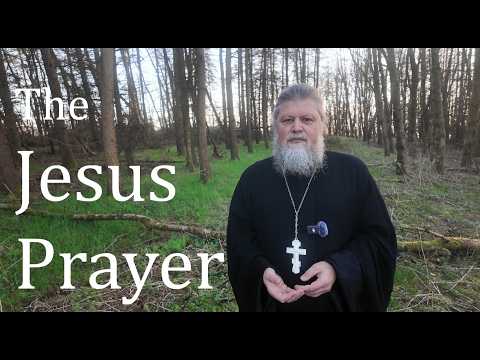
[0:14]In the name of the Father, and of the Son, and of the Holy Spirit. Amen. One of the great spiritual treasures of Orthodoxy is the Jesus Prayer. In the we read that the Jesus Prayer is a summary of the whole Gospel. An expression of the deepest nature of the relationship between man and God. And of course the reality of the gospel is the person of Jesus Christ. And so the Jesus prayer is a means of turning directly to him, the very person of Christ. Lord Jesus Christ, Son of God. And when we pronounce the name of Jesus in this way, we are making a declaration that he is the second person of the Holy Trinity. He is God incarnate, He is God made man and who has lived in the midst of us. This is our declaration when we say the Jesus Prayer. Saint Paul teaches us of course that it is the the work of the Holy Spirit that that guides man to proclaim these truths about Jesus. And by saying the short phrase, this short little prayer, we make our confession of faith to him. When we say the Jesus prayer, we always begin with a confession of everything that God has done for us to save us. But a confession of faith is not enough to save us. A confession of faith will not save us in itself. In the second chapter of the Epistle of St. James, he warns us. He says even the the demons believe, but their belief does not save them. In fact, their belief in who Jesus is makes them tremble, makes them fearful. They shudder, St. James says. Faith must lead to a right relationship with God. It is the foundation, faith is the foundation of the right relationship with God that saves us. In the Jesus prayer, the profession of faith is then followed by the words, "Have mercy on me a sinner." Have mercy on me a sinner. This is where we find that profession and that expression of the true relationship that we must have with God. Throughout our liturgies, again and again, the people respond to our prayers, to the litanies, "Lord have mercy." This is the foundation of the right relationship with God, "Lord have mercy." But we mustn't make the mistake of limiting what Lord have mercy actually means. We mustn't reduce it to some kind of legalistic concept, as Saint John Chrysostom says. When we go to church, we do not stand in a court of law. That is not the nature of this expression and this request, "Lord have mercy." Many people who are not Orthodox will be aware of that phrase, "Kyrie Eleison." It's very popular even amongst Protestants. When we translate the words "have mercy" from Eleison, we are limiting it to a certain degree always because the word eleison has the same root as the word eleon, which which means the olive tree or or the oil from the olive tree. And this is important because throughout the Old and New Testament, we have many references to the olive tree. And it's no good just picking out a single verse and declaring that that is how our whole faith can be understood. We must see the entirety. We must take their meaning from all these different aspects because sometimes these references, these verses can appear appear to be saying something very different. But in fact, as a totality, they express the faith, they teach us. So for example, to begin with, when Noah sends the birds out to find dry land, eventually a dove returns with with an olive branch, an olive twig. A sign that there is dry land. So the olive twig there is a sign that God's punishment is complete. that He is offering a new beginning, dry land, a new beginning. So when we ask for mercy, when we say, "Lord have mercy, have mercy on me a sinner." Yes, we're asking for our past sins to be forgiven, but we're also asking for a new start. For the chance to walk once more on dry land, that the punishment is over. And when Jesus tells the parable of the Good Samaritan, of course, it is olive oil that is poured into the man's wounds to help him heal. It's a symbol of God's healing grace. And when we ask for mercy, we're asking God to soothe and heal the wounds that we have committed to the soul through our sins, through our disobedience. We're asking him to restore us to to put right the damage we have done to ourselves through our sinfulness. And again, olive oil was used in the Old Testament to anoint kings. It was a sign of the hope that God's grace would give these men the strength, the courage to fulfill duties that were really beyond them. And when we ask for mercy, we're seeking God's strength. We're we're asking that his grace will enable us to live and do those things which are beyond our fallen nature, beyond our sinfulness, beyond our weakness. Lord have mercy. Give me the grace and the strength to follow your commandments to repent.
[6:57]In many countries of course, Orthodox worship in the language of Slavonic, Church Slavonic. And instead of Eleison, we find the word "pomiluily." Now pomiluily has the same root in Slavonic as the word for tenderness. Tenderness, It reminds us that we're we're not just asking for something, something legalistic. But we are calling out for God's love. We are seeking the the tenderness and the intimacy of God's love for his closeness, for union with him. So the second part of the Jesus Prayer is an expression really of the mystery of God's love for man. Of the infinite, unfathomable love that God has for us. Because the power, the power of the Gospel is the willingness of Christ to love and have mercy on us, to forgive us, to heal us. And so when we say the Jesus Prayer, we're bringing ourselves to to focus on Christ, who offers to transform us with his love, with his mercy.
[8:28]When we focus on Christ and we enter his love, that love transforms, that love changes us. The simplicity of the words of the Jesus Prayer, call us to to focus entirely on him. Yes, there are times in our liturgical year, our calendar, in our services, where we rightly focus on so much on the great things God has done, His promises, his miracles, his power, the events in Christ's life and so on. So many things, so many things that are precious, that guide us and teach us and help us on our spiritual journey. But when we say the Jesus Prayer, we're called to a stillness, where where we can be consumed with nothing but the very presence of Christ. I'm sure from experience, we know that these these these few words can express everything. Whatever it is we're going through, whether we're in a trough of misery and weakness and exhaustion, whether we're at one of the peaks of our joy and celebration. Whatever it is, whatever human experience we're going through, those few words of the Jesus Prayer can capture and express everything that's necessary. Everything, whatever our condition, because Christ is with us in everything. And the Jesus Prayer leads us to the very person of Christ, who is the answer and the fulfillment of everything, every human need, every human experience. The Jesus Prayer calls us back from from the noise, the activity of the world, the tumult of of our own opinions and ideas and thoughts that swirl around our minds. We get past all of this, this confusion and noise, the clamor, the clamor of our own thoughts. The Jesus prayer enables us to enter deeper into ourselves to that part of ourself that sadly too few people even know exist. The deeper mystery of the human person, that we may stand before God and simply seek his love. The Jesus Prayer makes possible the miracle, the miracle that we may first profess our faith. And having having declared our faith in him, we may be transformed. When we encounter Christ, we may be transformed, transformed by his love and by his grace.


