[0:00]Hello, welcome to Smart ideas. It is with great joy I welcome you to this series of training where you get to learn about copywriting as a beginner. So, if you are just joining us, don't forget to subscribe to this channel and hit the bell notification so that you can be getting updates from us. So, having known that, let's dive right in.
[0:27]Now, this course is divided into eight modules. In this module, we'll learn about introduction to copyrighting, the psychology of persuasion, how to write high-converting copy, specialized copyrighting techniques, and copyrighting niches. I think I like this. You get to learn all the niches in copyrighting. In module 6, we'll learn freelancing and client management, real-world projects and assignments, certification and next steps. Well, for this certification, it all depends maybe in our Telegram channel, we shall decide if there is really need for that. But I can assure you, without certification, clients will still hire you. You just you just have to get to know how to write copy and if you are good at it, then you are good to go. Then lastly, we have our bonus module where we'll be having some tools, templates, and resources that can help you to enhance your copyrighting skills. So, it's going to be an interesting course all in all. So, having learned that, let's go to the next slide. Now the question is, what is copywriting? Who is a copywriter? What is a copy? Copywriting is the art of writing persuasive content designed to drive action, whether it's clicking a link, purchasing a product, or subscribing to a service. So, the person that writes a copy is a copywriter and what you have written is a copy. I think this is fair enough and easy to understand. But I think we see this almost every day in our lives. At times you're driving past, you see noticeboard, billboards, you know, telling you about a product or a service and all that. All of that is copyrighting. Or at times you come to social media, you open your Facebook, you see ads popping up, you see messages. Or at times you maybe you have subscribed to a service before and you receive emails, a lot of emails from brands, from companies, from coaches and all that. So all of these are results of copywriting. So copyrighting is in our day-to-day lives, but probably you may not have been noticing them or paying good attention to them, but now, I think you'll be paying attention to them. So, since we know what copywriting is all about, let's see how we can be applying them or how we can get better in this copyrighting journey. Copywriting is very, very important in marketing, sales and marketing. Wherever there is sales, there is marketing and there you need to pass a message across to a particular audience or to a target audience. You really need copyrighting. That's how you will learn how to craft well a copy that can boost conversion. You also learn how to create brand loyalty and communicate value to your target audience. So, since copyrighting is essential, it's very important in marketing, you will learn how well-crafted copy can boost conversions, how to create brand loyalty and communicate value to your target audience. Now, there's a difference between copywriting and content writing. Don't get me wrong, all of them are copywriters. As a copywriter or as a content writer, you are all copywriters. But with copywriting, the focus is on persuasion and direct action. So, your role or your function as a copywriter is how to make your audience to take immediate action. That that thing you want them to do, you will make them to do it now or never. You don't give them time to do it, to think about it tomorrow or later because if you leave it for later, they will never going to do it. So, for copyrighting, if you're a copywriter, your major emphasis is to persuade your target audience to take that action, direct action, immediately. But as a content writer, the aim is to inform or to entertain without having or requiring immediate action. So you see the difference now, but the course is all about copyrighting. In fact, it has been narrowed down to email copyrighting because this is the very foundation of copyrighting. If you understand this or you know email copyrighting, you know, as a copywriter, you can learn other secondary skills that goes with it. So, since we know the difference between copyrighting and content writing, let's see how or the roles and responsibility of a good copywriter. One of the responsibilities that you will have as a copyrighting, as a copywriter is how to craft engaging headlines. Hmm, I think this is very nice. Sometimes you see maybe in the newspaper or some news outlets, you see some headlines that just either they grab your attention or they stay kind of curiosity in you that you want to know what is inside. So, these are good copywriters that have really mastered the skill or the art of writing headlines that some newspaper companies they even employ them just to write headlines alone. So what happens is that when other people write copy for them, they send this to these copywriters that are specialized in writing headlines. They will use the content, that copy they have written, someone has written to write, to bring a very good catchy headlines that whenever the the target audience sees them, they will they will be curious enough to want to learn or to want to know the information. So, another responsibility of you as a copywriter is how to write ads copy, advertisement copy, how to write emails, how to write scripts, either for videos, YouTube videos or even general script for movies and all that.
[6:39]Now, another responsibility, what what you often notice is how to optimize content for specific goals.
[7:18]So, as a copywriter, if you are writing, if your goal is to make sales, you should know how to focus your writing to achieve just that goal. If it means your major aim is to direct your audience to click a link or to sign up, you should, your your they call it call to action. So you your call to action should be specific and one at a time. You can't write a copy and your call to action is saying your audience should do this at the same time do this, they will get confused and no. So, these are some of the responsibilities. Now, is there a good opportunity for you as a copywriter? The answer is an effatic yes. Copywriters are in high demand across industries, e-commerce, SaaS, healthcare, etcetera.
[8:08]Just think of it, they are everywhere. You will get to learn about them as we progress. They say, so, again, apart from having them in big industries in high demand, there are so many freelancing platforms like Upwork, like Fiverr or even LinkedIn where you can also land good clients. Apart from that, some brands might even employ you as a main staff. You know, you have the liberty of either being in the office or even working from home. And most importantly, you have the opportunity of also growing a career in copywriting. So, all of these are the responsibilities and opportunities that will be open to you as a copywriter. So, before we continue, if you are finding value from this video, don't forget to subscribe to this channel and hit the bell notification so that anytime we drop new message new videos, you can get to see them. Now, this is the application of copywriting in real-world example.
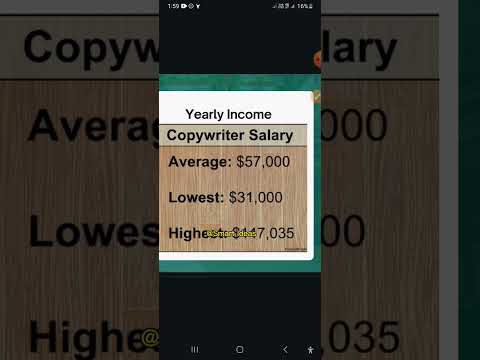
[9:20]Now, in this graph, in this tracing, this is the representation of a particular company or a brand growing business with and without the services of copywriter or employing copywriting in their marketing strategy. Now, look at this. This vertical line, this vertical line, this one represent this vertical line represent the profit in any amount could be in dollar. This is the profit or the income or the revenue generated. While this horizontal line, this is the time in days that this business has been running. Now, this lower graph in orange, this lower graph in orange, you notice that when this business started, at a point, it was the profit was very at the at the base of this graph. It is at the base. You see this dotted line is going up and down, going up and down. He's doing lean for a very long period of time. It almost even the business almost even crashed at this point. You see it, it almost crashed. Then the business try the growth start to accelerate a little before it now starts climbing steadily. Now, this growth, this increase from these points may also be as a result of the business have been able to survive a whole lot of time over a period of time that the business has been able to at least, probably they have had a good number of customers or services provided. They have had a good number of customer base over the time. So this customer base are returning to patronize, that is how the business was able to survive to this stage. But now, let's look at the same business with the services of copywriter. You see where it started from, not from the bottom, but as high as this profit margin. So, you can see that from this point where it started without copywriting to this point where it started with copywriting, you see the gap. So, you can imagine the the the profit margin. So, if this, the lowest point was $1,000, so this point where it started with copywriting could be as high as $20,000. So, you can imagine the profit margin. So, business owners, they understand this, they understand this that without persuasion, without writing good contents about their products and services and making the whole world to know about what they are doing, the business might crumble, might die off. So, because they know this, they are always in hunt for copywriters to help them promote their brand, their businesses, to make profit. And they are willing to pay any amount, not just any amount anyway. But they are ready to part with some money so that you can help them to make this kind of profit. So, just imagine the same business when it was doing the other time, say they were making a profit of say $10,000 in a month without copywriter. And with copywriter they are making about $100,000 a month with copywriter. Will it not be wise or will you did you think it will be difficult for this business owner to pay $5,000 or even $10,000 a month for you to help them to make about 100,000 instead of struggling with just 10,000 initially? So, you see that there is a place for you in this journey of copywriting. So, having known that, let's just see this is just a random information I saw online. This is for an entry level as a copywriter. This is what the yearly incomes look like. So, as a copywriter, the average income is about $57,000 while the lowest point is like at 31,000 and the highest at 147,000. So, this is an average of like 2,500 to about $5,000 every month as an entry-level copywriter. So, you see that the pay is good and the skill is what you can learn. Within three months, it might not be up to that if only you devote the time and you know what you are doing. You understand. But the the the essence of this training, the essence of this course is to help you to write your very first copy. In as much, once you are able to establish to write your very first copy, then the next is just practice, practice, practice, practice until you feel you are confident and good enough to start hunting for clients. So, let's go to our next slide. Now, this should ring a bell. Look at these brands. I guess you've been seeing, sorry, let's go back. I guess you've seen all of these, you you should know all of these trademarks. Maybe you know one or two or three out of all of these. You see Coca-Cola, you see BMW, you see Audi, Adidas, Nike and all that. These brands, they are still running advertisement every day from back to back to back to back. So, it shows that copywriters are working them doing this wonders for them. So, this tells a story. It does not really mean that because they are big brands and people know them, they just sleep off and they just realize that there's no need to advertise or to tell people about what to do. So, it shows that in everyday life, copywriters are needed. Their services are needed. So, having this in mind to give you that encouragement to know that there is a place for you, what you just need to do is how to learn the skill and go out for the bag. So, we go to the next slide. So, as a copywriter, you get to learn all of this. You will get to learn the core copyrighting framework. Yes, every copy you see, there is a framework for it. You don't just come and say, you just write anything from your head. No, it doesn't work that way. There is a framework, it's just like a formula or a structure that you align whatever idea you have, you align it to that to make a very good copy. So, these structures, the most popularized are the first two, which is this PAS and AIDA. What it means is PAS means problem, agitation and solution. While AIDA means attention, interest, desire and action. These structures shows that whenever you want to write a copy, you start with the problem for that particular target audience you want to write to. You want to tell about your services or your product. You ask yourself, what are the problems, what are the problems these people are facing? What are their problems? Now, let's bring it back to us as people learning copywriting, you want to learn copywriting. What is the problem in the first place that made you want to learn copywriting? Maybe that you are broke, you don't have money, you have tried so many things, maybe skills online and it's not working. You have tried to sell so many things online, it's not working and all that. So, this might be your problem. Now, if I want to sell a course to you, for example, about on copywriting and I come with this problem, this common problem that I know you may be having, people that want to study copywriting they are having and I established this problem. After establishing this problem, I agitate the problem, I make it look even more worse than it were. You know, to still fear to create fear in your mind, then I offer a solution that look, I know you have this problem. I know you are afraid right now that you might not even you might not succeed because you have tried so many things and it's not working. But this is the solution. The solution is to learn copywriting, to learn this skill that you can use to make money. You will be happy and for any amount whatsoever reason, you may you may want to part with that money to get this solution that I'm offering to you. So, that is just what it is. So, this is just the introduction. We're going to we are going to them deeply as we go further. But let's just highlight them. So, we said the first one is PAS, problem agitation solution. The we have the AIDA, attention, interest, desire, action. You have the FAB framework, FAB means feature, advantage, benefit. Now, this one is mostly used by e-commerce for their product listing and all that. We'll get to learn them later. Then you have the PPAS. Now, this PPAS and the next one PWAT, they are just like the modification of that first one PAS. So what PPAS means is problem, promise, agitation and solution. You state the problem that your audience is having, your target audience, they are having. You promise them, you give a promise that will give them hope, then you agitate, then you give them the solution. While the PWAT is problem, what causes the problem, you agitate, then you tease the solution. You don't just give them the solution, you tease it. The CGN is you have the challenge, justification and the need. You challenge your existing knowledge or what they have perceived to be the, their belief system. You challenge it. So, with that challenge, they want to know how. You know, you justify your challenge, then you give them the need and the need is your solution, whatever thing you are writing about. Then lastly, you have the HSO, the hook, the story and your offer. Your offer is your services or the product you are giving to them. So, these are the framework. Almost every copy you see, they are centered around any of these frameworks. So, if you understand this and you tell your your persuasion, you you string your copies, you know, your ways together to follow this pattern, you see that it will move them to take the desired action that you want them to take. Now, apart from this core framework of copyrighting, you also learn how to write for different formats. You learn how to write if it's for email, if it's to write ads, if it's even to write landing pages. Now, a landing page, let me just say something about it because this is a beginner's class. A landing page is that page that you visit after you get interaction with your first advertisement. At times, you see advert online, you see you you read the advert or you listen to the advert, then you see they say click here to learn more. You see a link. Now, when you click that link, the link will take you to a different page. At times it will take you from that platform you were, you saw the advert. Even if it's on Facebook, it will take you from Facebook to a different page entirely. So, that page you landed is a landing page and in that page, they will now give you more information about the product or the service before you now proceed to either buy or to take any other action. So, that is what a landing page is. Now, you will also learn the psychological principle behind persuasive copywriting. So, this is very key. You will learn the persuasive the psychological principle behind persuasive copy. You will get to learn that people don't just buy. There is a behavior pattern of every human and it works on their psychology. Whatever ideas, their pain, their fear, their desire, their goal, their dream, whatever, you will get to learn that. So, this course has been structured into eight modules and we are in module one. Beginning from the fundamentals to advanced strategies. So, all of these are highlighted in this course and lastly, we also get practical assignments and real-world examples at the end of some of the modules anyway. And most importantly, in our discussion channel where we will be reviewing our work and critiquing them, we shall be having more of this, some of these assignments and all that. Lastly, there are key resources that we provide, templates, swipe files, quizzes, access to tools and platform for practice. So, these are some of the things we are going to learn in these copywriting course. Now, to you as a beginner copywriter, what is success, what do you see as success? To me, at the end of this whole course, if you are able to have a solid understanding of what copywriting entails and the potential you can have in it as a career, that should be a success. That is what I will see as a success to you. So, the starting point is how to get to the top. And how do you get to the top is trying to learn and master the very fundamentals of copywriting. So, when you are able to establish this, you will see that it becomes easy as you progress.
[24:25]Now, lastly, these are some of the tools that you will need, that will assist you in this journey of copywriting. You will need Google Document. Now, Google Document is just like your notebook that you'll be writing on, where you'll be doing all your practice. That's where you will write on. So, the document is the Google app where when you download it, you put your email, you sign up. You can be writing on it. And after writing, you can share the link of that note to that document to anybody so that they can see it to critique your work, to give input and all that. Even if you have landed a client, that is where you will still write on. You write on the Google document, you send the link to your client. When they follow the link, they click on the link, they will see what you have written. The second tool you will need is Grammarly. Grammarly is an AI app that you need to download. When you install it in your phone, you put your email and you sign up. What it does is that anytime you are writing anything you've written, this app will help you to correct your grammar, your spelling and all that. So, you don't even have to worry about if you can write or if you can construct a good sentence. Grammarly will help you with that. So, you don't have any excuse for not being a copywriter. You have AI tools that can help you. Then the last tool you will need for now is Hemingway.com. It's not really an app, it's a website. Now, what Hemingway does is that after writing your copy, you just copy it and you paste it to that website. The website will help you to check it. If what you have written is too complex for a for a basic four or a primary four person that the level of primary four cannot understand it, it will show you, it will highlight all the places where the the sentence or the words are too complex. It will highlight it for you so that you can break it down. Now, when it has been highlighted for you, what you just do is you take those words or those sentences, go to ChatGPT. You remember I said ChatGPT is one of these the tool you will need. Just take it back to ChatGPT and tell ChatGPT, hey, see, this is too complex. Break it down to level three or basic three or primary three or primary four level. ChatGPT will just do that magic for you and you are happy. So, these are some of the tools you need and don't forget, we are still in our beginners or introduction class. We still have more to learn, but having established this, I believe you have the right information, have your mind prepared for the steps ahead. Don't forget to subscribe to this channel. Don't forget to also hit the like notification, the bell notification so that you can be getting all our updated information. So, having said that, in our next module, which is module two, we will learn the psychology of persuasion. This is in fact, one of the most interesting topics in copywriting. You learn the psychology of persuasion. So, that, my friend, is the very foundation to our journey to becoming a copywriting. See you in module two.


