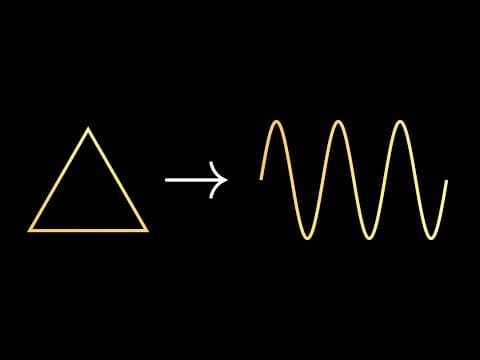
[0:00]In nature, we observe numerous phenomena that propagate in the form of waves or can be described by the concept of a wave. To understand these phenomena, we model them mathematically. It is remarkable that the mathematical description of a wave, even when solving complicated differential equations, can be traced back to a simple geometric shape: the triangle. So how can a wave arise from a triangle? Let's find out.
[0:32]First of all, there are an infinite number of triangles with different sizes, orientations and angles. But which one is the coolest? Well, for the Babylonians, it was the equilateral triangle. They were so impressed by it that they even formulated the concept of an angle based on it. In a sense, what they observed between two sides was one angle. And because all sides of this triangle are equal in length, it had three of them. And because these people used the sexagesimal system for the concept of numbers, which is a number system based on the number 60, they loved to divide different things into 60 parts. Not only were units of time divided into 60 parts, but also units of space. So they imagined that this angle also consisted of 60 equal parts. One angle therefore corresponds to 60 angle parts, which we now call degrees and symbolize with a circle. Since exactly six of these form a complete circle, we measure 6 x 60 or 360 degrees in a circle. When humans later discovered that they had 10 fingers and began using the decimal number system, they were not very amused by the fact that the Babylonians divided spacetime by 60. So they divided the units of time further into powers of 10. And the angle measurement also had to be changed. For this purpose, a fascinating property of a circle was used. If we divide the length of the circumference C by the length of the diameter D, that is, if we calculate the ratio of circumference to diameter, we get a number that always remains the same, no matter how large or small we make the circle. Today we know this number as pi. If we rearrange the equation and set the diameter equal to two times the radius, the circumference corresponds to two pi times the radius. If a radius of one, the circumference is simply two times pi. And it was precisely this circle that was used as a template for a new measurement of angular units, which is why it became known as the unit circle. Instead of imagining that, for example, a 60 degree angle consists of 60 parts, we place our circle template with its center at the tip of the angle and measure the length of the arc that this angle encloses. In the case of this angle, the arc length corresponds to one sixth of the entire circumference, that is 2 pi divided by 6, or pi thirds in reduced form. At a 90 degree angle, the arc occupies a quarter of the circle, so this angle corresponds to a quarter of 2 pi or half of pi for short. Because we use this angle so often and want to recognize it quickly, we mark it with an additional dot. And for a full circle, we eventually measure the complete circumference of 2 pi.
[3:40]Oh, and the coolest triangle was no longer the equilateral triangle, but the right angle triangle, because it can do everything that other triangles can do, and in addition, the Pythagorean theorem applies to it. Furthermore, we can construct any other triangle from two right-angled ones. So if we understand the right angle triangle, we understand all the others. For the study of triangles, known as trigonometry, it is therefore sufficient to examine the right angle triangle. All right, let's first name the individual sides. The side opposite the right angle is called the hypotenuse, the other ones are called legs. From the perspective of an angle, which I will simply call alpha, we can also name the legs more precisely. The side opposite to alpha is then called the opposite leg, and the one adjacent to the angle is called the adjacent leg. From the perspective of the other angle, we would swap these accordingly.
[4:40]With these three sides, we can create a total of six ratios, whereby in the last three ratios, only the numerator and the denominator of the first three are swapped. And now comes the remarkable part. As with the circle, these ratios also correspond to a number that does not change no matter how large or small we make the triangle. For the number to change, for example in the first ratio, we would have to change only the numerator, or only the denominator. But how can we change the numerator, which is the length of the opposite side, without changing the denominator, which is the length of the hypotenuse? Well, we would have to change the angle alpha.
[5:25]Meaning, if we set the hypotenuse to a fixed length and increase or decrease the angle alpha, then the ratios change. So, if these ratios only change when alpha changes, then we can also understand them as functions that depend on alpha. Each of these functions has been given its own name. The first one is called sine, the next one cosine, then there's tangent, cotangent, secant, and cosecant. If we choose a fixed length for the hypotenuse, then we might as well choose a length that simplifies everything a little bit. For instance, with a length of one, the sine of alpha simply corresponds to the length of the opposite side, and the cosine to the length of the adjacent side. And even better, we see that we can calculate the other ratios using just the sine and cosine. In other words, if we understand these two, we also understand the others. And we can now also use our unit circle template to measure the angle alpha.
[6:36]All right, now we need to visualize these functions. Let's start with the sine. To do this, let's draw a coordinate system and plot the angle on the x-axis and the length of the opposite side on the y-axis.
[6:51]If we increase the angle slightly, the opposite side becomes longer. As we approach an angle of zero, the length becomes smaller and smaller. At an angle of exactly zero, the opposite side disappears. But we can imagine that it's still there, just with a length of zero. If we now rotate around the entire circle and trace the path, we obtain this curve for the sine.
[7:18]Here, negative lengths mean that the opposite side is in the lower semicircle. And that looks like a wave, doesn't it? For the cosine, we can simply copy the coordinate system and offset it by 90 degrees because the adjacent side is offset by 90 degrees to the opposite side.
[7:42]However, we can also draw the cosine function in the same coordinate system. Here we can also see that the cosine looks exactly like the sine. It's just shifted by 90 degrees or half of pi. So, if we understand the sine, we also understand the cosine. And finally, we can extend the sine function to a larger angle range. We can just agree that we can keep rotating around the circle beyond 2 pi. And a negative angle just means we rotate clockwise.
[8:21]And with that, we have managed to develop a mathematical description for a wave out of a triangle. In reality, of course, not all waves look like this pure sine wave. But we can manipulate this function with additional numbers. For example, if we multiply the sine by a certain number, we influence the height of a wave crest, the so-called amplitude. And if we multiply the angle by a certain number, we influence its frequency. We can also shift the function in the x or y direction, or even put alpha into a separate function.


