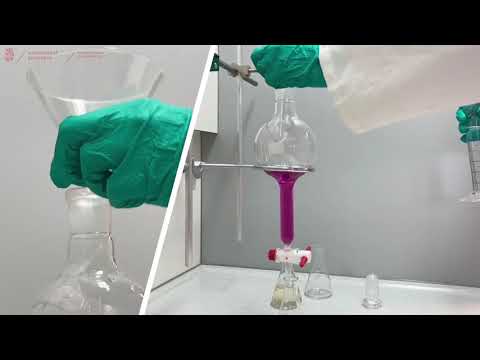
[0:04]In this video, we will show you how to perform a liquid liquid extraction, or a separation. To perform a separation, you will need one metal ring to hold your separator funnel. And you need to attach this to the fume hood. When the ring is properly attached, you can take your separator funnel. Use a separator funnel which which is of sufficient size to hold your crude product and any washing liquids you intend to use. Place it in the metal ring. You will need several meers to hold all the fractions you intend to collect. Place one of them under the separator funnel and close the tap. To pour in any liquid into your separator funnel, you will need to use a big funnel. And for the separation, you will need to close the separator funnel with a stopper that is lightly greased. When you have your crude mixture, you have to add it to the separator funnel. In this case, our crude mixture is iodine dissolved in water.
[1:33]Rinse your crude mixture with the same solvent used as for the crude. To make sure that all your product actually enters the separator funnel. Now, we're going to extract our iodine in the water layer towards our organic layer. In this case, our organic layer is pentane, and we're using the same amount of pentane as we had water. Add the pentane to the separator funnel. And remove the funnel from your separator funnel. Now close the separator funnel by adding the stopper on top of the separator funnel and place your hand on top of the stopper and holding the separator funnel in a firm grip. Lift it up and flip it upside down. Now you can shake your separator funnel to make sure that the extraction has the largest surface amount possible. Don't forget to vent the separator funnel as pressure will build up by the increased increase of heat from shaking. Repeat this motion several times for proper extraction.
[3:00]When you think the extraction is done, place it back into the ring. And remove the stopper.
[3:11]When your separator funnel stands for a while, you will see a clear difference between the two layers. The higher density water is at the bottom and is colorless in this case, and our pink pentane layer is at the top. Now we want to separate these two layers by opening the tap and let the water flow out into our mire. Keep an eye on the separation and close the tap before the pentane leaves the separation funnel.
[3:47]When you have a colored and a discolored layer, it's very easy to sep to see the separation. To demonstrate separation between two colorless layers, we will neutralize the iodine by using sodium bisulfite. The sodium bisulfite is in a saturated solution in water and will now add it to our separation funnel.
[4:29]Place the stopper back on your separation funnel, put it, place your hand on top of the stopper and hold it tight. Now we'll repeat our shaking motion and frequent opening of the vent to release pressure.
[4:58]After placing the separator funnel back into our holder, we can clearly see that the pink color is gone. Because we now have two colorless layers, we will have to search for our separation. Sometimes it's difficult to see the separation as it's in the part where the separator funnel goes from narrow to wide. By opening the tap slightly, you will see that the separation separation will show up in the thin part of the separator funnel.
[5:42]The separation can be seen here. There is a tin meniscus between the two colorless liquids, water with the higher density on the bottom, and pentane with the lower density on the top. Now continue removing the water until only pentane is left.
[6:10]You can now collect your pentane into a clean mir and continue with the rest of your procedure. This is how you perform a liquid liquid extraction.


