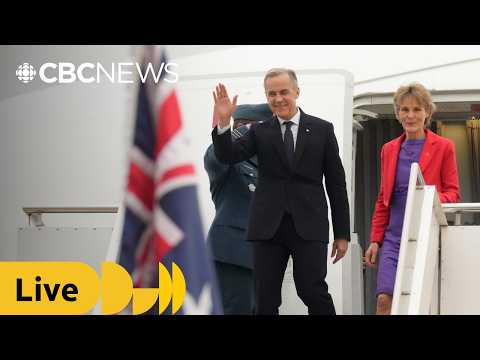
[0:00]leader of the opposition Taylor. Thank you for reminding me of the importance of beer. And competition. And in terms of deflating the pomps, I would note, I would I would recall our meeting with Prime Minister Starmer, uh, our trilateral at a time of great consequence, uh, where it was around drinks and Prime Minister Albanese. brought four of Australia's finest tins, which just happened to bear his name. Mr. Speaker, President, honorable members and senators, distinguished guests, ladies and gentlemen. Thank you for this warm welcome to myself, my wife, my colleagues to Australia. Let me also thank the Australian firefighters who are here in this chamber today. They came to my home province of Alberta, when we faced record wildfires last summer, as is all too common. But what is also common is that action, that heroism is just as Australian firefighters have done for Canadians over the years. And this is just one of the many testaments to the profound and practical friendship between our two nations. Friends. It is a distinct honor and privilege to address this parliament. One of the world's great chambers of democracy and a testament, as both previous speakers indicated, to our shared Commonwealth heritage. Allow me a few words in Canada's other official language.
[2:00]Le Canada et l'Australie sont de grands amis et ce depuis longtemps. La confiance est le pilier central de notre relation. Lorsque le Canada et l'Australie agissent de concert, nous faisons une grande différence. Et en cette période de rupture, notre collaboration est encore plus stratégique. Nous pouvons chacun renforcer notre souveraineté et ainsi produire des résultats concrets pour nos citoyens et citoyennes, de même que pour nos économies. Mr. Speaker, the last time a Canadian Prime Minister stood here, it was a different era, with different challenges. 2007. The eve of the global financial crisis. A crisis through which Australia and Canada sailed. We sailed through that storm because of the soundness of our banks, the probity of our public finances and the resourcefulness of our people. And well much has changed since then, these qualities endure, as does the friendship between our nations. Although we could not be further physically apart, Canada and Australia are strategic cousins. We may look to different skies, the North Star in our hemisphere, the Southern Cross in yours, but we have the same orientation. We share a common heritage, have developed a common perspective and can build together a common future. Two sovereign nations, two proud democracies. The true North and the land down under, navigating with the same values. As the Prime Minister indicated, what makes our relationship rare is that it was not built by geography or by great power design. It was chosen repeatedly over centuries. In the mud of Flanders, on the shores of Normandy, in the hills of Korea and the valleys of Kandahar. Canadians and Australians have stood by each other when the hour was darkest and victory most in doubt. And we have done so because we believe that people everywhere deserve to live freely, to govern themselves and determine their own futures. And that these values are worth defending, even at great cost. Together, we helped to build the post-war international system, to draft the UN Charter, and to create a global economic order that brought prosperity to our peoples. We helped write its rules from Basel to Brisbane. We were at the table when the G20 was formed, when the Trans-Pacific Partnership was negotiated, and when the standards governing trade, finance and security were all set. Yes, that system was imperfect, but it functioned. Keeping sea lanes open, resolving disputes, growing trade and investment and narrowing the gaps between rich and poor across the world. With that global architecture now breaking down from consecutive crises, I've come to Australia at your invitation, to reaffirm our alliance and to suggest where it can go next. Because it's my fundamental belief, as a result of optimism, I've picked up from people from this great country. that from this rupture we can build something better, more prosperous, more resilient and more just. It's often observed that we have much in common. The Westminster system, federalism, common law, the crown. Yet the foundations of our relationship go much deeper. We intuitively understand how each other's systems work. How power is constrained, how our institutions functions, and the values that underpin them. This is the product of decades, centuries of parallel development, common inheritance and continuous exchange between our peoples. It's not something that can be replicated by a treaty or sustained by rhetoric. On this common foundation, we have built civic nations. Societies held together not by blood or soil, not by a single faith or culture, but by something more demanding and durable. A shared commitment to live together, to accommodate our differences, and to pursue the common good. Canada's founding insight is that unity does not require uniformity.
[7:27]That we can share a country without conforming to a single identity. That our differences, honestly, acknowledged and respectfully navigated, are source of strength. Australia arrived at the same destination by its own path. Let us remember that Australia was the first nation in the world to give women the right to vote and to stand for Parliament. Your example, your example has inspired the world ever since. And that act of democratic extension, choosing to widen the circle rather than guard its edges, is the fundamental instinct that drives our common civic nationalism. Our two nations were built by risk takers, by voyagers, by drovers. Adventurers, people whose families left everything behind to start again. They crossed oceans with uncertain prospects to bet on themselves and bet on each other. And that commitment, that commitment to building something together rather than resting on something inherited, is bred in the bone of our national characters. Of course, we are both nations still in the making. The important work of reconciliation with indigenous peoples is ongoing. We continue to strive so that everyone has equal opportunities, regardless of gender, race, sexual orientation or starting point in their lives. This work is not the sign of weakness, rather the product of a confidence and honesty that acknowledges when we fall short and relentlessly strives to do better. Mr. Speaker, the institutional depth we share, our friendship forged by shared values and common battles, creates a trust that is also a strategic asset. It is a source of power. And the question today for middle powers like us is whether we establish the conventions and help write the new rules that will determine our security and prosperity or let the hegemons dictate outcomes. In the new global environment, the ability to form effective coalitions is becoming a central strategic capability. Great powers can compelle, but compulsion comes with costs both reputational and financial. Middle powers can convene, but not everyone can. In the post-rupture world, the nations that are trusted and can work together will be quicker to the punch, more effective in their responses and more proactive in shaping outcomes and ultimately those countries will be more secure and prosperous. Mr. Speaker, Middle powers like Australia and Canada hold this rare convening power. Because others know we mean what we say and we will match our values with our actions. This has been earned by those before us throughout our history. And the question is now what do we do with it?
[11:09]Canada is choosing to create a dense web of connections to build our resilience. We've adopted a new framework for engaging the world, variable geometry. Creating different coalitions for different issues, based on common values and interests for those issues. This is not a retreat from multilateralism, it is its evolution. And to be clear, Canada's support for the United Nations, the Bretton Woods institutions, the multilateral system is like Australia's unwavering. But while we are committed to reforms of these institutions in order to better reflect today's world, we need coalitions now to address immediate challenges. And as those coalitions work, they will help demonstrate the power of multilateralism and reinvigorate it. The fact is right now many countries are concluding that they must develop greater strategic autonomy. And this impulse is understandable. When the rules no longer protect you, you must defend yourself. A country that can't feed itself, fuel itself or defend itself has few options. But in the 21st century, the requirements for economic security and prosperity of our countries extend far beyond food, conventional energy and defense, as important as these are. Today, sovereignty requires reliable access to space-based communications and storage, vaccines, semiconductors, payment systems and capital. Because governments and businesses went for decades, prioritized efficiency over resilience. We've developed supply chains and trading relationships that create dependencies on the great powers. Sometimes even individual corporations. All of these affecting essential elements of our sovereignty. And as that integration is weaponized, this creates fundamental vulnerabilities. In response, Canada's strategic imperative is to build sovereign capabilities in these critical sectors at home, and in coalition with trusted, reliable partners like Australia. To ensure that integration is never again the source of our subordination.
[13:51]And let me in the spirit of the leader of the opposition, move from the theoretical to the practical. I'll give five examples of this variable geometry in practice. The first, Prime Minister is in critical minerals. Canada and Australia are the world's two most reliable and like-minded mining giants. We are both committed to sustainability. We have each developed the most advanced extractive ecosystems. all the range from prospecting to engineering, logistics and capital markets. We're blessed with abundance of foundational metals that power the batteries, the EVs, the smartphones, the AI systems of this century. Together we produce one third of global lithium, one third of global uranium, 40% of iron ore. In fairness, that's largely you. But we'll take credit for it. Uh, and we have a combined war chest, a combined war chest right now, of $25 billion to fast track global projects. Globally, we're one and two in the most attractive we are one and two as the most attractive mining investment jurisdictions in the world. We are the world's critical mineral superpowers. Now, in the old world, and even to a degree today, the temptation would be to see each other as competitors. In the new world, we should, as Prime Minister Albanese has suggested, be strategic collaborators. To boost investments, accelerate technological cooperation, enhance supply chain resilience, expand our domestic processing abilities, and to reinforce each of our strategic autonomy. Which is why earlier today we've signed a series of new agreements on critical minerals, including with respect to the G7 critical minerals alliance, an alliance Prime Minister Albanese helped to launch in Kananaskis in June. This is the largest group of trusted democracies with critical minerals reserves in the world. The second area is in defense. Both our countries are building up our capabilities so the next generation of drone surveillance aircraft, cyber and artificial intelligence are created in Adelaide and Alberta. Canada has just announced our first ever defense industrial strategy. It will catalyze half a trillion dollars of investment in our security and resilience over the course of the next decade. This creates enormous opportunities for cooperation between our countries. As the Prime Minister rightly referenced, we are already cooperating with Australia on your world-leading over the horizon radar. And we will explore we're actively exploring new opportunities to protect our vast territories together. Australia and Canada are core members of the coalition of the willing, which provides vital military and humanitarian aid to Ukraine in response to Russia's illegal, horrific war. Mr. Speaker, the outcome of this war is not in doubt, although its duration is still uncertain. And when peace comes, and it will come, the coalition, including Canada and Australia, will provide robust security guarantees to support a just and lasting peace in Ukraine and Europe. As we have seen in this war in Ukraine, satellite communications are now a fundamental requirement for security. A Canadian-based constellation of Leo satellites will launch next year, providing reliable and secure global communications. We're working with other like-minded partners who possess similar capabilities to build out a deep, resilient, sovereign system that we can all share and we can each control in our territories. Mr. Speaker, artificial intelligence is my third example. As AI begins to transform our economies and our lives, strategic autonomy will require sovereign intelligence infrastructure, including secure clouds, data, LLM models, enterprise applications. Canada can contribute here as well in partnership. With the number one global destination for masters and doctoral students. We produce some of the world's most renowned AI developers and are home to the leading AI institutes and many of the startups. But we know that is not sufficient. We know we must work with others, who share our values, to build sovereign AI capabilities so we are not caught between the hyper scalers and the hegemons. We're partnering with like-minded nations in Europe, and we look forward to today's agreements to work more closely in partnership with Australia and as well building on the announcement at the Apex Summit in our trilateral AI initiative with India. Fourth on trade. Our two nations are championing efforts to build a bridge between the Trans-Pacific partnership and the European Union. Canada is already a member of both trading blocks. I hope soon you will be as well. Both of us know that the value of this is a global public good. Yes, it's market access, but it's a global public good because this is a block of one and a half billion people, grounded in common standards, shared values and is capable of anchoring a new rules-based trading system, even as the old one falters. To be clear, this is an ad hoc coalition, variable geometry, of middle powers that has a larger GDP than United States, three times the trade flow of China, the largest combined financial balance sheets in the world, over 60 of the world's top universities and the largest source of cultural exports globally. It might not surprise you give my background that my final example is capital. Over the past two decades, access to capital has become increasingly weaponized. And in the coming period of global volatility, our financial systems will likely be tested once again. Canada and Australia retain the advantages of sound banking systems, the most sophisticated and reliable financial infrastructure. We have the ability that others might think they have, but don't. We have the ability to sustain openness to cross-border capital flows. Our pension funds and your supers constitute one of the largest pools soon to be the largest pools of capital in the world, at present nearly $7 trillion under management. This is a strategic asset for our citizens and future generations, particularly in a riskier world where where it will increasingly matter who owes whom and who owns what. The fact is, we are currently underinvested in each other's economies, and it's high time to modernize our bilateral tax and investment treaty, and I welcome today's agreement to do exactly that. Mr. Speaker, the connections, these new connections between Australia and Canada are greater than the sum of their parts. This is an alliance reaffirmed, a friendship strengthened, and a partnership to build greater prosperity and security in the Indo-Pacific and beyond. The fact is, Australia and Canada have never waited for others to write our futures. We've written it ourselves through a century of choices, standing together in the darkest hours, building the post-war order with optimism and purpose, and now helping to create what comes next. Yes, the world will always be driven by great powers. But it can also be shaped by middle powers that trust each other and act with speed and purpose. Australia and Canada have demonstrated that trust again this week. Every agreement signed, every coalition deepened, every commitment made, variable geometry in practice, and we do so because we both understand the scale of the task ahead and because we have travelled together on this road before. Canada could not have a better partner than Australia. And as one of my predecessors, Prime Minister Pierre Trudeau said in the 70s, Australia is a self-possessed and confident nation that believes in the future of mankind. Two nations under different skies with the same orientation. A friendship built over a century that is ready to build the century that awaits. Thank you very much for this honor.
[24:55]Prime Minister, on behalf of the house, I thank you for your address. I wish you and Madame Fox, a successful and enjoyable stay in Australia. I thank the President of the Senate and Senators for their attendance. And now I invite the Prime Minister to escort our guests from the chamber. Thank you.


