[0:04]Let's talk about it.
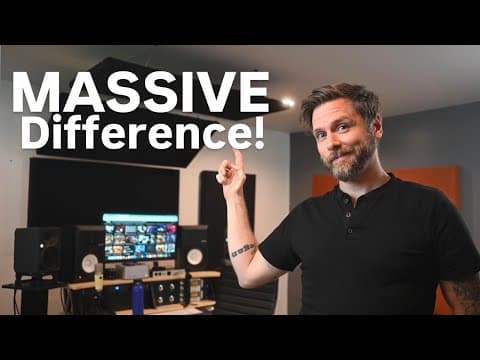
[0:10]I moved my desk around. If you guys remember, I've actually had my desk on that wall for a little while. I've been wanting to move it over here for a minute, but I've been waiting on building a few acoustic panels before doing that. So today is all about acoustics and acoustic treatment. Let's be honest. Like acoustic treatment is maybe one of the most expensive things that you can buy for your studio. So if you can build your own acoustic panels, you will save a substantial amount of money. And it's really easy. So, I'm going to give you my step-by-step how to guide on how I build my acoustic panels, the materials you'll need, the tools, and then once you build them, where you can place them to get the best bang for the buck and then along the way, try to dispel some misconceptions about acoustics and acoustic treatment. One thing to say real quick, so even though I have been a college level instructor of audio engineering at an accredited college where students would take my class to get a degree in audio engineering. Audio engineers are not acoustics and that's important to know. Because like we love to play dress up and pretend like we are, we just play in this world, but acoustics are special. They are the ones that are like part mathematician, part architect and they blend those two worlds. Like we just play in this world. So, I say that so you can filter it through that lens and and understand that the more content that you consume about acoustics that's from audio engineers, just take it with a little bit of a grain of salt. I'm going to share with you all the fundamentals in the basics that I understand. However, if you are an acoustics, make yourself known in the comments. I will read it and I will pin it up at the top of the video if any corrections need to be made. So let's dive in. So first and foremost, you're going to need some sort of acoustic ins
[2:04]I use this stuff uh from this company ATS, it's called acidic cotton. It's like a compact recycled cotton insulation type thing. If you couldn't tell from the tattoo that I've got here, I'm kind of a hipster and so I love the idea of those panels being made out of cotton as opposed to fiber glass. Although the fiber glass stuff is safe, you can also use rock wool and Owens coring is kind of the the industry standard these days too. Uh you're going to need some wood. I just go to loads or home and I pick out what's called the common boards. They're just pine boards, nothing special. Find the cheapest wood you can. Just make sure it's straight. Like lay it down on the ground at home depot and like push down on like the different parts of the wood, see if anything lifts up because if anything lifts up, it's got a bin to it. Just try to find the straight board you can. This is we're not being graded on this. Uh and then you're going to need a few other tools, so of course like measuring tape, you're going to need some sort of saw or way to cut the wood. Uh you're going to need a drill so that you can put some screws into the frame uh and uh and then last but not least, you're going to need some fabric. Uh I just went to Michael's recently to pick just some plain black fabric. That's a good go-to. Uh and uh then just like a staple gun and some staples. All right, welcome to my basement. Um first thing we're going to do, we're just measuring out the wood here. Uh these are 24x 48 inches the the insulation. that we're using. So, uh we are first going to measure the first cut of wood is exactly 48 inches. So, let's go ahead and cut that.
[3:46]Okay, so now that we got all the 48 inch cuts done, let's actually measure out the next cut which is uh 25 inches. Uh which is going to go across the top.
[4:02]All right, now since we got our cuts done, uh you're going to take the 48-inch board and the 25-inch board and we are going to put them together. You want the 25-inch board to be on top, not on the side. If you put it on the side, this whole frame is going to be 1 inch too short and 1 inch too wide. You don't want that. Uh these are 25-inches to accommodate for the thickness of this board. So it's going to be perfectly 24x48 on the inside. of this. So there is one magical tool that I do love and I'll I'll put links to Amazon where I got this, but it's this uh this angle clamp, which actually holds these two pieces of wood in the perfect spot while you're drilling, so you don't have to worry about like balancing the wood. All right, now that we got it clamped up. Now it is time to drill. Uh you know, yeah. just, you know, make it make it happen. I'm leaning this against the table for you're probably better at this than me. But this works. You know. Like with many things in DIY, it's it's fine. It doesn't have to be perfect. Once you get your holes drilled, it's just sending a few screws in and I mean it's it's basic stuff. So uh don't get too nervous. My legs on it, it won't move. It works. It's literally just rince and repeat until you get all four sides done.
[6:09]All right. If you follow my instructions carefully, you should have made a box and these are actually a lot sturdy than you might think they are. They're not super wobbly. Perfect. They don't need to be weight bearing or anything. They just need to hold a little insulation. All right, so once you got your frame built up, the next thing that you want to do, do not skip this step is to clean up your space. Uh specifically the floor, which is most likely where you're going to be doing the next part. So, if you are working on your garage or your basement floor, sweep, if you're working on carpet, make sure you vacuum. Reason why is because the next step is we're going to lay our fabric down, like face down. Yep, that's right. The part of this acoustic panel that is facing you once it's on the wall. That's going to go face down on the ground first before you do anything else. So, make sure your space is you own anything to give it a snag or stain or anything stupid like that. Uh I've had to reface these things before. It sucks. It's no fun, so prevent that from happening. Now, once that fabric is down on the ground, you're going to put your frame on top of that fabric and then you're going to fill that frame with the insulation. If you've built your frame correctly, the insulation should go in without much convincing, it sometimes will be a tight fit, but it should go in there pretty easily. Uh then what you're going to do is you're actually going to take that fabric and you're going to pull it around from the front of the frame to the back of the frame and you're going to staple it on the back. Uh best advice that I've gotten on this, start in the center and then work your way out. So, what I'll do is I'll staple kind of the center on the side and then I'll work around to the other side and I'll staple the center on that side. Uh then the center of the top and bottom and then I'll work my way out from those centers. spots. It's almost like tuning a snares drum. You don't want to just go completely around the side clockwise or counterclockwise. You kind of you bounce around in a star pattern, that kind of thing. That way as you're pulling it and you're stretching the fabric, there shouldn't be too many wrinkles or creases or anything like that. Once you get to the corners, I just realize I'm going to have to pull the panel off the wall again. Okay.
[8:29]Okay, for the corners. Just make it as pretty as you can. I kind of pull it across and back and then I staple it down back there. Knowing full well that no one has ever going to see the back of this panel. So this part it can be a little freaky. It it doesn't need to be perfect. Again, we are not getting graded on this. Uh then on the back side, I like to I like to put another piece of fabric on the back. And then I like to put a 2x4 with uh just one screw on each side uh two first of all in the back and then that's what I used to mount it. And then when I mounted it on the wall, I literally just put a few screws in the wall and then let it this like rest on the screws. It's fine. I we it doesn't need to be pretty. I mean, you should probably use dry wall anchors to be totally honest, but I I mean, it's fine. Okay, so once you've got your panels built up, the best first place where you get the most out of those panels in my opinion is going to be first position. And so what do I mean by that? When you're listening to your speaker, it's not just going straight to your ear, right? It's also going to scatter in multiple directions. And one of those directions is going to be the walls that's immediately to the left and right. And that audio is going to bounce off the wall before it gets to your ear and mix with the audio that goes straight to your ear. And what can that cause? mudness, so a lack of clarity and detail and nuance. Uh your stereo image can get a little muddled up uh face These problems can happen as well. So in my opinion, the left and right walls are probably your best bet for the first set of panels. You also have a reflection point that's also coming off of the ceiling and back down to you. All right, I swear to God, if you do not like this video, it's okay. You don't have to like it, but it would be nice if you did. Like and subscribe to the channel while I'm doing all this work. Um, okay. A cloud is just an acoustic panel, but it's just suspended from the ceiling. Uh I use this like galvanized steel picture hanging wire, it works like a champ. Uh and then I got these hooks off of uh well actually I think that was home Depot as well. But I'm sure there's some on Amazon. I'll look if I find something I will post the links down below. There we go. But that way it's suspended in air and uh that not only helps with the first reflection point. But if you separate your panel from the wall, it actually helps with base build up a little bit more too. So that's a nice little extra benefit. Uh one quick thing to note, I know those are only two inches thick. Uh generally speaking, you want your panels to be four inches of thickness or more. I just ran out of insulation to use and I reached out to ATS to see if they wanted to work with me on a video, but they just never responded. So, uh I had to buy all this with my own money and my own budget. So that's uh yeah, we'll upgrade later. After you get your first reflection points taking care of, then what I would do is I would work on the corners of your room. This is why sometimes you'll see me put a crib mattress in the corner of my room. Uh the corners are where base will build up in a room. A lot of small rooms have base frequency build up problems if you're having a hard time with like low-end translation of your mixes. Uh treating the corners can actually be one of the most beneficial things for that. So it's a really good use of some base traps or acoustic panels. Uh after you get that done, then I would put the uh behind the listening position. So as you're sitting there listening to your mix like panels behind you. Uh that's probably the next best place. And then once that's done, then I would put panels on the front wall kind of behind the speakers. To me, that's kind of the order of operations to where you get the most out of your panels. With all this being said, I know that there are some people that will not want to build their own panels. So down below I will link some acoustic treatment that is legitimate acoustic treatment. It's not like the little foam wedges or anything. It's it's good acoustic treatment and it is decently cost effective. Doing it yourself is always going to be cheaper, but these are not bad. So for those that just have no interest in building panels, there you go. You have access to those. Uh if you buy through the links, that also gives me a little kick back to the channel. so thank you in advance for anybody who does. Uh and then uh last little bonus tip. If you can get those panels off of the wall by just a couple inches, uh you can actually increase the effectiveness of those panels exponentially so. So either the panels you build yourself or the ones that are down in the links below. Uh if if you are able to do that, if you're able to separate the panel, it makes it so that it's not only absorbing just the frequencies coming in to the front of that panel, but it's also the frequencies coming in off of the wall and some of those base frequencies. that build up. So it just increases the effectiveness of those panels. So, uh get more bang for your buck that way. If you are interested in a video that's talking about acoustics while tracking, I have that video somewhere up here. So, keep an eye for that. If you enjoyed this video, hit the like, hit subscribe, uh comment down below, let me know your thoughts, feelings, opinions, smart remarks, uh comments, whatever you got. I'm all yours. All right, thanks guys. I'll see you in the next one.