[0:46]Finally, we will pay homage to the Buddha, saying Namo Tassa three times. Namo Tassa Bhagavato Arahato Samma Sambuddhassa. Namo Tassa Bhagavato Arahato Samma Sambuddhassa. Namo Tassa Bhagavato Arahato Samma Sambuddhassa.
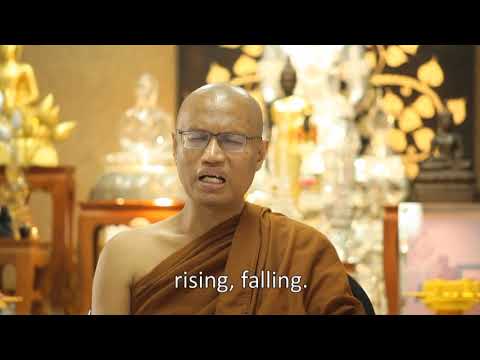
[1:34]Today, I would like to talk about how to practice meditation, or Vipassanā, or Satipaṭṭhāna, different names but the same meaning. In daily life, people are not usually mindful of the present moment. That's why I would like to talk about how to practice mindfulness at every moment. If you know the purpose of practice Vipassana meditation, Vipassanā is then not difficult. We have to know the purpose of practice Vipassanā. Vipassanā, Satipaṭṭhāna means we just observe our own body and mind. Why do we need to observe? Because every day you are doing something, you are not really observing your body and mind. That's why we just observe our nature of the body and mind. What is the nature of body and mind? Naturally, because of the weather, food, etc., our body is changing: heat, or cold, tight, heavy, peaceful, not peaceful. Sometimes the body is light, heavy, painful, itchy, uncomfortable, and comfortable. The mind is naturally thinking of a lot of things, mostly loba, tosa, moha. Actually, when you practice meditation, you have to observe your kusala mind, akusala mind. Sometimes when you have a kusala mind, you want to do dāna, sila, bhāvana. Sometimes you are angry, upset. Sometimes you have the greedy, wandering mind, thinking mind a lot. We just observe those kinds of minds. Some people think meditation means being peaceful and calm. That's why when they see the body uncomfortable, painful, itchy, tight, and heavy, so they don't like it. When they see a lot of akusala: loba, tosa, moha, sleepy, wandering mind, they don't like it. Actually, meditation means you observe those kinds of body and mind. The nature of the body: heat, or cold, tight, heavy, pain, itch, uncomfortable, discomfort. The mind usually has kusala, and akusala mind, you just observe. So if you know how to observe, practice is just to observe. Do not try to control or get upset, then your meditation will be easier. But if you do not know how to observe, you don't like sleepy, wandering mind, angry mind, and upset mind. Then, you just get up, or you want to do something. Actually, when you do meditation, you need to have strong determination. I will sit about one hour, even though I feel pain, I feel discomfort, I feel a lot of wandering mind. These are meditation objects. When you have determination to observe everything, within a few days or within a few hours, you'll gain concentration and mindfulness. Then, it will be easier and easier for you to practice mindfulness. Practice mindfulness, the Buddha teaches, firstly sitting meditation for about 1 hour, then walking meditation about 1 hour, and in other daily activities: eating, drinking the water, using the toilet, taking the shower. Practicing mindfulness requires every moment, not only sitting meditation, not only walking meditation. In Mahāsatipaṭṭhāna sutta, the Buddha explains in detail how to observe the body (kāyānupassanā), how to observe the vedanā (the feeling), how to observe the mind (cittānupassanā), how to observe the general object (dhammanupassanā). Body means we have the 4 elements: pathavī (earth), āpo (water), tejo (fire), vāyo (wind). You will see hot, cold, tight, heavy, sometimes pain, itchy. The feeling you have good feeling, bad feeling in your mind and body. Sometimes you feel happy. Sometimes you feel not happy. Sometimes you feel angry, upset, or sometimes you feel very good in the body and mind (sukha vedanā, dhukka vedanā), sometimes neutral (upekkha vedanā), you just observe. Usually people have kusala, akusala mind. Puthujjana (ordinary people) have mostly akusala mind. When you practice Vipassanā, you have to observe this akusala mind mostly. Sometimes you can observe the Kusala mind. This is observing the mind. Observe general object: seeing, hearing, smelling, tasting, touching. Just observe. When you practice sitting meditation, you don't need to adjust your body a lot. Just breathe normally, then observe the rising, falling. Don't worry about the body shaking, or leaning. Of course, when you are uncomfortable, if you would like to change your position, you can change with mindfulness. But during the one hour sitting meditation, do not open your eyes to check or something. Even when you would like to change your position, you have to change your position with mindfulness, without opening your eyes. In this way, your mindfulness will be continuous. So then you will not lose your mindfulness. That's why during sitting one hour, you have to close your eyes, straighten your upper body. But do not worry too much about body: my body is leaning, or shaking. You have to observe the primary object: rising falling, rising falling. You have to observe primary object carefully, follow the rising falling. Sometimes, people, just use rising falling, but their focusing on the object is not enough to see it. That's why when you do Vipassanā, sometimes you can do with the labelling: rising, falling. Sometimes, you can do without labelling. It is more important that you see the rising falling movement. When you observe rising falling, rising falling can be many different ways. It depends on the yogis' practice. Some experienced yogis can see many kinds of movement. That's why, even though, we call rising falling, but for the yogis, you have to just observe the movement of the abdomen. Sometimes movement can be slow, fast, small, big, heavy, sometimes moving up and down, side by side, small. Keep observe the rising falling. The purpose of observing the rising and falling is to see the nature of the body. You'll see the nature of the body, not only at the abdomen, you will see in the whole body. You have to observe. Not only that, when you practice observing the rising falling, when you improve, you will see also the nature of your mind. There are many kinds of minds. Seeing the body and mind. The more you practice, the more you'll see it. The Buddha says every nāma and rūpa is rising and passing away very quickly. Like when you look at the river, it seems the river does not move. But, when you look at it closer, the river is moving. In the same way, when you observe closely our own body and mind, every moment the mind is also changing. Noting mind, the body, rising falling can be changing. But in the beginning, you don't need to look for the change of rising falling, changing of the mind. For you, just need to observe. When you have enough concentration and mindfulness, you will see the rising falling. You will see even the rising falling is changing a lot. Not only that, the whole body, whatever you observe is changing. You'll see a lot. Not only body, mind also changing. So in this way, when you see the body and mind changing, changing, cannot control. You see every moment the body and mind changing (anicca), every moment they are changing (dukkha), cannot control (anattā). In this way, you can remove or reduce attachment: the taṇhā, the māna, the wrong view (This is mine, I own). Actually, the Buddha teaches only the 5 khandha, the 5 khandha means rūpa (body), the mind (nāma). No one can control, no one can own. When you really see the body and mind changing every moment, you can reduce/remove taṇhā, māna, diṭṭhi for the attachment of the body and mind. If you remove this kilesa, you will be much happier for practice Vipassanā. That's why for the purpose of practicing Vipassanā, we just observe the body and mind. Finally, you can see body and mind changing every moment. But in the beginning, you don't' need to looking for. You don't need to expect to see. Just observe. Just observe: sitting, walking, daily activities. When you improve, you will see. You will gain the benefit. Now, I would like to show how to do sitting meditation.
[15:04]Before you sit, you stand like this. When you stand, you have to observe the whole body standing, standing.
[15:17]Then, you go to the cushion. You have to observe right step, left step. Then, observe Standing Standing. You have to observe siting down, sitting down. Usually before you sit, you do the respect bowing down to the Buddha three times. When your hand is up, you have to observe. When your hands touch, you have to observe. Then, move your body down until touching the floor and get up slowly mindfully three times.
[16:04]After you bow down to the Buddha, you have to cross-leg sitting like this. Put the two hands. Then, straighten your upper body like this. Then, close your eyes. You have to observe everything: moving your hands, touching your hand. Even when you close your eyes, you have to observe. After you close your eyes, sit, breathe normally. The abdomen means the part below the navel. When you breathe in, the abdomen will rise, note rising. When you breathe out, the abdomen will fall, note falling. You don't need to follow the air from the nose to here. Just observe here. Breathe normally. When you breathe in, the abdomen will rise, note rising. When you breathe out, the abdomen will fall, note falling.
[17:21]You just observe here, rising falling. Some people, they see the rising falling very obviously. Some people, they see rising falling not obvious, move slowly. Do not try to do anything. Do not try stronger breathing or slower breathing. Even though you see rising falling small, just observe carefully. Some yogis want to see rising falling in very clear movement. If they see rising falling only a little bit movement, they are not satisfied. They want to do something. If you do something, or do not observe continuously, you will be very tired. Meditation means you need to understand how to observe the object. Though, you see a small, or not clear movement, you have to keep observe the rising falling here. And though, we call rising falling, but it may not always rise and fall. According to the yogis' experience, old yogis can see many kinds of movement, many kind of rising falling. But some yogis at the beginning just see rise and fall, rise and fall, rise and fall. Just be aware of rise and fall. There are 4 foundations of mindfulness: Kāyā (body), Vedanā (feeling), Cittā (mind), Dhamma (general object). Don't worry about how to observe the mind. Don't worry about how to observe the feeling. Don't worry about how to observe the general object. Because If you know how to observe the body, rising falling, if you really improve, you will understand automatically how to observe your mind, how to observe your feeling, how to observe general object. In the beginning, you have to keep observing the rising falling carefully, rising falling carefully. When you improve, you'll see your mind. When do you need to observe your mind? Sometimes when you observe the rising falling, you mind is already thinking something. When you realize you are already thinking or wandering, you are not on the object, rising falling. Then you can observe thinking, wandering, planning. When you observe thinking, wandering, planning, there are two options. Sometimes you can observe until finish thinking mind, wandering mind. When the thinking mind, wandering mind is so long, even though you observe, they keep coming. You can go back to rising falling, rising falling. If you make a lot of effort to observe rising falling, the thinking mind, wandering mind cannot come easily. If it's very quick thinking mind, you don't need to observe the mind.
[20:59]When you realize, the wandering mind already stops, you can keep observing the rising falling. Now the body: hot, cold, tight, heavy, or sometimes very tight, sometimes the body shaking, you can observe, if it is obvious. If it is not, mean if you can keep observing the rising falling, you still can keep observing the rising falling. Don't worry. But if hot, heavy, tight, discomfort, pain, itchy, is very strong that you cannot observe the rising falling, you can move. When you observe those feelings, there are two options. You can observe until this feeling goes away. If this is very long, you can go back to rising falling.
[44:03]Then, I will show you how to do daily activities. Walk mindfully to the door. Mindfully observe your step.
[44:19]Observe standing, standing. Then, you move your hand. You have to put down your hand, then walk outside.
[46:27]Mindfully observe your step. Then, put down and chewing chewing, swallowing, swallowing. When you are chewing, swallowing, do not move your hands.
[46:58]After you completely finish chewing, swallowing, you take another spoon. Then put down and chewing chewing, swallowing, swallowing. When you are chewing, swallowing, do not move your hands. After you completely finish chewing, swallowing, you take another spoon. Then put down and chewing chewing, swallowing, swallowing. When you do eating, you cannot observe everything, but you have to observe as much as you can. You're taking the food. You are opening the mouth, putting the food into the mouth, chewing, chewing. Especially when the food tastes very good, you want to swallow very quickly. You have to observe as much as you can. Do not try to do very quickly. In this way practicing eating, you can gain a lot of mindfulness


